H.R. 6472 explained · 119th Congress · Pending in Congress
Territorial Student Access to Higher Education Act
Cosponsors: 5 (3 D, 2 R) · per Congress.gov, 2026-10-09
Introduced: 2025-12-04
Latest action (2026-03-09): Received in the Senate and Read twice and referred to the Committee on Health, Education, Labor, and Pensions.
What H.R. 6472 does, in plain terms
Territorial Student Access to Higher Education Act This bill requires public institutions of higher education that participate in federal student aid programs to charge no more than in-state tuition and fee rates to students who are residents of Guam, the Northern Mariana Islands, American Samoa, or the U.S. Virgin Islands, provided they are also U.S. nationals.
Official summary by the Congressional Research Service, via Congress.gov.
Constitution Index
“VFA Constitution grade”
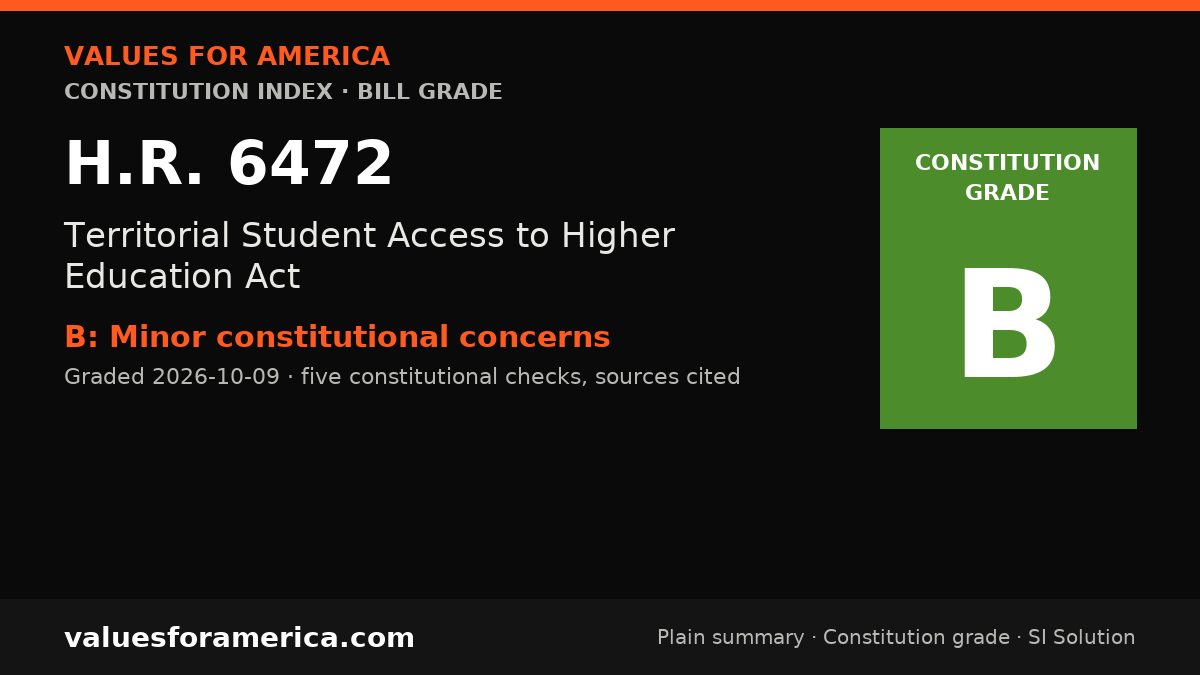
Minor constitutional concerns
Graded 2026-10-09
SI-generated grade · five published checks · not individually reviewed by a person · methodology
The Territorial Student Access to Higher Education Act is mostly constitutional but has minor tension with principles of federalism. Congress likely has authority under the Spending Clause to attach conditions to federal student aid funds, and the bill does not infringe individual rights or due process. However, it consolidates tuition policy decision-making at the federal level, which raises decentralization concerns, though states retain the option to decline federal funds.
-
✓ Passes · Enumerated powers
Congress has authority under Article I, Section 8, Clause 1 (Spending Clause) to attach conditions to federal funds, including student aid programs. The condition requiring in-state tuition for territorial residents is related to the federal interest in education and territorial welfare, and is not coercive under South Dakota v. Dole. Additionally, Article IV, Section 3, Clause 2 (Territorial Clau… -
✓ Passes · Bill of Rights
The bill does not infringe any of the first ten amendments. It imposes a requirement on public institutions, not on individuals, and does not restrict speech, religion, assembly, press, petition, arms, quartering, search and seizure, self-incrimination, due process, takings, fair trial, jury, cruel and unusual punishment, or unenumerated rights. It actually benefits territorial residents by reduci… -
✓ Passes · Individual sovereignty
The bill does not restrict what individuals can do with their person, property, speech, labor, or belief. It imposes a condition on institutions, not on individuals, and provides a benefit to territorial students. There is no government restriction on individual freedom; the burden is on institutions to comply if they accept federal funds. -
✗ Concern · Decentralization
The bill fails one of the four decentralization questions: it consolidates decision-making upward by imposing a federal condition on state tuition policies. However, states can opt out by declining federal student aid funds, preserving some choice. Questions: (1) individual/family cannot handle statewide tuition policy; (2) local community cannot handle for all public institutions; (3) state can h… -
✓ Passes · Due process and takings
The bill does not bypass due process or take property without just compensation. It does not deprive any person of life, liberty, or property without fair notice or hearing. It does not involve a taking of private property; any impact on state tuition revenue is a condition on voluntary participation in federal programs, not a direct taking.
Sources: Congress.gov: HR 6472 summary
Report an error in this grade
What should pass
“VFA SI Solution”
No solution yet
A sourced SI draft appears here once it passes automated checks (Constitution citation, source verification, independent SI critic). How publication works.
Related on VFA

For journalists and bloggers
“Embed this grade”
Free to use with the link back. The badge and card update when the grade changes. Embed terms →
