H.R. 6409 explained · 119th Congress · Pending in Congress
FENCES Act
Cosponsors: 2 (0 D, 2 R) · per Congress.gov, 2026-10-08
Introduced: 2025-12-03
Latest action (2026-04-17): Received in the Senate and Read twice and referred to the Committee on Environment and Public Works.
What H.R. 6409 does, in plain terms
Foreign Emissions and Nonattainment Clarification for Economic Stability Act or the FENCES Act This bill modifies standards under the Clean Air Act to exempt states from penalties for emissions outside of the state’s control. The bill provides that certain nonattainment areas (i.e., those classified as severe or extreme for ozone or as serious for particulate matter) are not subject to sanctions for implementation plan deficiencies or for fees for failing to attain national ambient air quality standards (NAAQS) if the state demonstrates it would have avoided deficiencies or attained its standards but for emissions outside of its control (e.g., emissions from an exceptional event like a wildfire). A state must renew its demonstration at least once every five years for exemption from the sanctions or fees to continue to apply. The bill specifies that an area within a state may not be designated as a nonattainment area regarding any new or revised NAAQS for a pollutant if the state demonstrates it would be in attainment but for emissions emanating from outside of the country, regardless of whether the emissions resulted from human activity. For purposes of approving a state implementation plan or meeting certain NAAQS, current law provides that a state may demonstrate to the Environmental Protection Agency that but for emissions emanating from outside of the country, it would have attained applicable NAAQS by the attainment date for certain pollutants. The bill specifies that such emissions emanating from outside the country may include emissions that result from human activity.
Official summary by the Congressional Research Service, via Congress.gov.
Constitution Index
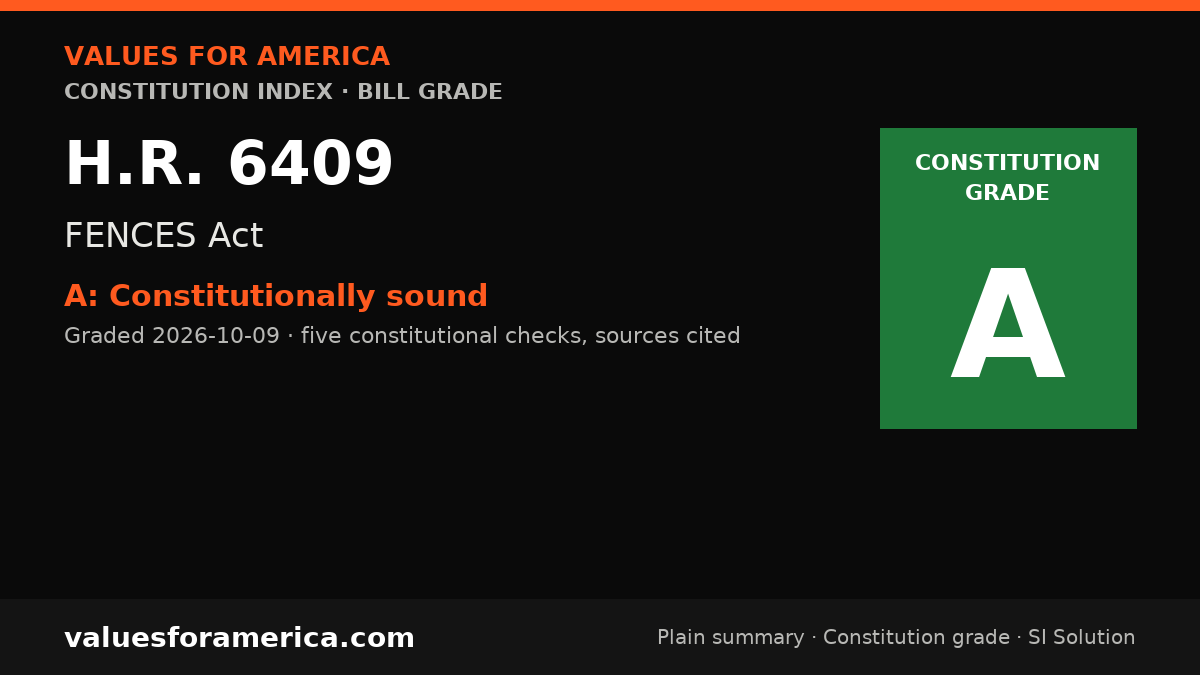
“VFA Constitution grade”
Constitutionally sound
Graded 2026-10-09
SI-generated grade · five published checks · not individually reviewed by a person · methodology
The FENCES Act modifies the Clean Air Act to exempt states from certain penalties and nonattainment designations when emissions outside their control (including foreign emissions and exceptional events) are the cause. The bill operates within Congress's established Commerce Clause authority to regulate interstate and foreign pollution, does not infringe any Bill of Rights protections, imposes no restrictions on individual liberty, respects federalism by limiting federal sanctions and allowing state demonstrations, and provides a clear procedural process without violating due process or takings protections. It is fully constitutional.
-
✓ Passes · Enumerated powers
Congress has authority under the Commerce Clause (Article I, Section 8, Clause 3) to regulate interstate and foreign commerce, which includes air pollution that crosses state and national boundaries. The Clean Air Act is a longstanding exercise of this power. The FENCES Act merely adjusts the conditions under which states face penalties, staying well within the scope of federal environmental regul… -
✓ Passes · Bill of Rights
The bill does not implicate any of the first ten amendments. It does not restrict speech, religion, press, assembly, petition, arms, quartering, search and seizure, self-incrimination, due process (addressed separately), fair trial, jury, cruel and unusual punishment, unenumerated rights, or reserved powers. It is a regulatory adjustment affecting state-federal relations, not individual rights. -
✓ Passes · Individual sovereignty
The bill imposes no restrictions on what individuals may do with their person, property, speech, labor, or belief. It addresses state compliance with federal air quality standards and exempts states from penalties under specific conditions. No individual liberty is burdened, and the government has not placed any new restriction on personal freedom. -
✓ Passes · Decentralization
The bill passes all four questions of the decentralization test. (1) An individual or family cannot handle interstate or international air pollution regulation. (2) A local community cannot handle emissions originating outside its jurisdiction. (3) A state cannot unilaterally control foreign emissions, but the bill empowers states to demonstrate that such emissions are the cause of nonattainment, … -
✓ Passes · Due process and takings
The bill provides a clear procedural mechanism: states must demonstrate that emissions outside their control caused the deficiency or nonattainment, and they must renew that demonstration every five years. This satisfies procedural due process (fair notice and opportunity to be heard). There is no arbitrary government action; the EPA retains oversight. No property is taken without just compensatio…
Sources: Congress.gov: HR 6409 summary
Report an error in this grade
What should pass
“VFA SI Solution”
No solution yet
A sourced SI draft appears here once it passes automated checks (Constitution citation, source verification, independent SI critic). How publication works.
Related on VFA

For journalists and bloggers
“Embed this grade”
Free to use with the link back. The badge and card update when the grade changes. Embed terms →
