H.R. 6387 explained · 119th Congress · Pending in Congress
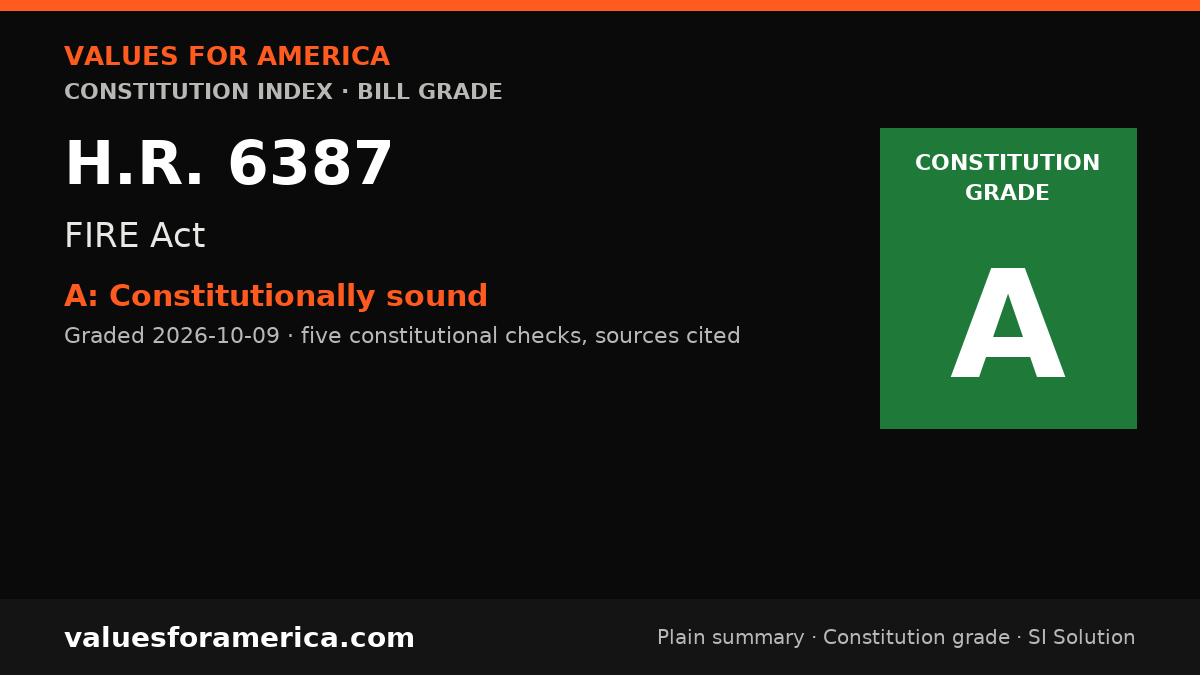
FIRE Act
Cosponsors: 3 (1 D, 2 R) · per Congress.gov, 2026-10-08
Introduced: 2025-12-03
Latest action (2026-04-27): Received in the Senate and Read twice and referred to the Committee on Environment and Public Works.
What H.R. 6387 does, in plain terms
Fire Improvement and Reforming Exceptional Events Act or the FIRE Act This bill modifies the definition of exceptional events under the Clean Air Act and requires the Environmental Protection Agency (EPA) to revise its regulations regarding exceptional events or actions to mitigate wildfire risk. Generally, the EPA must exclude data from use in determinations of exceedances and violations of national ambient air quality standards (NAAQS) if a state demonstrates that an exceptional event caused a specific air pollution concentration. The bill provides that events caused by human activity that are intended to mirror the occurrence or reoccurrence of a natural event are exceptional events. Additionally, the bill no longer excludes from consideration as an exceptional event (1) meteorological events involving high temperatures or a lack of precipitation, or (2) stagnation of air masses that does not ordinarily occur. The bill requires the EPA to revise regulations regarding the reviewing and handling of air quality monitoring data influenced by actions to mitigate wildfire risk. The bill also requires the EPA to conduct regional modeling and analysis when multiple states submit petitions regarding the same exceptional event or action to mitigate wildfire risk.
Official summary by the Congressional Research Service, via Congress.gov.
Constitution Index
“VFA Constitution grade”
Constitutionally sound
Graded 2026-10-09
SI-generated grade · five published checks · not individually reviewed by a person · methodology
The FIRE Act is a permissible exercise of Congress's Commerce Clause authority to regulate interstate air pollution through the Clean Air Act. It does not infringe on the Bill of Rights or individual sovereignty, preserves a substantial role for state petitions in EPA determinations, and follows established administrative due process. No constitutional defect is apparent.
-
✓ Passes · Enumerated powers
Congress has authority under Article I, Section 8, Clause 3 to regulate interstate commerce, and air pollution that crosses state lines has long been treated as within that authority. The Clean Air Act's national ambient air quality standards and EPA oversight are grounded in this power. The FIRE Act modifies EPA's treatment of exceptional events and wildfire mitigation data within that existing f… -
✓ Passes · Bill of Rights
The bill does not restrict speech, press, religion, assembly, petition, the right to keep and bear arms, or any other right protected by the first ten amendments. It concerns administrative handling of air quality data and state petitions to the EPA. No provision implicates the Fourth, Fifth, Sixth, Seventh, or Eighth Amendments. -
✓ Passes · Individual sovereignty
The FIRE Act does not restrict what individuals may do with their own person, property, speech, labor, or belief. It governs EPA review of air quality monitoring data and state demonstrations regarding exceptional events. There is no direct burden on individual liberty, and any indirect effects through air quality regulation are consistent with longstanding environmental law. -
✓ Passes · Decentralization
The bill does not improperly consolidate decision-making at the federal level. Air pollution is interstate in nature, so a national framework is appropriate. The bill actually strengthens the role of states by allowing them to demonstrate exceptional events and requiring EPA to consider regional modeling when multiple states petition. An individual or local community cannot effectively regulate in… -
✓ Passes · Due process and takings
The bill establishes criteria and procedures for EPA to evaluate exceptional event demonstrations and revise regulations. It does not bypass notice, hearing, or judicial review requirements already present in the Clean Air Act. It takes no private property and imposes no penalty or forfeiture. Administrative decision-making under the bill remains subject to the Administrative Procedure Act and due…
Sources: Congress.gov: HR 6387 summary
Report an error in this grade
What should pass
“VFA SI Solution”
No solution yet
A sourced SI draft appears here once it passes automated checks (Constitution citation, source verification, independent SI critic). How publication works.
Related on VFA

For journalists and bloggers
“Embed this grade”
Free to use with the link back. The badge and card update when the grade changes. Embed terms →
