H.R. 6380 explained · 119th Congress · Sent to the President
Chiricahua National Park Act
Cosponsors: 1 (1 D, 0 R) · per Congress.gov, 2026-10-14
Introduced: 2025-12-03
Latest action (2026-10-15): Presented to President.
What H.R. 6380 does, in plain terms
Chiricahua National Park Act This bill redesignates the Chiricahua National Monument in Arizona as the Chiricahua National Park. The bill directs the National Park Service (NPS) to (1) ensure the protection of traditional cultural and religious sites in the park, and (2) provide access to those sites by members of Indian tribes for traditional cultural and customary uses. Upon the request of an Indian tribe, the NPS may temporarily close to general public use one or more specific areas of the park to protect traditional cultural and customary uses in the area by members of the tribe. The closure must be limited to the smallest practicable area for the minimum period necessary for the traditional cultural and religious activities.
Official summary by the Congressional Research Service, via Congress.gov.
Constitution Index
“VFA Constitution grade”
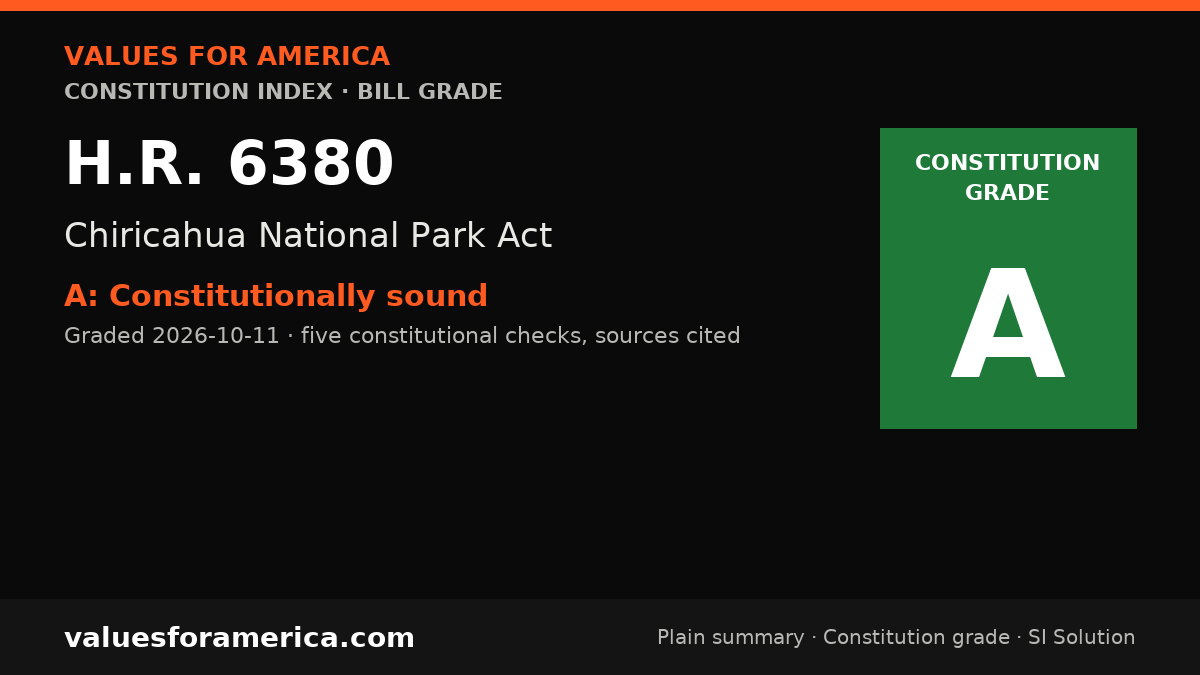
Constitutionally sound
Graded 2026-10-11
SI-generated grade · five published checks · not individually reviewed by a person · methodology
This bill is fully constitutional. It operates within the federal government's enumerated power over federal lands, does not infringe any rights, respects individual sovereignty, properly decentralizes decision-making to tribal communities, and provides due process protections for access and closures.
-
✓ Passes · Enumerated powers
The federal government has explicit constitutional authority over federal lands under the Property Clause (Article IV, Section 3, Clause 2), which grants Congress power to 'dispose of and make all needful Rules and Regulations respecting the Territory or other Property belonging to the United States.' Redesignating a national monument as a national park and managing access to federal lands falls s… -
✓ Passes · Bill of Rights
The bill does not infringe any provision of the Bill of Rights. It does not restrict speech, religion, assembly, press, petition, arms, quartering, search and seizure, self-incrimination, due process, takings, fair trial, jury, or cruel and unusual punishment. To the contrary, it protects religious exercise by ensuring access to traditional cultural and religious sites, consistent with the First A… -
✓ Passes · Individual sovereignty
The bill does not restrict what any person can do with their own person, property, speech, labor, or belief. It provides access to federal lands for traditional cultural uses and allows temporary closures only upon tribal request, with strict limits on scope and duration. The burden remains on the government to justify any closure, and the closure is limited to the smallest practicable area for th… -
✓ Passes · Decentralization
The bill passes all four questions of the decentralization test. (1) Individuals and families cannot manage a national park on their own, as this is a federal land management function. (2) Local communities and counties cannot manage a national park without state or federal involvement. (3) States cannot manage a national park without federal involvement, as the land is federally owned. (4) The bi… -
✓ Passes · Due process and takings
The bill provides robust due process protections. It requires that any closure be limited to the smallest practicable area for the minimum period necessary, and only upon the request of an Indian tribe. This ensures fair notice and non-arbitrary government action. There is no taking of private property; the land in question is already federally owned as a national monument. The bill does not bypas…
Sources: Congress.gov: HR 6380 summary
Report an error in this grade
What should pass
“VFA SI Solution”
No solution yet
A sourced SI draft appears here once it passes automated checks (Constitution citation, source verification, independent SI critic). How publication works.
Related on VFA

For journalists and bloggers
“Embed this grade”
Free to use with the link back. The badge and card update when the grade changes. Embed terms →
