H.R. 6260 explained · 119th Congress · Pending in Congress
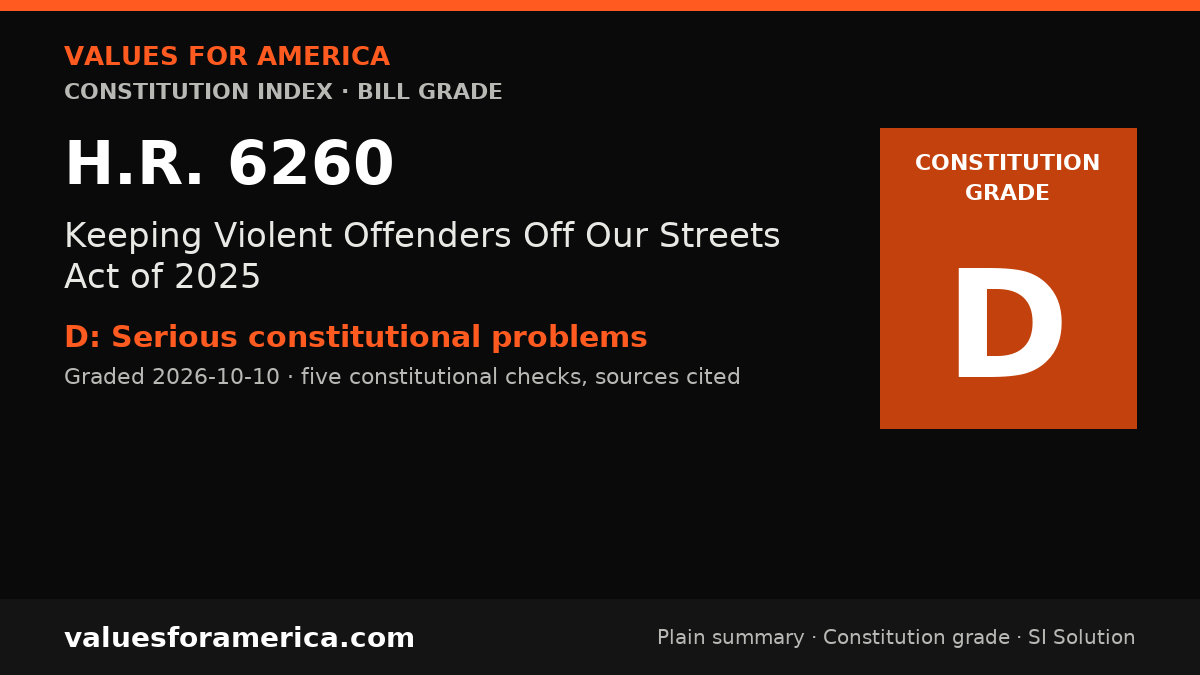
Keeping Violent Offenders Off Our Streets Act of 2025
Cosponsors: 5 (0 D, 5 R) · per Congress.gov, 2026-10-08
Introduced: 2025-11-21
Latest action (2026-05-18): Received in the Senate and Read twice and referred to the Committee on the Judiciary.
What H.R. 6260 does, in plain terms
Keeping Violent Offenders Off Our Streets Act of 2025 This bill broadens the definition of the term business of insurance, for the purposes of federal crimes related to insurance fraud, to include the posting of monetary bail, criminal bail bonds, and federal immigration bail bonds. Under the bill, entities and organizations that pay cash bond or bail for defendants (e.g., charitable bail funds) are engaged in the business of insurance under federal law and subject to federal criminal provisions related to insurance fraud, as well as state licensing requirements and regulation by state insurance commissions.
Official summary by the Congressional Research Service, via Congress.gov.
Constitution Index
“VFA Constitution grade”
Serious constitutional problems
Graded 2026-10-10
SI-generated grade · five published checks · not individually reviewed by a person · methodology
The bill likely exceeds federal enumerated powers by redefining charitable bail funds as insurance businesses, thereby imposing federal criminal liability and state licensing requirements on activities traditionally regulated by states. It infringes on individual sovereignty and due process by penalizing the exercise of bail rights and potentially criminalizing charitable conduct without clear notice. The decentralization analysis shows significant upward consolidation, and the bill raises serious due process concerns.
-
✗ Concern · Enumerated powers
The bill's stated purpose is to combat insurance fraud, which falls under Congress's power to regulate interstate commerce (Article I, Section 8, Clause 3). However, the bill redefines 'business of insurance' to include charitable bail funds that post bail, which are not engaged in commerce in the traditional sense. This stretches the Commerce Clause beyond its recognized limits, as the activity r… -
✗ Concern · Bill of Rights
The bill implicates the Eighth Amendment's prohibition on excessive bail by potentially criminalizing the act of posting bail for others, which could deter individuals from exercising their right to bail. Additionally, by subjecting charitable bail funds to criminal insurance fraud provisions, it may chill First Amendment rights of association and expression, as these funds engage in expressive an… -
✗ Concern · Individual sovereignty
The bill restricts the ability of individuals and organizations to use their own property (money) to post bail for others, a traditional exercise of personal liberty and charity. The government has not provided a compelling justification for treating charitable bail funds as insurance businesses, as they do not operate for profit or spread risk in the manner of insurers. This restriction burdens i… -
✗ Concern · Decentralization
The bill fails the decentralization test. (1) Individuals and families can and do handle bail posting without government involvement, as charitable bail funds are private initiatives. (2) Local communities can regulate charitable bail funds if needed, without state involvement. (3) States already regulate insurance and bail bonds, and can handle this without federal intervention. (4) The bill cons… -
✗ Concern · Due process and takings
The bill may violate due process by imposing criminal liability on charitable bail funds without clear notice of what constitutes 'business of insurance.' The definition is vague and could encompass a wide range of activities, leading to arbitrary enforcement. Additionally, by subjecting these funds to state licensing and regulation, the bill may effectively take property (the funds' assets) witho…
Sources: Congress.gov: HR 6260 summary
Report an error in this grade
What should pass
“VFA SI Solution”
No solution yet
A sourced SI draft appears here once it passes automated checks (Constitution citation, source verification, independent SI critic). How publication works.
Related on VFA

For journalists and bloggers
“Embed this grade”
Free to use with the link back. The badge and card update when the grade changes. Embed terms →
