H.R. 6238 explained · 119th Congress · Pending in Congress
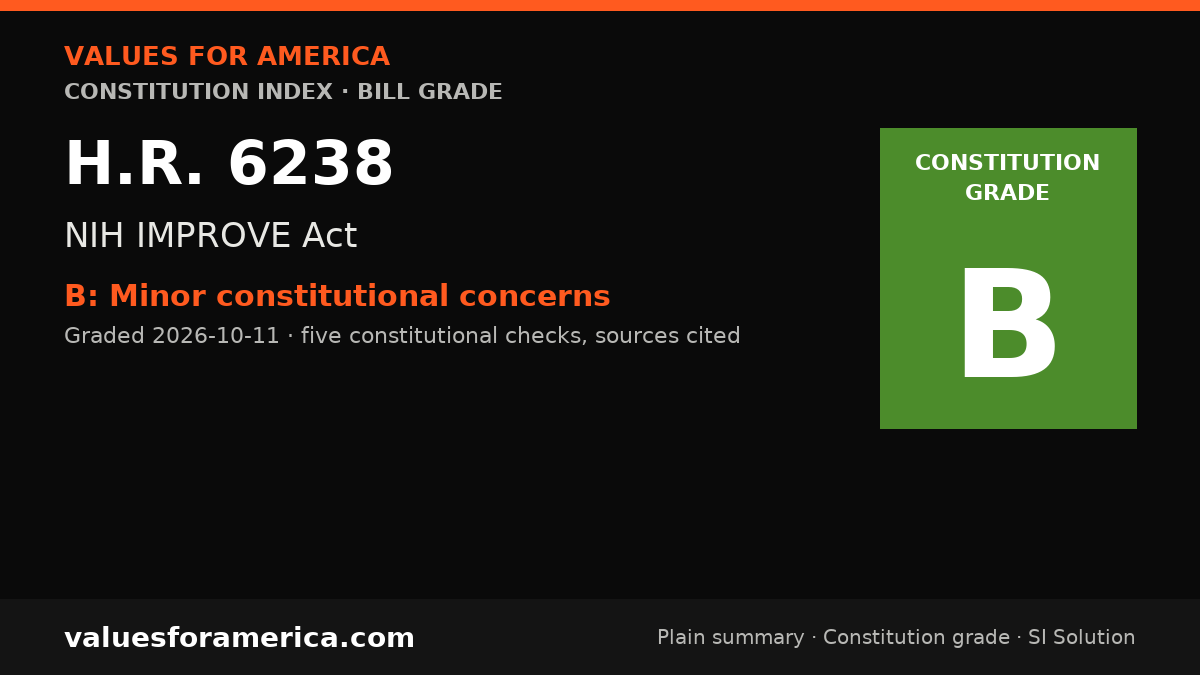
NIH IMPROVE Act
Cosponsors: 4 (3 D, 1 R) · per Congress.gov, 2026-10-15
Introduced: 2025-11-20
Latest action (2026-07-21): Received in the Senate and Read twice and referred to the Committee on Health, Education, Labor, and Pensions.
What H.R. 6238 does, in plain terms
NIH Implementing a Maternal health and PRegnancy Outcomes Vision for Everyone Act or the NIH IMPROVE Act This bill provides statutory authority for the National Institutes of Health to provide grants and other support for research on improving health outcomes for pregnant and postpartum women, especially in populations that are disproportionately affected.
Official summary by the Congressional Research Service, via Congress.gov.
Constitution Index
“VFA Constitution grade”
Minor constitutional concerns
Graded 2026-10-11
SI-generated grade · five published checks · not individually reviewed by a person · methodology
The NIH IMPROVE Act is a federal grant program for maternal health research, which falls within Congress's spending power and is generally consistent with the Constitution. It does not infringe on individual rights, and while it involves federal involvement in health research, this is a legitimate use of the spending power. The bill receives a B due to minor federalism concerns, as health research could be left to states or private actors, but the federal role is well-established and not a direct violation.
-
✓ Passes · Enumerated powers
Congress has the power to tax and spend for the general welfare under Article I, Section 8, Clause 1. Providing grants for medical research is a long-standing exercise of this power, as seen in numerous NIH programs. The bill does not regulate conduct but rather funds research, which is within the spending power. -
✓ Passes · Bill of Rights
The bill does not restrict speech, religion, assembly, press, petition, arms, quartering, search and seizure, self-incrimination, due process, takings, trial rights, or cruel and unusual punishment. It is a funding measure that imposes no restrictions on individual liberties. -
✓ Passes · Individual sovereignty
The bill does not restrict individual autonomy over person, property, speech, labor, or belief. It provides grants for research, which is voluntary and does not compel participation or restrict individual action. The burden of justification for any restriction is not triggered because no restriction exists. -
✗ Concern · Decentralization
The bill fails the decentralization test because it consolidates decision-making at the federal level for health research that could be handled by states or private institutions. However, the federal role in health research is well-established and the bill does not directly violate the Tenth Amendment, as it does not commandeer states or regulate private conduct. The questions indicate that while … -
✓ Passes · Due process and takings
The bill does not deprive anyone of life, liberty, or property without due process, nor does it take private property for public use without just compensation. It is a voluntary grant program that does not impose penalties or burdens on individuals.
Sources: Congress.gov: HR 6238 summary
Report an error in this grade
The Framers
“Founders’ Verdict”
Confidence 0.75
Archived SI output (machine-generated)No editorial review recorded. This historical SI verdict was machine-generated by software and predates the review desk; check it against the official bill text.
Synthesis
The bill is constitutional only if Congress confines its spending to truly national concerns in maternal health research, avoiding any pretext for regulating areas traditionally reserved to the states under the Tenth Amendment. The spending power under Article I, Section 8, Clause 1 is a valid basis, but must be exercised with strict adherence to enumerated powers and not as a general police power.
The NIH IMPROVE Act provides statutory authority for the National Institutes of Health to fund research on maternal health outcomes. This falls squarely within Congress's power to lay and collect taxes to provide for the general welfare, as the promotion of public health is a legitimate object of federal expenditure. The Necessary and Proper Clause further authorizes Congress to establish agencies and programs to execute this power. As I argued in Federalist No. 30, the power to raise revenue and appropriate it for the general welfare is essential to the national government. There is no encroa…
This bill exceeds the limited powers delegated to the federal government by the Constitution. The Constitution enumerates specific powers to Congress in Article I, Section 8, and nowhere does it grant authority to establish a general program of medical research grants, particularly in the field of maternal health, which is a matter of state police power. The Tenth Amendment reserves all powers not delegated to the United States to the States respectively, or to the people. The 'general welfare' clause is not an independent grant of power to spend for any purpose; rather, it is a limitation on …
The bill's provision of grants for maternal health research falls under Congress's power to lay and collect taxes for the general welfare, as enumerated in Article I, Section 8, Clause 1. However, this power must be exercised with strict adherence to the principle of enumerated and limited federal authority, as I argued in Federalist No. 45. The Constitution does not grant Congress a general police power over health; thus, such funding must be directed toward truly national concerns and not intrude upon the reserved powers of the states under the Tenth Amendment. The bill is constitutional onl…
This bill is a valid exercise of Congress's power to tax and spend for the general welfare, as it authorizes grants and support for maternal health research. The Constitution vests Congress with discretion to choose the means to promote the general welfare, and the Necessary and Proper Clause permits such legislation as a means to execute that power. The Supreme Court has long held that Congress may appropriate funds for purposes that benefit the nation, and this research falls squarely within that authority. There is no encroachment on state powers, as the bill merely provides federal funding…
Report an error in this Founders' Verdict
What should pass
“VFA SI Solution”
No solution yet
A sourced SI draft appears here once it passes automated checks (Constitution citation, source verification, independent SI critic). How publication works.
Related on VFA

For journalists and bloggers
“Embed this grade”
Free to use with the link back. The badge and card update when the grade changes. Embed terms →
