H.R. 6207 explained · 119th Congress · Pending in Congress
Chip EQUIP Act
Cosponsors: 11 (3 D, 8 R) · per Congress.gov, 2026-10-14
Introduced: 2025-11-20
Latest action (2026-09-16): Ordered to be Reported by the Yeas and Nays: 39 - 0.
What H.R. 6207 does, in plain terms
Chip Equipment Quality, Usefulness, and Integrity Protection Act of 2025 or the Chip EQUIP Act This bill prohibits companies that receive certain federal funds from purchasing specified semiconductor manufacturing equipment made by foreign entities of concern (e.g., companies owned or controlled by China, Iran, North Korea, or Russia) or their subsidiaries for the federally funded project. The CHIPS Act of 2022, which became law in August 2022, appropriated funding for the Department of Commerce to carry out the CHIPS for America provisions enacted in the National Defense Authorization Act for Fiscal Year 2021. These provisions included appropriations for financial incentives to expand domestic manufacturing capacities across the semiconductor supply chain, as well as for research and development programs. Under the bill, Commerce must include in the terms of each agreement with a covered entity (e.g., companies receiving CHIPS funds) prohibitions with respect to a project relating to the procurement, installation, or use of the specified semiconductor manufacturing equipment. The prohibitions must be effective for 10 years beginning on the date on which the agreement is signed. The bill authorizes Commerce to waive these prohibitions under certain circumstances, such as if the specified semiconductor manufacturing equipment is not produced in the United States or an allied or partner country in sufficient and reasonably available quantities or of a satisfactory quality to support established or expected production capabilities.
Official summary by the Congressional Research Service, via Congress.gov.
Constitution Index
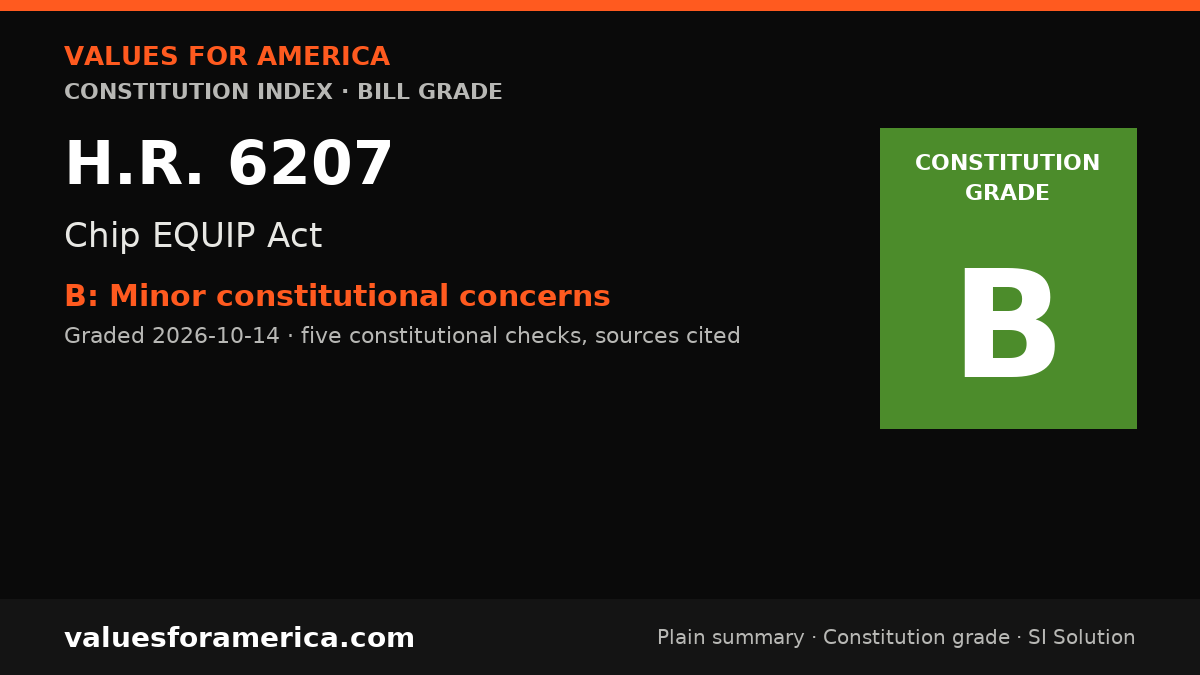
“VFA Constitution grade”
Minor constitutional concerns
Graded 2026-10-14
SI-generated grade · five published checks · not individually reviewed by a person · methodology
The bill is a conditional restriction on the use of federal funds, which falls within Congress's spending power. It does not directly infringe on constitutional rights, but it imposes a 10-year restriction on private conduct that may raise mild concerns about individual sovereignty and due process, though waivers and the voluntary nature of accepting federal funds mitigate these issues.
-
✓ Passes · Enumerated powers
Congress has the power to appropriate funds and attach conditions to their use under the Spending Clause (Article I, Section 8, Clause 1). The bill conditions receipt of CHIPS Act funds on compliance with equipment procurement restrictions, which is a valid exercise of the spending power. The foreign commerce and national defense implications also fall within Congress's authority under the Commerc… -
✓ Passes · Bill of Rights
The bill does not implicate the First, Second, Third, Fourth, Fifth, Sixth, Seventh, Eighth, or Ninth Amendments. It restricts the use of federal funds for purchasing certain equipment, which is not a protected right. The Tenth Amendment is not violated because the bill does not commandeer state governments; it applies to private entities receiving federal funds. -
✗ Concern · Individual sovereignty
The bill restricts the freedom of companies to choose their equipment suppliers for federally funded projects. However, this restriction is a condition of receiving voluntary federal funds, not a general prohibition on private conduct. The government has a compelling interest in protecting national security and ensuring the integrity of federally funded projects. The restriction is narrowly tailor… -
✓ Passes · Decentralization
The bill does not consolidate decision-making upward; it is a federal action that addresses a national security concern regarding foreign equipment in federally funded projects. The federal government is the appropriate level to regulate foreign commerce and national security. The bill does not prevent individuals, localities, or states from acting; it only conditions federal funds. Therefore, it … -
✓ Passes · Due process and takings
The bill does not take property without just compensation; it imposes a condition on future federal funding. Companies are free to decline the funds if they do not wish to comply. The waiver process provides a mechanism for relief, and the restrictions are clearly specified in agreements, providing fair notice. There is no deprivation of life, liberty, or property without due process.
Sources: Congress.gov: HR 6207 summary
Report an error in this grade
What should pass
“VFA SI Solution”
No solution yet
A sourced SI draft appears here once it passes automated checks (Constitution citation, source verification, independent SI critic). How publication works.
Related on VFA

For journalists and bloggers
“Embed this grade”
Free to use with the link back. The badge and card update when the grade changes. Embed terms →
