H.R. 590 explained · 119th Congress · Pending in Congress
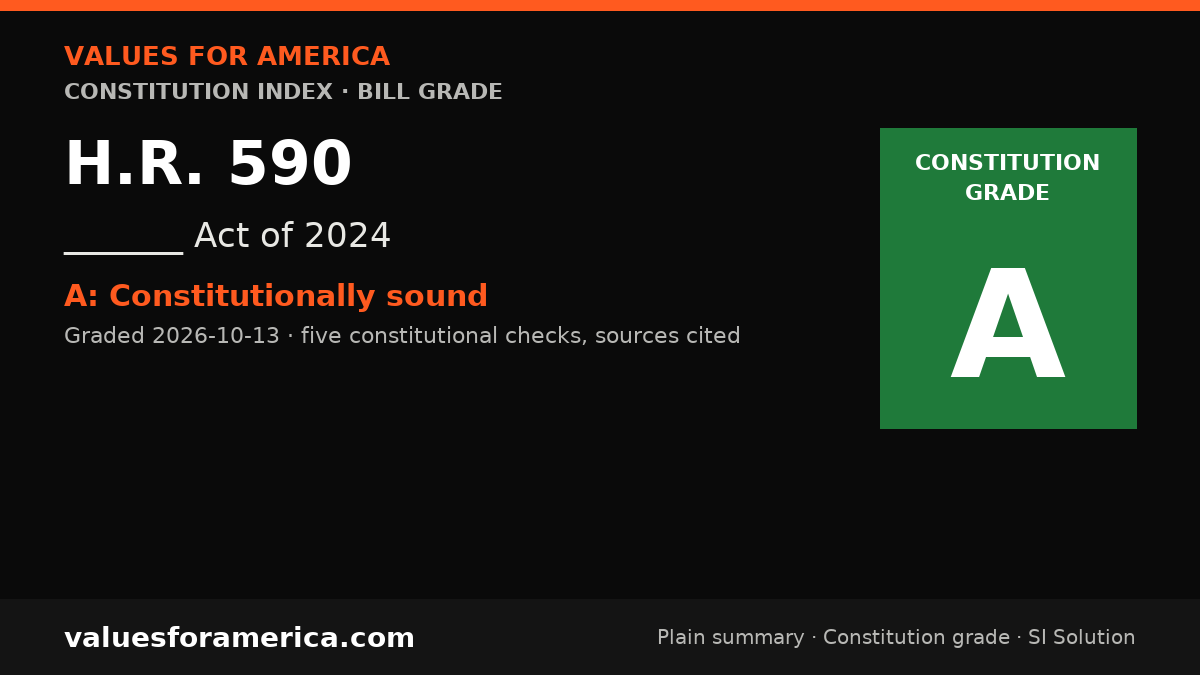
_______ Act of 2024
Cosponsors: 2 (2 D, 0 R) · per Congress.gov, 2026-10-12
Introduced: 2025-01-21
Latest action (2025-01-21): Referred to the House Committee on Armed Services.
What H.R. 590 does, in plain terms
This bill requires the consent of the chief executive officers (e.g., governors) of involved states when the President or Department of Defense orders National Guard units to perform training or other duty in such states. Under the bill, the term state includes the District of Columbia and territories or possessions of the United States. The bill also subjects the ordered training or duty to the limitations of the Posse Comitatus Act of 1878, which prohibits the use of the military for civil law enforcement purposes.
Official summary by the Congressional Research Service, via Congress.gov.
Constitution Index
“VFA Constitution grade”
Constitutionally sound
Graded 2026-10-13
SI-generated grade · five published checks · not individually reviewed by a person · methodology
This bill reinforces constitutional limits on federal power over state militias (National Guard) by requiring gubernatorial consent for training or duty orders and applying Posse Comitatus restrictions. It is fully consistent with the Constitution's allocation of authority.
-
✓ Passes · Enumerated powers
The bill does not expand federal power; it restricts it. Congress has authority under Article I, Section 8, Clause 16 to provide for organizing, arming, and disciplining the militia, but this power is expressly subject to reserving to the states the appointment of officers and the authority of training the militia according to congressional discipline. Requiring gubernatorial consent for training … -
✓ Passes · Bill of Rights
The bill does not infringe any right protected by the first ten amendments. It imposes no restriction on speech, religion, press, assembly, petition, arms, quartering, search and seizure, self-incrimination, due process, trial rights, or cruel punishment. To the contrary, it protects against potential Fourth Amendment violations by limiting military involvement in civilian law enforcement. -
✓ Passes · Individual sovereignty
The bill does not restrict individual liberty; it places procedural limits on federal command of state military forces. Individuals are not burdened by this bill. The Posse Comitatus Act limitation protects civilians from military enforcement actions, which aligns with individual sovereignty by preserving civilian control and due process. -
✓ Passes · Decentralization
The bill passes all four decentralization questions. (1) Individuals and families are not involved in National Guard command decisions, so this question is not applicable in a restrictive sense. (2) Local communities and counties do not handle National Guard command; states do. (3) States can handle National Guard training and duty within their borders without federal override. (4) The bill preven… -
✓ Passes · Due process and takings
The bill does not bypass due process or take property without just compensation. It imposes no penalties, seizures, or adjudications. The Posse Comitatus Act limitation actually enhances due process by keeping military forces out of civilian law enforcement, preserving the civilian judicial system.
Sources: Congress.gov: HR 590 summary
Report an error in this grade
What should pass
“VFA SI Solution”
No solution yet
A sourced SI draft appears here once it passes automated checks (Constitution citation, source verification, independent SI critic). How publication works.
Related on VFA

For journalists and bloggers
“Embed this grade”
Free to use with the link back. The badge and card update when the grade changes. Embed terms →
