H.R. 586 explained · 119th Congress · Pending in Congress
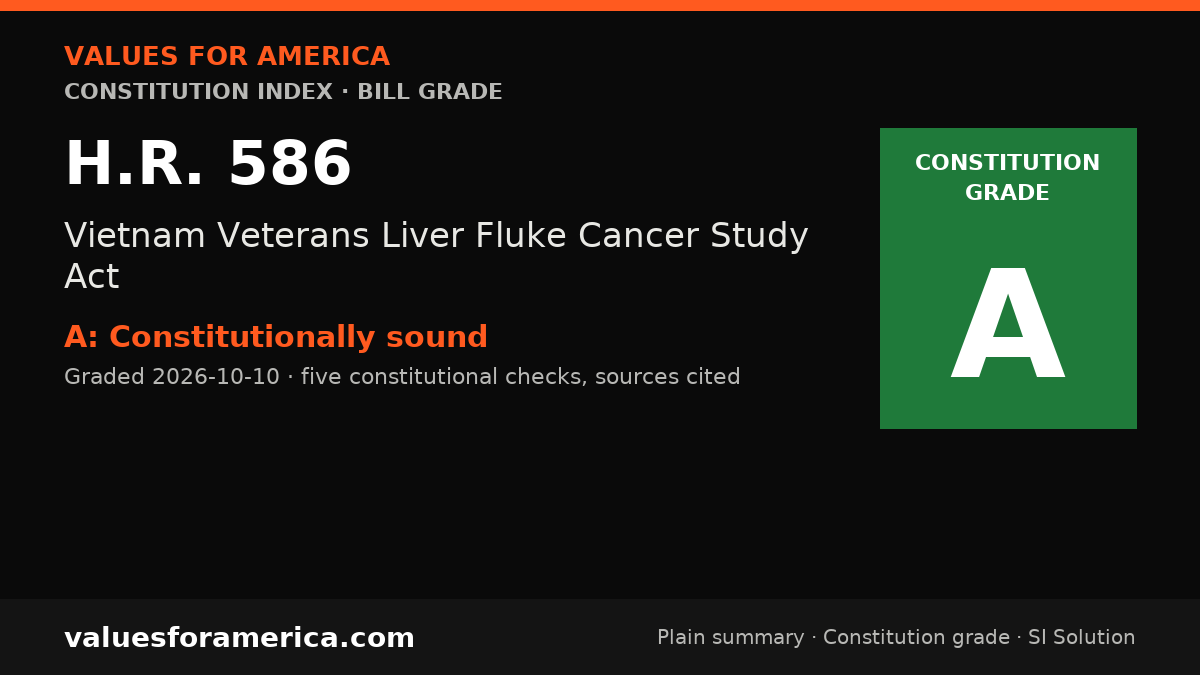
Vietnam Veterans Liver Fluke Cancer Study Act
Cosponsors: 8 (5 D, 3 R) · per Congress.gov, 2026-10-11
Introduced: 2025-01-21
Latest action (2025-04-08): Received in the Senate and Read twice and referred to the Committee on Veterans' Affairs.
What H.R. 586 does, in plain terms
Vietnam Veterans Liver Fluke Cancer Study Act This bill requires the Department of Veterans Affairs (VA) to conduct an epidemiological study and report on the prevalence of cholangiocarcinoma (bile duct cancer) in veterans who served in the Vietnam theater of operations during the Vietnam era. The study must identify the rate of incidence of cholangiocarcinoma in such veterans and in U.S. residents. The bill also requires the VA to track and report on the prevalence of cholangiocarcinoma using the Veterans Affairs Central Cancer Registry. Additionally, the VA must periodically submit follow-up reports to Congress regarding the epidemiological study and information collected from the cancer registry regarding the prevalence of bile duct cancer.
Official summary by the Congressional Research Service, via Congress.gov.
Constitution Index
“VFA Constitution grade”
Constitutionally sound
Graded 2026-10-10
SI-generated grade · five published checks · not individually reviewed by a person · methodology
The bill is a straightforward exercise of Congress's power to provide for the veterans it has pledged to care for, and it imposes no restrictions on individual rights or liberties. It directs the Department of Veterans Affairs to conduct studies and report to Congress, which is well within the federal government's enumerated powers and does not raise any constitutional concerns.
-
✓ Passes · Enumerated powers
Congress has broad authority under Article I, Section 8, Clause 12 to 'raise and support Armies' and under the Necessary and Proper Clause (Article I, Section 8, Clause 18) to enact laws that are reasonably related to the care and welfare of military veterans. The bill directs the Department of Veterans Affairs to conduct epidemiological research and report to Congress, which is a legitimate exerc… -
✓ Passes · Bill of Rights
The bill does not implicate any of the first ten amendments. It does not restrict speech, religion, assembly, press, petition, arms, quartering, search and seizure, self-incrimination, due process, takings, trial rights, or cruel and unusual punishment. It is a purely administrative and informational measure. -
✓ Passes · Individual sovereignty
The bill imposes no restrictions on what individuals can do with their person, property, speech, labor, or belief. It merely requires the government to conduct studies and report on health data. It does not compel any individual to act or refrain from acting, and it does not infringe on any personal autonomy. -
✓ Passes · Decentralization
The bill passes all four questions of the decentralization test. (1) An individual or family could not conduct a nationwide epidemiological study of veterans; this requires government resources. (2) A local community or county could not handle this because the affected population is spread across the entire nation. (3) A state could not handle this because the VA is a federal agency and the data i… -
✓ Passes · Due process and takings
The bill does not deprive any person of life, liberty, or property, nor does it take any property without just compensation. It does not bypass any procedural or substantive due process requirements. It is a purely informational and research directive, with no adjudicative or enforcement components.
Sources: Congress.gov: HR 586 summary
Report an error in this grade
What should pass
“VFA SI Solution”
No solution yet
A sourced SI draft appears here once it passes automated checks (Constitution citation, source verification, independent SI critic). How publication works.
Related on VFA

For journalists and bloggers
“Embed this grade”
Free to use with the link back. The badge and card update when the grade changes. Embed terms →
