H.R. 5763 explained · 119th Congress · Pending in Congress
Main Street Parity Act
Cosponsors: 4 (4 D, 0 R) · per Congress.gov, 2026-10-09
Introduced: 2025-10-14
Latest action (2026-01-26): Received in the Senate and Read twice and referred to the Committee on Small Business and Entrepreneurship.
What H.R. 5763 does, in plain terms
Main Street Parity Act This bill lessens the financing requirements for certain Small Business Administration loans to small businesses for plant acquisition, construction, conversion, or expansion, including the acquisition of land. Specifically, the bill reduces the amount of equity a borrower must provide by 5% of the total cost for loans for limited or single-purpose properties.
Official summary by the Congressional Research Service, via Congress.gov.
Constitution Index
“VFA Constitution grade”
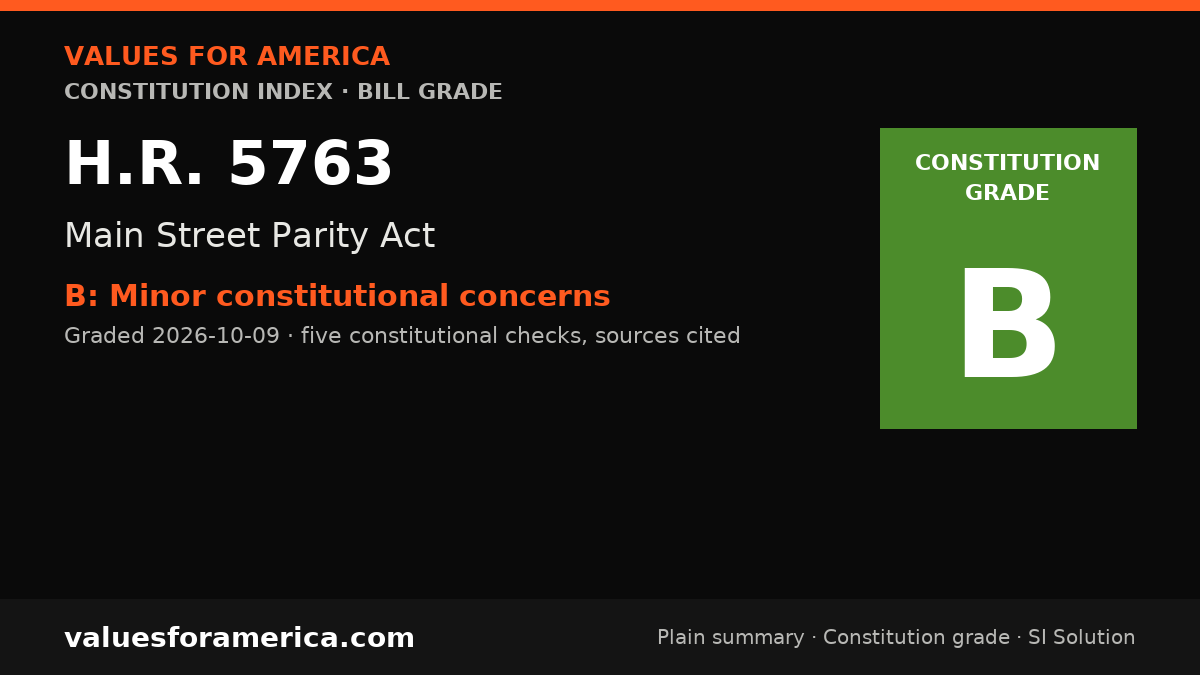
Minor constitutional concerns
Graded 2026-10-09
SI-generated grade · five published checks · not individually reviewed by a person · methodology
The Main Street Parity Act is likely constitutional. Congress has the spending and commerce power to administer Small Business Administration lending, the bill does not infringe the Bill of Rights or individual sovereignty, and it creates no due-process or takings problem. Its only constitutional tension is that it operates through a federal lending program rather than a more decentralized state, local, or private vehicle. That is a structural preference, not a rights violation, so the bill is mostly sound and fixable.
-
✓ Passes · Enumerated powers
Congress may provide for the general welfare and spend money under Article I, Section 8, Clause 1, and it may regulate lending and economic activity that substantially affects interstate commerce under Article I, Section 8, Clause 3. The bill merely adjusts borrower-equity thresholds for an existing SBA program; it does not create a new federal mandate or regulate purely private conduct outside Co… -
✓ Passes · Bill of Rights
The bill imposes no restriction on speech, press, religion, assembly, petition, bearing arms, quartering soldiers, searches, self-incrimination, trial rights, juries, or cruel punishment. It changes only the equity requirement for a voluntary federal loan, so none of the protections in the first ten amendments is implicated. -
✓ Passes · Individual sovereignty
This measure reduces a condition for obtaining a voluntary federal loan and therefore expands what a borrower may do with private property and enterprise. It does not restrict personal liberty, labor, speech, or belief, and it imposes no burden requiring compelling constitutional justification. The Ninth Amendment's reservation of unenumerated rights is not threatened. -
✗ Concern · Decentralization
Small-business financing could in principle be handled by private lenders, local lending programs, or state-level initiatives, so the federal SBA is not the most decentralized vehicle. The bill does not commandeer states or individuals and does not preempt local action, but it does continue and adjust a federal loan program rather than returning the function to a lower level. This is a modest stru… -
✓ Passes · Due process and takings
The bill does not deprive anyone of life, liberty, or property, deny a hearing, or impose a penalty. It changes eligibility terms for a discretionary federal loan program. No property is taken for public use, so the Fifth Amendment's Takings Clause and due process protections are not violated.
Sources: Congress.gov: HR 5763 summary
Report an error in this grade
What should pass
“VFA SI Solution”
No solution yet
A sourced SI draft appears here once it passes automated checks (Constitution citation, source verification, independent SI critic). How publication works.
Related on VFA

For journalists and bloggers
“Embed this grade”
Free to use with the link back. The badge and card update when the grade changes. Embed terms →
