H.R. 568 explained · 119th Congress · Pending in Congress
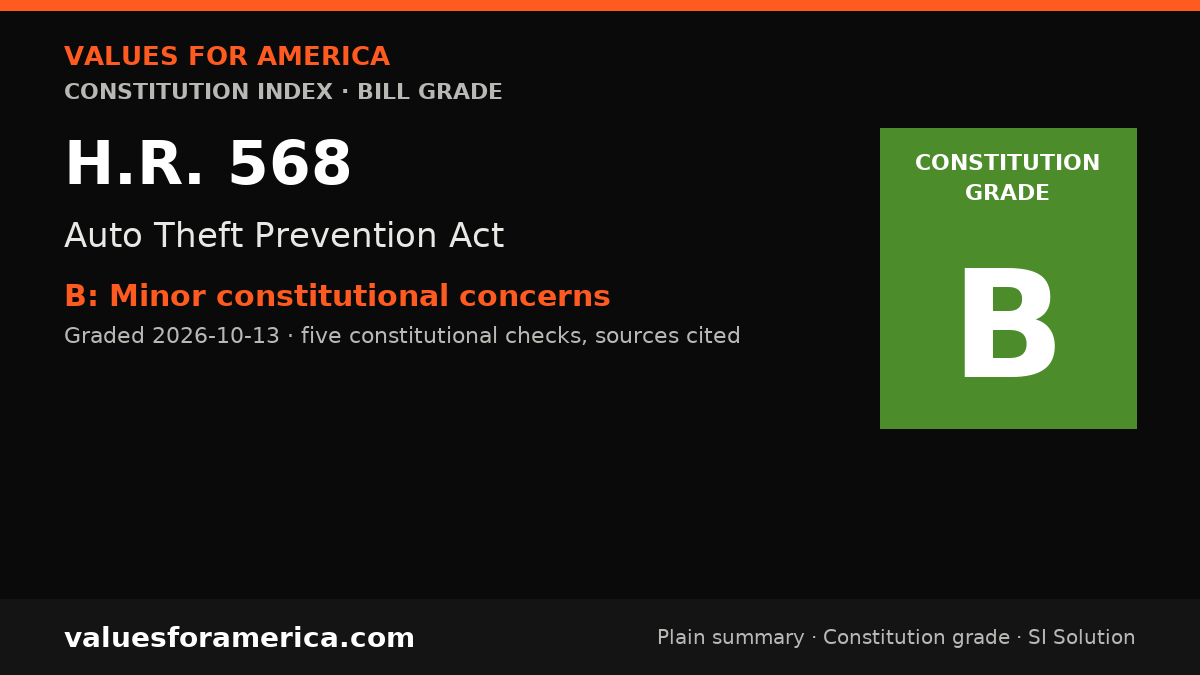
Auto Theft Prevention Act
Cosponsors: 2 (0 D, 2 R) · per Congress.gov, 2026-10-12
Introduced: 2025-01-20
Latest action (2025-01-20): Referred to the House Committee on the Judiciary.
What H.R. 568 does, in plain terms
Auto Theft Prevention Act This bill establishes a grant program to combat auto theft and stolen automobile trafficking. Specifically, the bill directs the Office of Community Oriented Policing Services within the Department of Justice to award grants for state and local law enforcement agencies to combat auto theft and stolen vehicle trafficking. The bill also allows funds under the Community Oriented Policing Services grant program to be used to combat auto thefts and stolen automobile trafficking.
Official summary by the Congressional Research Service, via Congress.gov.
Constitution Index
“VFA Constitution grade”
Minor constitutional concerns
Graded 2026-10-13
SI-generated grade · five published checks · not individually reviewed by a person · methodology
The Auto Theft Prevention Act establishes a federal grant program to assist state and local law enforcement in combating auto theft. While the federal government's enumerated powers do not explicitly include crime control, the spending power under Article I, Section 8, Clause 1 provides a constitutional basis for conditional grants to states. The bill does not infringe on individual rights, respects decentralization by leaving implementation to state and local agencies, and includes no due process or takings concerns. However, the use of federal funds to influence state and local law enforcement priorities raises minor federalism concerns, as crime control is traditionally a state and local function.
-
✓ Passes · Enumerated powers
The federal government lacks a general police power, but Article I, Section 8, Clause 1 grants Congress the power to spend for the general welfare. Grant programs that provide funds to state and local governments for law enforcement purposes have been upheld under the Spending Clause, as long as the conditions are unambiguous and related to the federal interest. Auto theft often involves interstat… -
✓ Passes · Bill of Rights
The bill does not restrict speech, religion, assembly, press, petition, or any other right protected by the Bill of Rights. It merely establishes a grant program and does not alter criminal procedure, search and seizure standards, or any other constitutional protections. No infringement on the first ten amendments is present. -
✓ Passes · Individual sovereignty
The bill does not restrict individual liberty or property. It provides funding to law enforcement agencies to combat auto theft, which is a legitimate government function. There is no burden on individuals to justify their freedom; the bill does not impose new regulations or restrictions on personal conduct. -
✓ Passes · Decentralization
The bill passes the four-question test. Auto theft prevention is a matter that individuals and families cannot fully handle on their own, as it requires law enforcement. Local communities and counties can handle auto theft prevention, and states can as well. The bill does not consolidate decision-making upward; it provides federal funds to state and local agencies, leaving implementation and prior… -
✓ Passes · Due process and takings
The bill does not affect due process rights or the Takings Clause. It does not deprive anyone of life, liberty, or property without due process, nor does it take private property for public use without just compensation. The grant program is voluntary and does not impose penalties or obligations on individuals.
Sources: Congress.gov: HR 568 summary
Report an error in this grade
What should pass
“VFA SI Solution”
No solution yet
A sourced SI draft appears here once it passes automated checks (Constitution citation, source verification, independent SI critic). How publication works.
Related on VFA

For journalists and bloggers
“Embed this grade”
Free to use with the link back. The badge and card update when the grade changes. Embed terms →
