H.R. 567 explained · 119th Congress · Pending in Congress
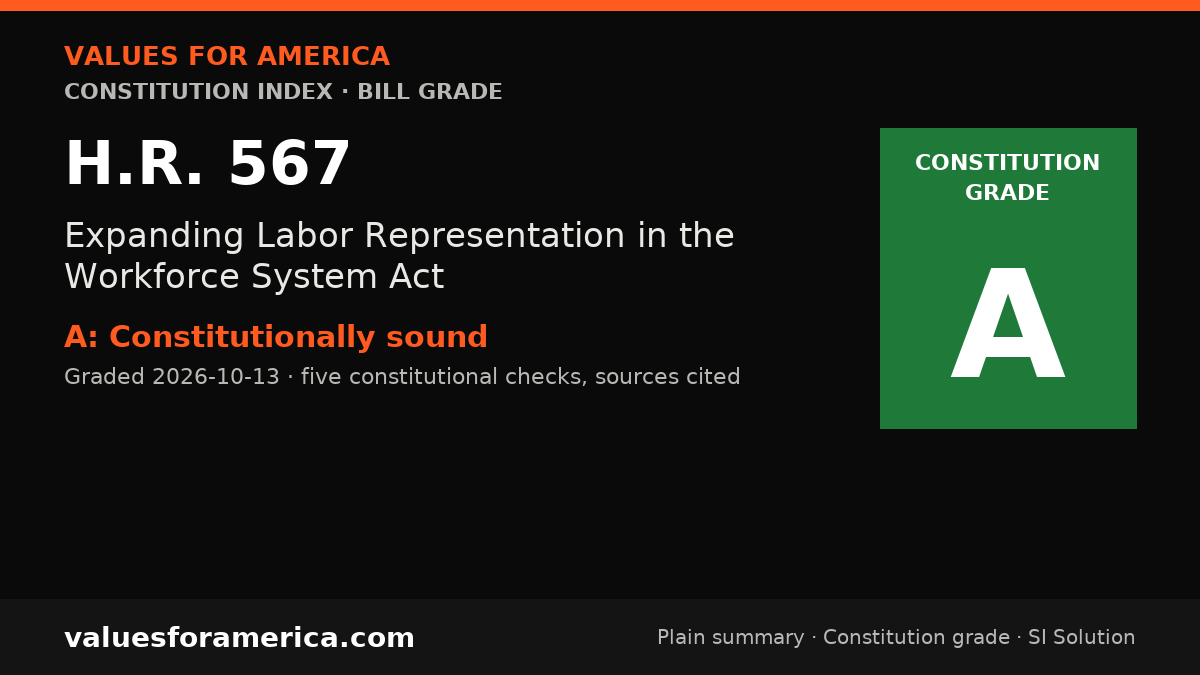
Expanding Labor Representation in the Workforce System Act
Cosponsors: 2 (1 D, 1 R) · per Congress.gov, 2026-10-12
Introduced: 2025-01-20
Latest action (2025-01-20): Referred to the House Committee on Education and Workforce.
What H.R. 567 does, in plain terms
Expanding Labor Representation in the Workforce System Act This bill increases from 20% to 30% the workforce representation on state and local workforce development boards. Workforce development boards perform a variety of functions to carry out the programs and services authorized under the Workforce Innovation and Opportunity Act, including by developing and implementing plans for workforce development and investment activities. Current law specifies that boards must include representatives of labor organizations, among others with relevant expertise. The bill specifies that labor organizations include organizations that are considered labor organizations based on the definition included in the National Labor Relations Act (e.g., unions); are composed of labor organizations (e.g., a labor union federation or a state or municipal labor body); or would be considered labor organizations but for the fact that the organization represents agricultural laborers or individuals employed by a federal agency, a government corporation, a Federal Reserve Bank, a state or local government, or an employer that is subject to the Railway Labor Act.
Official summary by the Congressional Research Service, via Congress.gov.
Constitution Index
“VFA Constitution grade”
Constitutionally sound
Graded 2026-10-13
SI-generated grade · five published checks · not individually reviewed by a person · methodology
The bill adjusts the composition of state and local workforce development boards, a matter within the purview of federal spending and program administration under the Workforce Innovation and Opportunity Act. It does not infringe on individual rights, respects federalism by allowing states and localities to administer the boards, and does not implicate due process or takings concerns. The change is a minor adjustment to existing federal program requirements and is fully consistent with the Constitution.
-
✓ Passes · Enumerated powers
The federal government has authority under the Spending Clause (Article I, Section 8, Clause 1) to condition federal funds for workforce development programs on compliance with statutory requirements. The Workforce Innovation and Opportunity Act is a federal spending program, and this bill modifies the composition of boards that administer those funds. This is a valid exercise of Congress's spendi… -
✓ Passes · Bill of Rights
The bill does not implicate any of the first ten amendments. It does not restrict speech, religion, assembly, press, petition, arms, quartering, search and seizure, self-incrimination, due process, takings, fair trial, jury, cruel and unusual punishment, or unenumerated rights. It merely adjusts the composition of advisory boards. -
✓ Passes · Individual sovereignty
The bill does not restrict individual liberty. It does not compel individuals to join labor organizations or restrict their freedom of association. It only affects the composition of government boards, which is a matter of government administration, not individual conduct. -
✓ Passes · Decentralization
The bill does not consolidate decision-making at a higher level of government. Workforce development boards are state and local entities. The federal government sets broad requirements, but states and localities retain significant discretion in implementing the programs. The change is a minor adjustment to federal requirements and does not shift authority upward. -
✓ Passes · Due process and takings
The bill does not deprive any person of life, liberty, or property without due process of law. It does not take private property for public use without just compensation. It only adjusts the composition of government boards, which is a legislative policy choice that does not implicate due process or takings.
Sources: Congress.gov: HR 567 summary
Report an error in this grade
What should pass
“VFA SI Solution”
No solution yet
A sourced SI draft appears here once it passes automated checks (Constitution citation, source verification, independent SI critic). How publication works.
Related on VFA

For journalists and bloggers
“Embed this grade”
Free to use with the link back. The badge and card update when the grade changes. Embed terms →
