H.R. 5587 explained · 119th Congress · Pending in Congress
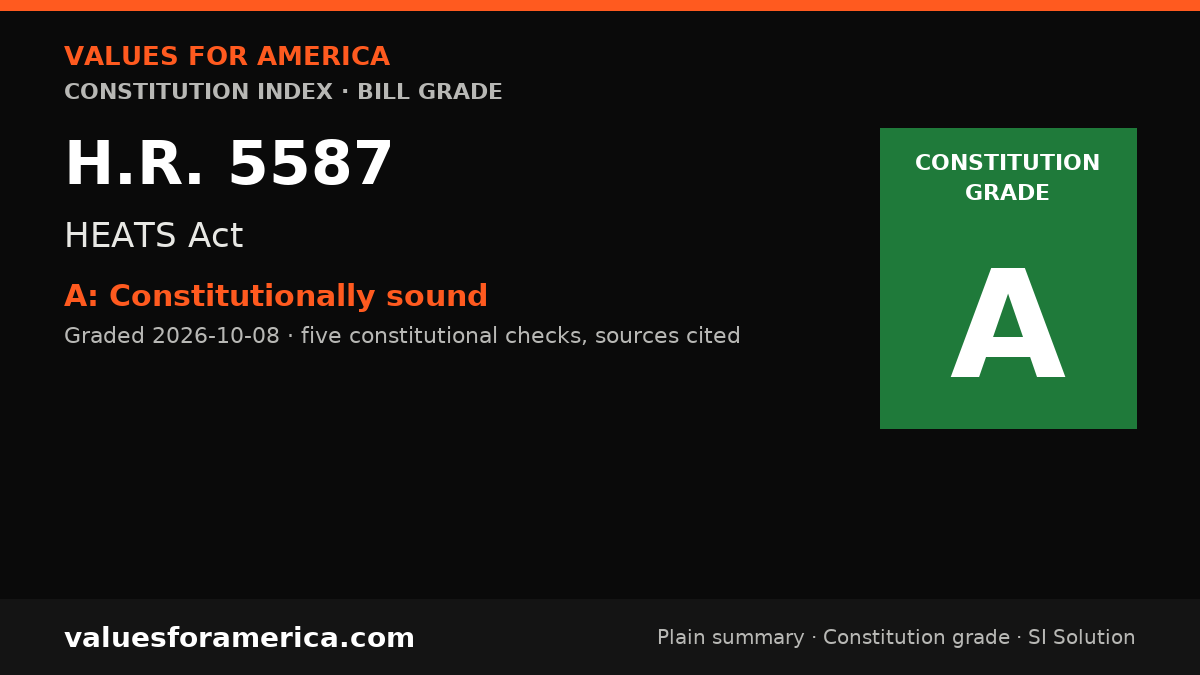
HEATS Act
Cosponsors: 2 (1 D, 1 R) · per Congress.gov, 2026-10-08
Introduced: 2025-09-26
Latest action (2026-07-15): Committee on Energy and Natural Resources Subcommittee on Public Lands, Forests, and Mining. Hearings held.
What H.R. 5587 does, in plain terms
Harnessing Energy At Thermal Sources Act or the HEATS Act This bill exempts certain geothermal activities on state and private lands (except Indian lands) from drilling permit requirements as well as environmental and historic preservation review requirements. First, the bill prohibits the Department of the Interior from requiring an operator to obtain a drilling permit under the Geothermal Steam Act of 1970 for any geothermal exploration and production activity conducted on a nonfederal surface estate (i.e., the part of the estate that is above ground) if (1) the United States holds an ownership interest of less than 50% of the subsurface geothermal estate to be accessed by the proposed action, and (2) the operator submits to Interior a state permit to conduct the geothermal exploration and production activity on the nonfederal surface estate. Next, the bill states that such geothermal exploration and production activity is not considered a major federal action under National Environmental Policy Act of 1969 (NEPA). Thus, such activity does not trigger NEPA's environmental review requirements. In addition, the bill exempts such activity from the consultation requirements under the Endangered Species Act of 1973. It also exempts the activity from review under the National Historic Preservation Act unless the state in which the activity occurs does not have a state law that addresses the preservation of historic properties.
Official summary by the Congressional Research Service, via Congress.gov.
Constitution Index
“VFA Constitution grade”
Constitutionally sound
Graded 2026-10-08
SI-generated grade · five published checks · not individually reviewed by a person · methodology
SI review: the HEATS Act reduces federal overreach on state and private lands by removing federal drilling permits and federal environmental and historic review where the federal subsurface interest is under 50 percent and a state permit exists. It respects enumerated limits, the Tenth Amendment, property rights, and due process, leaving regulation at the state level. Grade A.
-
✓ Passes · Enumerated powers
Congress acts within Article I, Section 8 authority and Article IV, Section 3 authority over federal property by limiting, rather than expanding, federal regulation. The Property Clause in Article IV, Section 3, Clause 2 governs federal land; where the surface is nonfederal and the federal subsurface interest is under 50 percent, Congress may decline to require Geothermal Steam Act permits and dec… -
✓ Passes · Bill of Rights
No provision of the first ten Amendments is infringed. The bill does not restrict speech, religion, press, assembly under the First Amendment, does not touch arms under the Second Amendment, and authorizes no search, seizure, or surveillance implicating the Fourth Amendment. It creates no compelled testimony implicating the Fifth Amendment self-incrimination clause. By leaving state historic-prese… -
✓ Passes · Individual sovereignty
The bill expands individual sovereignty by removing federal permit and review barriers to productive use of private property, labor, and contract on state and private lands, consistent with the Ninth Amendment and Tenth Amendment. The burden on the federal government to justify restricting surface owners and operators on nonfederal land is not met where the federal interest is minor, so withdrawal… -
✓ Passes · Decentralization
The bill moves decision-making downward, satisfying the Tenth Amendment. Private operators with state permits can conduct geothermal work without federal permits: (1) individuals, families and private firms can contract for and conduct energy development subject to state law; (2) local communities and counties can address land-use and nuisance effects through local law; (3) states can fully handle… -
✓ Passes · Due process and takings
No deprivation of life, liberty, or property without due process under the Fifth Amendment and Fourteenth Amendment Section 1, and no taking without just compensation under the Fifth Amendment Takings Clause. The bill reduces federal restraint on use of nonfederal surface estates and does not seize property, impose fines, or create presumptions of guilt. State permit requirements remain, preservin…
Sources: Congress.gov: HR 5587 summary
Report an error in this grade
What should pass
“VFA SI Solution”
No solution yet
A sourced SI draft appears here once it passes automated checks (Constitution citation, source verification, independent SI critic). How publication works.
Related on VFA

For journalists and bloggers
“Embed this grade”
Free to use with the link back. The badge and card update when the grade changes. Embed terms →
