H.R. 556 explained · 119th Congress · Pending in Congress
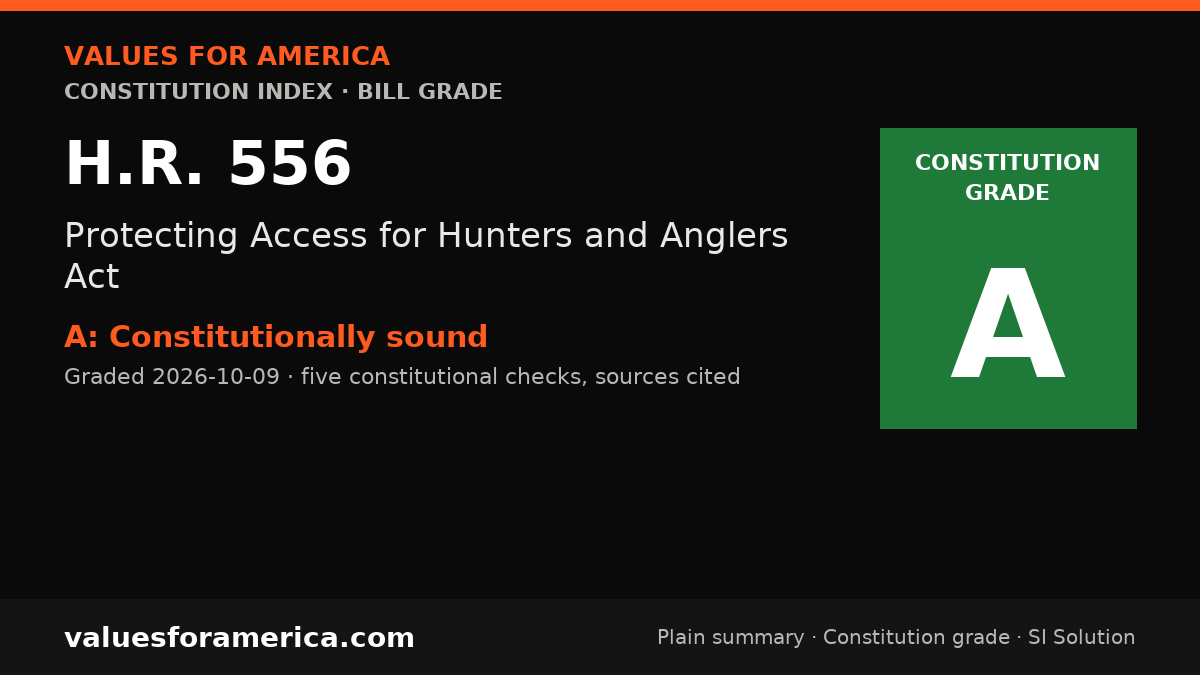
Protecting Access for Hunters and Anglers Act
Cosponsors: 83 (0 D, 83 R) · per Congress.gov, 2026-10-09
Introduced: 2025-01-16
Latest action (2026-03-19): Received in the Senate and Read twice and referred to the Committee on Environment and Public Works.
What H.R. 556 does, in plain terms
Protecting Access for Hunters and Anglers Act of 2025 This bill bars the Fish and Wildlife Service (FWS), the Bureau of Land Management (BLM), and the Forest Service from prohibiting or regulating the use of lead ammunition or tackle on federal land or water. The bill makes exceptions for specified existing regulations and where the FWS, the BLM, or the Forest Service determines that a decline in wildlife population at the specific unit of federal land or water is primarily caused by the use of lead in ammunition or tackle, based on the field data from such unit, and the state approves the regulations.
Official summary by the Congressional Research Service, via Congress.gov.
Constitution Index
“VFA Constitution grade”
Constitutionally sound
Graded 2026-10-09
SI-generated grade · five published checks · not individually reviewed by a person · methodology
The bill is a valid exercise of Congress's authority over federal public lands. It restricts federal agencies rather than private individuals, does not infringe any enumerated constitutional right, and does not consolidate authority beyond the necessary federal role as owner and manager of federal property.
-
✓ Passes · Enumerated powers
Congress has express constitutional authority over federal lands and waters under Article IV, Section 3, Clause 2, which grants power to make rules respecting property belonging to the United States. The bill simply limits the regulatory discretion of the Fish and Wildlife Service, Bureau of Land Management, and Forest Service on federal land and water. This is a lawful exercise of the Property Cl… -
✓ Passes · Bill of Rights
The bill does not implicate the First, Third, Fourth, Fifth, Sixth, Seventh, Eighth, or Ninth Amendments. It does not infringe the Second Amendment; to the extent it addresses ammunition and hunting, it protects lawful access rather than restricting it. No Bill of Rights protection is violated. -
✓ Passes · Individual sovereignty
This bill restricts government agencies, not individuals. It preserves the freedom of hunters and anglers to choose lead ammunition or tackle on federal lands. It imposes no mandate, prohibition, penalty, or burden on a person's property, labor, speech, or belief. The burden is on government, not on the individual. -
✓ Passes · Decentralization
Federal land and water are ultimately under federal authority, so Congress is the appropriate level to set the scope of federal agency regulation. The bill does not commandeer state governments; moreover, it preserves a state-approval role for certain wildlife-population exceptions. It does not consolidate decision-making above the minimum necessary level for federally owned resources. -
✓ Passes · Due process and takings
The bill creates no new penalties, forfeitures, or seizures. It does not deprive anyone of life, liberty, or property without due process. It takes no private property for public use and does not affect just-compensation obligations under the Fifth Amendment.
Sources: Congress.gov: HR 556 summary
Report an error in this grade
What should pass
“VFA SI Solution”
No solution yet
A sourced SI draft appears here once it passes automated checks (Constitution citation, source verification, independent SI critic). How publication works.
Related on VFA

For journalists and bloggers
“Embed this grade”
Free to use with the link back. The badge and card update when the grade changes. Embed terms →
