H.R. 5505 explained · 119th Congress · Pending in Congress
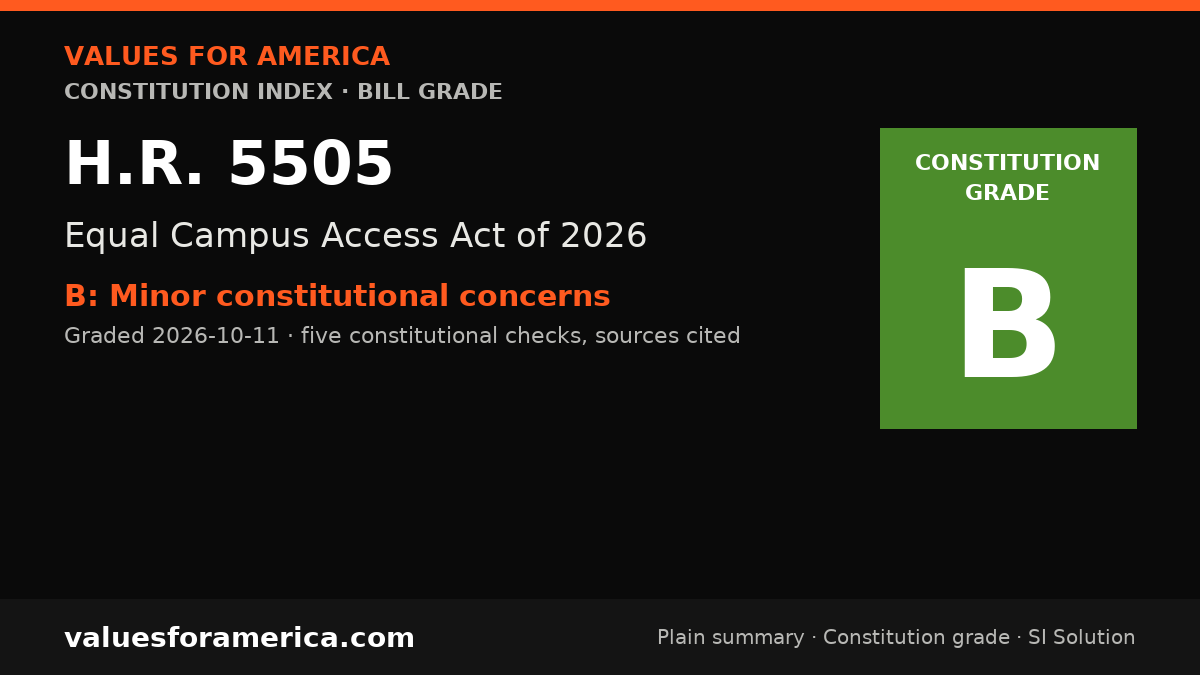
Equal Campus Access Act of 2026
Cosponsors: 14 (0 D, 14 R) · per Congress.gov, 2026-10-14
Introduced: 2025-09-18
Latest action (2026-09-16): Placed on the Union Calendar, Calendar No. 730.
What H.R. 5505 does, in plain terms
Equal Campus Access Act of 2025 This bill prohibits funding made available under the Higher Education Act of 1965 from being provided to any public institution of higher education (IHE) that denies certain campus rights to religious student organizations. Specifically, the bill prohibits a public IHE from receiving these funds if it denies a religious student organization any right, benefit, or privilege that is otherwise afforded to other student organizations at the IHE because of the religious student organization's beliefs, practices, speech, leadership standards, or standards of conduct.
Official summary by the Congressional Research Service, via Congress.gov.
Constitution Index
“VFA Constitution grade”
Minor constitutional concerns
Graded 2026-10-11
SI-generated grade · five published checks · not individually reviewed by a person · methodology
The Equal Campus Access Act of 2026 is mostly sound but has minor constitutional tension. It uses federal spending power to enforce religious free exercise and free speech at public universities, which is within Congress's enumerated authority under the Spending Clause. However, conditioning funds on compliance with religious organization autonomy could, in narrow cases, conflict with a state's own constitutional protections or institutional autonomy, creating a minor federalism tension. No Bill of Rights or individual sovereignty violations are present; in fact, the bill protects First Amendment rights. The decentralization check shows the bill consolidates policy upward, but the issue is one of fundamental rights where federal enforcement is appropriate.
-
✓ Passes · Enumerated powers
Congress has authority under Article I, Section 8, Clause 1 (Spending Clause) to attach conditions to federal funds, including those under the Higher Education Act. The bill does not directly regulate public institutions but instead conditions receipt of federal funds on compliance with nondiscrimination rules protecting religious student organizations. This is a well-established use of spending p… -
✓ Passes · Bill of Rights
The bill protects the First Amendment rights of religious student organizations—free exercise of religion, free speech, and freedom of assembly. It does not infringe any Bill of Rights protections; rather, it prevents public universities from discriminating against religious groups based on their beliefs or leadership standards, which would itself violate the First Amendment. No infringement of th… -
✓ Passes · Individual sovereignty
The bill protects the autonomy of religious student organizations to set their own beliefs, practices, speech, leadership standards, and standards of conduct. This respects the individual sovereignty of members to associate freely and practice their religion without government coercion. The government is not restricting individual action but rather preventing public universities from imposing rest… -
✗ Concern · Decentralization
The bill fails the decentralization test because it consolidates decision-making at the federal level. While the issue of religious discrimination on campus could be addressed by states or local communities, the bill uses federal spending power to impose a uniform national standard. This fails questions 3 and 4: states could handle this without federal involvement, and the action consolidates upwa… -
✓ Passes · Due process and takings
The bill does not bypass due process or take property without just compensation. It provides clear notice to public institutions: if they deny certain rights to religious student organizations, they lose eligibility for federal funds. Institutions retain the choice to comply or forgo funds. No arbitrary government action, no deprivation of property without hearing, and no taking of private propert…
Sources: Congress.gov: HR 5505 summary
Report an error in this grade
What should pass
“VFA SI Solution”
No solution yet
A sourced SI draft appears here once it passes automated checks (Constitution citation, source verification, independent SI critic). How publication works.
Related on VFA

For journalists and bloggers
“Embed this grade”
Free to use with the link back. The badge and card update when the grade changes. Embed terms →
