H.R. 5408 explained · 119th Congress · Pending in Congress
Faster Labor Contracts Act
Cosponsors: 110 (93 D, 17 R) · per Congress.gov, 2026-10-08
Introduced: 2025-09-16
Latest action (2026-06-10): Received in the Senate.
What H.R. 5408 does, in plain terms
Faster Labor Contracts Act This bill establishes mandatory deadlines for parties negotiating an initial collective bargaining agreement (CBA) and provides for mediation and arbitration to finalize CBAs. Under the bill, CBA negotiations must begin within 10 days after an employer receives a written request from a newly recognized or certified bargaining representative. The bill provides that parties must make every reasonable effort to conclude and sign a CBA. Further, the bill provides that, if the parties have not reached an agreement after 90 days, either party may request mediation by the Federal Mediation and Conciliation Service (FMCS). The bill directs FMCS to use its best efforts to secure an agreement. If mediation does not result in an agreement within 30 days (or an additional period agreed to by both parties), FMSC must refer the parties to an arbitration panel to render a decision settling the dispute. The panel must consider specified factors, including the employer's financial prospects and employees' cost of living. The resulting CBA is binding on the parties for two years. (Parties may agree to amend the terms during the two-year period.) The bill specifies that (1) an employer must maintain current wages, hours, terms, and conditions of employment during negotiations; and (2) an employer's duty to collectively bargain continues even if a representative has been decertified. The Government Accountability Office must report to Congress regarding the average number of days between the certification or recognition of a bargaining representative and the date the initial CBA was executed.
Official summary by the Congressional Research Service, via Congress.gov.
Constitution Index
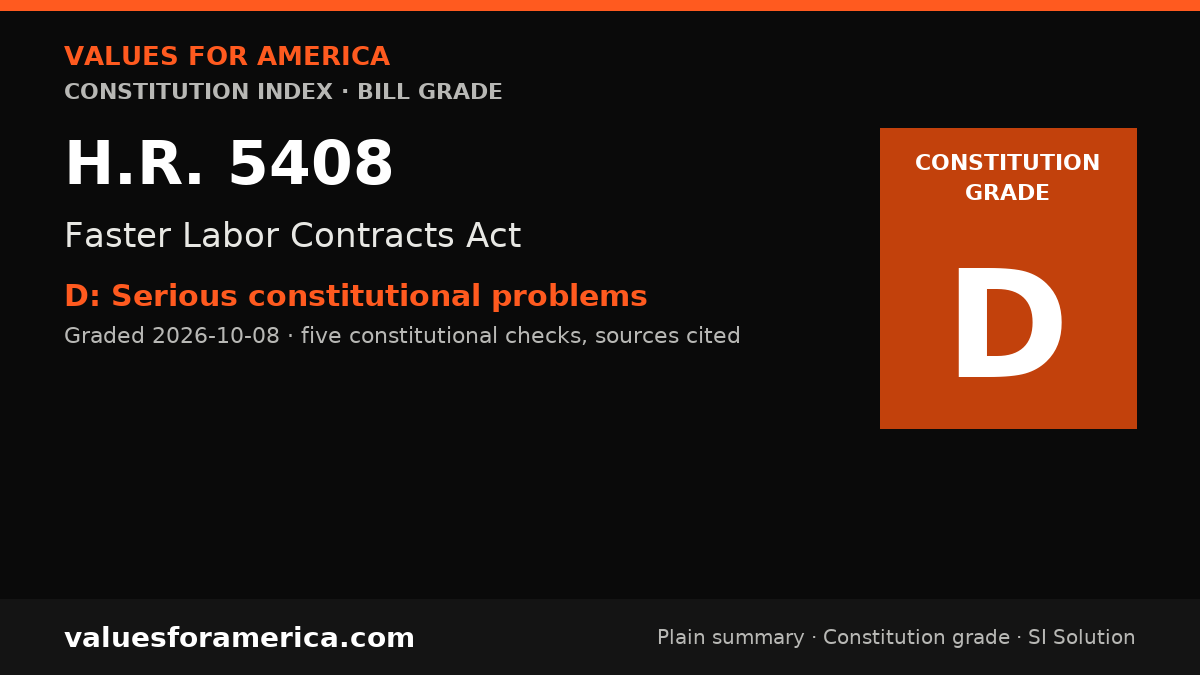
“VFA Constitution grade”
Serious constitutional problems
Graded 2026-10-08
SI-generated grade · five published checks · not individually reviewed by a person · methodology
Congress has Commerce Clause authority over labor relations, but HR 5408 imposes binding private contract terms through federal mediation and arbitration, freezes employment terms, and compels bargaining after decertification. Those features infringe freedom of association and contract, individual sovereignty, federalism, and due process, requiring structural rewrite.
-
✓ Passes · Enumerated powers
Labor relations affecting interstate commerce fall within Article I, Section 8, Clause 3, the Commerce Clause, as recognized for federal labor law. Congress may regulate negotiation procedures for employers engaged in interstate commerce. Authority exists, but mandatory binding terms and post-decertification bargaining stretch that authority toward compelling private contracts rather than regulati… -
✗ Concern · Bill of Rights
First Amendment freedom of association includes freedom not to associate. Section continuing duty to bargain after decertification compels association with a rejected representative. Binding two-year terms imposed by federal arbitration panel restricts freedom of contract protected under liberty in Fifth Amendment and Ninth Amendment retained rights. No direct Second, Third, Fourth, Sixth, Seventh… -
✗ Concern · Individual sovereignty
The bill restricts what employers and employees may do with their own labor, property, and speech: mandatory 10-day start, reasonable-effort mandate, status-quo freeze, referral to binding arbitration, and two-year binding terms even if one side disagrees, plus continued duty after decertification. Government has not shown a compelling constitutional justification for substituting a federal panel … -
✗ Concern · Decentralization
Workplace bargaining can be handled by the parties and, if regulation is needed, by states under their police powers and state labor law. Federal mandatory timetable, federal mediation, and federally imposed binding contract consolidate decision-making at the federal level beyond the minimum necessary, contrary to Tenth Amendment reservation to states and people. -
✗ Concern · Due process and takings
Fifth Amendment Due Process Clause requires non-arbitrary action and meaningful review before government imposes binding obligations. Imposition of a binding two-year agreement covering wages, hours, and conditions by an arbitration panel, plus a status-quo wage and terms freeze during negotiations, deprives employers and dissenting employees of liberty of contract and property interests without j…
Sources: Congress.gov: HR 5408 summary
Report an error in this grade
What should pass
“VFA SI Solution”
No solution yet
A sourced SI draft appears here once it passes automated checks (Constitution citation, source verification, independent SI critic). How publication works.
Related on VFA

For journalists and bloggers
“Embed this grade”
Free to use with the link back. The badge and card update when the grade changes. Embed terms →
