H.R. 5371 explained · 119th Congress · Became law
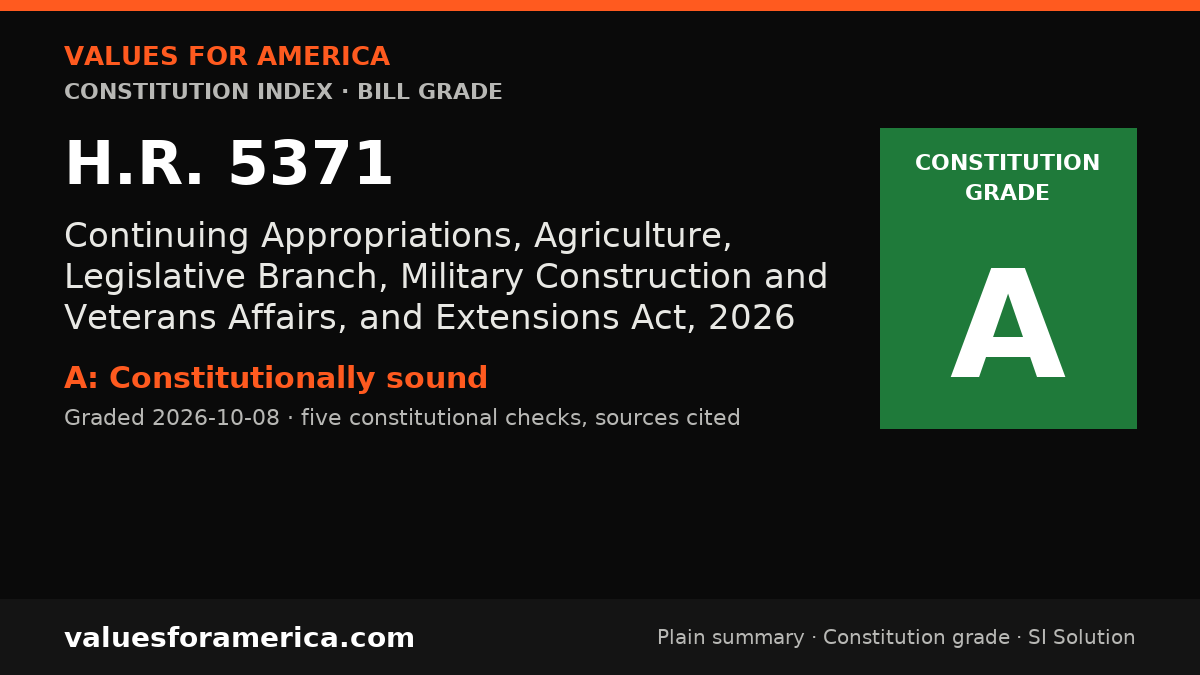
Continuing Appropriations, Agriculture, Legislative Branch, Military Construction and Veterans Affairs, and Extensions Act, 2026
Cosponsors: none · per Congress.gov, 2026-10-10
Introduced: 2025-09-16
Latest action (2025-11-12): Became Public Law No: 119-37.
What H.R. 5371 does, in plain terms
Continuing Appropriations, Agriculture, Legislative Branch, Military Construction and Veterans Affairs, and Extensions Act, 2026 This act ends the government shutdown that began on October 1, 2025, by providing FY2026 continuing appropriations for most federal agencies through January 30, 2026, and providing appropriations through the end of FY2026 for agriculture, military construction and veterans affairs, and legislative branch programs. It also extends various expiring programs and authorities. (Sec. 3) This section provides that references to this Act included in any division of this act refer only to the provisions of that division unless the act expressly provides otherwise. (Sec. 4) This section provides that the explanatory statement regarding this act that was printed in the Congressional Record has the same effect with respect to the allocation of funds and implementation of Divisions B through D of this act as a joint explanatory statement of a conference committee. (Sec. 5) This section specifies that the sums in this act are appropriated for FY2026. DIVISION A--CONTINUING APPROPRIATIONS ACT, 2026 Continuing Appropriations Act, 2026 This division provides continuing FY2026 appropriations to most federal agencies through the earlier of January 30, 2026, or the enactment of the applicable appropriations act. It is known as a continuing resolution (CR) and ends the government shutdown that began on October 1, 2025, because the FY2026 appropriations bills had not been enacted. The CR funds most programs and activities at the FY2025 levels with several exceptions that provide funding flexibility and additional appropriations for various programs. (Sec. 101) This section generally provides FY2026 appropriations to most federal agencies for continuing projects or activities at the levels and under the conditions included in the Full-Year Continuing Appropriations Act, 2025. It also specifies several exceptions. (Sec. 102) This section prohibits the Department of Defense (DOD) from funding new or accelerated production of certain projects and other activities and certain multiyear procurements prior to the enactment of the regular annual appropriations act. (Sec. 103) This section specifies that funds provided by Section 101 of this division shall be available to the extent and in the manner that would be provided in the pertinent appropriations act. (Sec. 104) This section generally prohibits appropriations provided by Section 101 of this division from being used to initiate or resume any project or activity that was not funded during FY2025. (Sec. 105) This section specifies that appropriations provided by the CR are to be used to conduct FY2026 activities and programs during the period of the CR. (Sec. 106) This section continues the appropriations provided by this division through the earlier of January 30, 2026, or the enactment of the applicable appropriations act. (Sec. 107) This section requires expenditures for activities funded in this division to be charged to the full-year appropriations bill and relevant account when the applicable appropriations bill becomes law. (Sec. 108) This section waives the normal time limitations for submission and approval of apportionments of accounts funded in annual appropriations acts. (Sec. 109) This section limits disbursements for programs that would otherwise have high initial rates of operation or would complete distribution of funding at the beginning of the fiscal year if those actions would impinge on final congressional funding prerogatives. (Sec. 110) This section requires this division to be implemented so that only the most limited funding action permitted by this division is taken in order to provide for continuation of projects and activities. (Sec. 111) This section continues funding for certain appropriated entitlements and other mandatory payments with budget authority provided in an FY2025 appropriations act at the rate necessary to maintain program levels under current law. It also provides authority to obligate funds for mandatory payments that are due up to 30 days following the expiration of the CR. (Sec. 112) This section permits funding made available by this division for civilian personnel compensation and benefits in each department and agency to be apportioned at the rate necessary to avoid furloughs. It also requires all necessary actions to reduce or defer non-personnel-related administrative expenses to be taken prior to using this authority. (Sec. 113) This section permits funds appropriated by this division to be obligated and expended notwithstanding specified statutory provisions restricting appropriations for foreign assistance, the Department of State, international broadcasting, and intelligence activities in the absence of prior authorizations. (Sec. 114) This section extends designations of emergency spending and disaster relief funds to funds provided by this division that previously carried those designations. (Sec. 115) This section sets forth requirements for the treatment of rescissions when federal agencies implement the funding levels provided by the CR. (Sec. 116) This section specifies that the funds provided by this division are available to provide back pay to federal employees who were furloughed or excepted employees during the government shutdown. (Sec. 117) This section ratifies and approves certain obligations that were incurred during the government shutdown, including obligations that were for the purposes of maintaining the essential level of activity to protect life and property and bringing about orderly termination of government functions. (Sec. 118) This section establishes requirements for reimbursing states or other federal grantees that used state or nonfederal funds to continue carrying out a federal program or furloughed employees during a government shutdown in FY2026. Specifically, this section requires the furloughed employees to be compensated at their standard rate of compensation for the period in which there was a lapse in appropriations; requires the state or other grantee to be reimbursed for expenses that would have been paid by the federal government during the period if appropriations had been available, including the cost of compensating such furloughed employees and interest; and allows the state or other grantee to use funds that are available under the federal program for the reimbursements. (Sec. 119) This section specifies that the time covered by Divisions A through D of this act is considered to have begun on October 1, 2025. (Sec. 120) This section prohibits federal funds from being used to initiate, carry out, implement, or otherwise notice a reduction in force (RIF) to reduce the number of employees within any department, agency, or office of the federal government through January 30, 2026. It also specifies exceptions and nullifies RIFs that were implemented by federal agencies between October 1, 2025, and the date of enactment for this division. (Sec. 121) This section extends the authority for the Forest Service to use the Agriculture Conservation Experienced Services (ACES) program through January 30, 2026. The program allows the Forest Service to acquire skilled personnel (age 55 and older) from nonprofit partners to provide temporary technical and administrative services for conservation-related programs that are executed on or directly impacting National Forest System land. (Sec. 122) This section allows the U.S. Marshals Service (USMS) to apportion funding at the rate necessary to maintain program operations. It also provides additional appropriations to the USMS for carrying out protective operations. (Sec. 123) This section extends the authorization for the U.S. Parole Commission through January 30, 2026. (Sec. 124) This section extends the availability of previously appropriated National Aeronautics and Space Administration (NASA) funds to support closeout activities of the Space Shuttle program. (Sec. 125) This section extends until January 30, 2026, the special assessment on nonindigent persons or entities convicted of certain offenses involving sexual abuse or human trafficking. The assessment funds programs for human trafficking survivors. (Sec. 126) This section permanently extends the requirement to pay certain quarterly bankruptcy fees to the U.S. Trustee Systems Fund for certain Chapter 11 bankruptcy cases that are open or reopened. (Sec. 127) This section allows the Navy to use certain funds to make advance payments to the Maritime Administration’s (MARAD’s) Ready Reserve Force program for programs, projects, activities, and expenses related to the National Defense Reserve Fleet through January 30, 2026. (Under current law, the payments from the Navy are required to be reimbursements.) (Sec. 128) This section permits funds provided to the Air Force for Research, Development, Test and Evaluation to be apportioned at the rate necessary for the E-7 Wedgetail aircraft program. The funds may not exceed a specified amount and may only be used for the purpose of continued rapid prototyping activities to maintain program schedule and transition to production for the E-7 Wedgetail aircraft program. (Sec. 129) This section requires specified unobligated Air Force Procurement funds for the E-7 Wedgetail aircraft program to be transferred to the Air Force’s Research, Development, Test, and Evaluation account and used only for the purpose of continued rapid prototyping activities to maintain program schedule and transition to production for the E-7 Wedgetail aircraft program. (Sec. 130) This section extends certain authorities under the Defense Production Act of 1950 through the duration of the CR. (Sec. 131) This section allows funds provided to the Navy for Shipbuilding and Conversion to be apportioned at the rate necessary to complete several specified prior year shipbuilding programs. (Sec. 132) This section authorizes DOD to reimburse the government of Palau for land acquisition costs for defense sites in Palau. (Sec. 133) This section increases the statutory funding limit for program management and oversight activities for the Bureau of Reclamation’s Calfed Bay-Delta Program through January 30, 2026. The activities under the program include levee protection, water quality, ecosystem restoration, water use efficiency, and water-supply-related studies and projects. (Sec. 134) This section permits funds provided for the National Nuclear Security Administration’s Weapons Activities account to be apportioned at the rate necessary to maintain current operations for the safe and secure transport of nuclear weapons. It also requires the Office of Management and Budget and the Department of Energy to notify the congressional appropriations committees after each use of this authority. (Sec. 135) This section increases a limit on trust fund transfers to make additional funding available for the Office of Personnel Management to administer the Postal Service Health Benefits Program. (Sec. 136) This section authorizes the District of Columbia to spend local funds at the rates set forth in the Fiscal Year 2026 Local Budget Act of 2025 for programs and activities that were funded in FY2024. (Sec. 137) This section increases the limit on Department of the Treasury funding that may be used for official reception and representation expenses. (Sec. 138) This section permits funds provided for the Small Business Administration’s (SBA’s) Business Loans Program Account to be apportioned at the rate necessary to accommodate increased demand for commitments for business loans authorized under several SBA loan programs. (Sec. 139) This section provides additional funding for the Department of the Treasury’s Office of Terrorism and Financial Intelligence. (Sec. 140) This section extends limits on pay increases for the Vice President and certain senior political appointees. (Sec. 141) This sect
Official summary by the Congressional Research Service, via Congress.gov.
Constitution Index
“VFA Constitution grade”
Constitutionally sound
Graded 2026-10-08
SI-generated grade · five published checks · not individually reviewed by a person · methodology
HR 5371 is a routine exercise of Congress's core appropriations power under Article I, Sections 8 and 9. It ends the shutdown by funding federal operations, imposes no restriction on individual rights, takes no property, and federalizes no state or private function. The SI analysis finds it fully constitutional.
-
✓ Passes · Enumerated powers
Appropriating money is an express federal power. Article I, Section 8, Clause 1 authorizes Congress to pay the debts and provide for the general welfare, and Article I, Section 9, Clause 7 provides that no money shall be drawn from the Treasury but in consequence of appropriations made by law. This Act does exactly that: continuing and full-year FY2026 appropriations. Agriculture, military constru… -
✓ Passes · Bill of Rights
The Act makes no restriction on speech, religion, press, assembly, arms, searches, trial rights, or other protections in the First through Eighth Amendments. It funds government operations at prior-year levels and extends programs; it creates no speech code, no search authority, no disarmament, and no punishment. No Ninth Amendment unenumerated right or Tenth Amendment reserved power is infringed … -
✓ Passes · Individual sovereignty
The Act restricts no personal conduct regarding person, property, speech, labor, or belief. It directs how the government may spend its own funds during the covered period. The burden analysis under the First Amendment and Fifth Amendment liberty principles is satisfied because there is no individual restriction to justify. -
✓ Passes · Decentralization
Funding the operations of the federal government itself cannot be performed at a lower level. (1) Individuals/families cannot appropriate federal funds or operate federal agencies. (2) Local communities cannot fund and direct federal agencies. (3) States cannot appropriate federal Treasury funds. (4) The Act does not consolidate upward beyond the minimum necessary - it funds existing federal funct… -
✓ Passes · Due process and takings
The Act provides prospective funding under published statutory rates through January 30, 2026, with full-year amounts for three divisions. It gives fair notice of funding levels, creates no criminal liability, presumption of guilt, summary seizure, or property taking. No Fifth Amendment Takings Clause compensation is triggered because no private property is taken for public use; disbursement limit…
Sources: Congress.gov: HR 5371 summary
Report an error in this grade
What should pass
“VFA SI Solution”
No solution yet
A sourced SI draft appears here once it passes automated checks (Constitution citation, source verification, independent SI critic). How publication works.
Related on VFA

For journalists and bloggers
“Embed this grade”
Free to use with the link back. The badge and card update when the grade changes. Embed terms →
