H.R. 5345 explained · 119th Congress · Became law
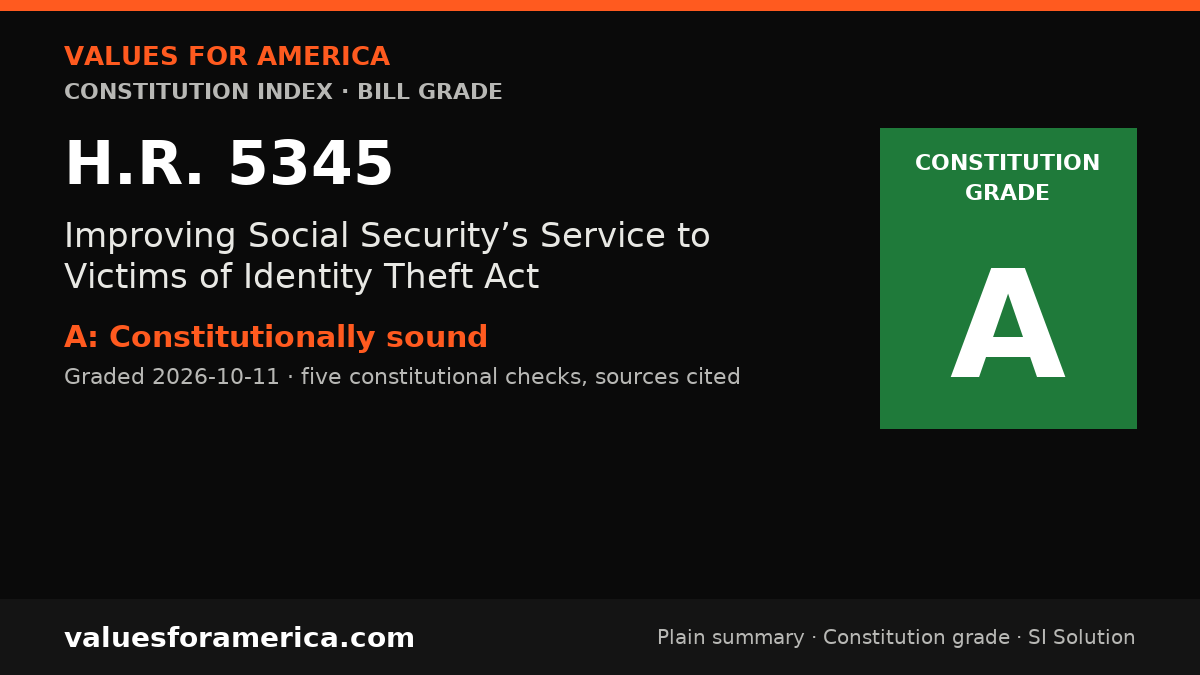
Improving Social Security’s Service to Victims of Identity Theft Act
Cosponsors: 1 (0 D, 1 R) · per Congress.gov, 2026-10-14
Introduced: 2025-09-15
Latest action (2026-10-07): Became Public Law No: 119-119.
What H.R. 5345 does, in plain terms
Improving Social Security's Service to Victims of Identity Theft Act This act requires the Social Security Administration to provide a single point of contact for any individual whose Social Security number has been misused or whose Social Security card has been lost in transport. The point of contact must track cases to completion and coordinate with other units to resolve issues as quickly as possible. The point of contact must consist of a team or subset of specially trained employees. Staffing may change provided there are procedures in place to ensure continuity of records and notify affected individuals when appropriate.
Official summary by the Congressional Research Service, via Congress.gov.
Constitution Index
“VFA Constitution grade”
Constitutionally sound
Graded 2026-10-11
SI-generated grade · five published checks · not individually reviewed by a person · methodology
This bill is fully constitutional. It directs the Social Security Administration to improve customer service for identity theft victims by assigning a single point of contact. The action falls within Congress's enumerated power to administer the Social Security system, does not infringe any rights, respects individual sovereignty, properly delegates to the federal level only where necessary, and involves no deprivation of property or liberty without due process.
-
✓ Passes · Enumerated powers
Congress has authority under Article I, Section 8, Clause 1 (the General Welfare Clause) to establish and administer the Social Security system. This bill merely directs the Social Security Administration to improve internal procedures for assisting victims of identity theft, which is a proper exercise of Congress's power to manage federal programs it has lawfully created. -
✓ Passes · Bill of Rights
The bill imposes no restrictions on speech, religion, press, assembly, petition, arms, quartering, search and seizure, self-incrimination, trial rights, jury rights, or cruel and unusual punishment. It does not infringe any provision of the first ten amendments. It creates a government service obligation, not a restriction on individual liberty. -
✓ Passes · Individual sovereignty
The bill does not restrict any individual's control over their person, property, speech, labor, or belief. To the contrary, it assists individuals who have suffered the misuse of their Social Security number by providing a dedicated point of contact to resolve their case. This enhances, rather than diminishes, individual sovereignty. -
✓ Passes · Decentralization
The Social Security system is a federal program by constitutional design. Identity theft involving Social Security numbers inherently requires federal coordination because the SSA maintains the national database. An individual cannot resolve SSA record errors alone, nor can a local community or state fix federal records. The bill does not consolidate decision-making upward beyond the minimum neces… -
✓ Passes · Due process and takings
The bill does not deprive any person of life, liberty, or property without due process. It does not take private property for public use. It imposes no penalties, fines, or forfeitures. It simply requires the SSA to provide better customer service, which involves no deprivation of any protected interest.
Sources: Congress.gov: HR 5345 summary
Report an error in this grade
What should pass
“VFA SI Solution”
No solution yet
A sourced SI draft appears here once it passes automated checks (Constitution citation, source verification, independent SI critic). How publication works.
Related on VFA

For journalists and bloggers
“Embed this grade”
Free to use with the link back. The badge and card update when the grade changes. Embed terms →
