H.R. 5334 explained · 119th Congress · Became law
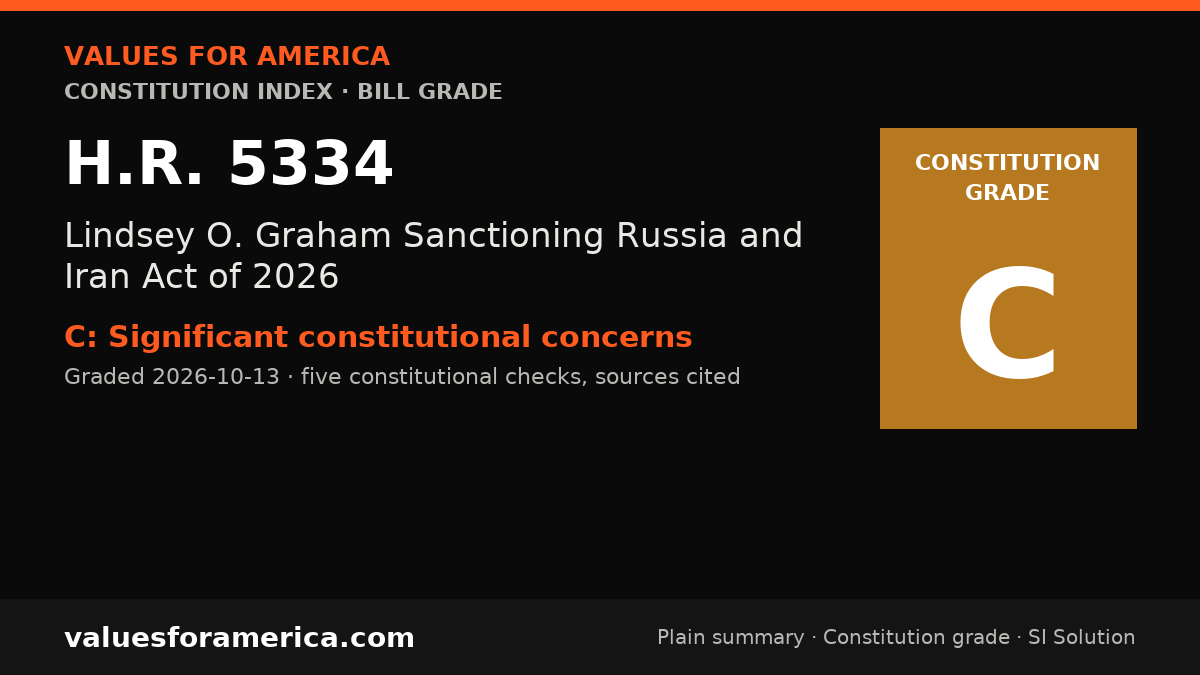
Lindsey O. Graham Sanctioning Russia and Iran Act of 2026
Cosponsors: 23 (18 D, 5 R) · per Congress.gov, 2026-10-14
Introduced: 2025-09-11
Latest action (2026-09-18): Became Public Law No: 119-111.
What H.R. 5334 does, in plain terms
Lindsey O. Graham Sanctioning Russia and Iran Act of 2026 This bill imposes a variety of sanctions, tariffs, and prohibitions related to Russia, extends an Iran-related sanctions law, and expands a tax deduction for teacher expenses to include early childhood educators. For example, under the bill, the President must impose visa- and property-blocking sanctions on specified persons (individuals and entities) such as the Russian president and certain Russian military commanders. The President must also increase the rate of duty up to 100% ad valorem (i.e., relative to the value) on all goods imported into the United States from a country that was among the five largest importers of Russian-origin crude oil or natural gas if such country knowingly makes new purchases of such products after enactment of the bill. The bill prohibits (1) the export, reexport, or in-country transfer to or in Russia of any U.S.-produced energy or energy product; (2) U.S. persons from making new investments in Russia or purchasing Russian sovereign debt; and (3) trading the securities of Russian government-owned, -controlled, or -affiliated entities on U.S. national securities exchanges. The bill extends through 2031 the Iran Sanctions Act of 1996, which requires the President, with some exceptions, to impose sanctions on certain persons engaged in specified transactions related to Iran's energy sector or Iran's efforts to acquire or develop certain weapons. The bill expands eligibility for federal tax deductions of certain educator expenses to early childhood educators providing educational or childcare services to those under age 6.
Official summary by the Congressional Research Service, via Congress.gov.
Constitution Index
“VFA Constitution grade”
Significant constitutional concerns
Graded 2026-10-13
SI-generated grade · five published checks · not individually reviewed by a person · methodology
HR 5334 raises significant constitutional concerns primarily in the areas of enumerated powers and decentralization. While the federal government has broad authority over foreign commerce and sanctions under Article I, Section 8, Clauses 3 and 10, the bill's imposition of tariffs up to 100% ad valorem and sweeping prohibitions on energy exports and investments may exceed the scope of Congress's enumerated powers by effectively regulating global economic activity beyond U.S. borders without clear constitutional grounding. The bill does not directly infringe the Bill of Rights or individual sovereignty, but its consolidation of economic decision-making at the federal level—including tariffs that affect state and local economies—fails the decentralization test by bypassing state and local capacity to manage trade relations. The due process and takings concerns are minor, as the sanctions target foreign entities and do not clearly take U.S. property without compensation. Overall, the bill is structurally problematic and requires a rewrite to align with constitutional limits on federal power.
-
✗ Concern · Enumerated powers
Congress has authority under Article I, Section 8, Clause 3 (Commerce Clause) and Clause 10 (Foreign Commerce) to regulate international trade and impose sanctions. However, the bill's provision to increase tariffs up to 100% ad valorem on goods from countries importing Russian oil or gas—targeting third-party nations not directly involved in the conflict—stretches the Commerce Clause beyond its t… -
✓ Passes · Bill of Rights
The bill does not directly infringe any of the first ten amendments. It imposes sanctions on foreign persons and entities, not on U.S. citizens' speech, religion, assembly, press, petition, or arms. The prohibition on U.S. persons making new investments in Russia or purchasing Russian sovereign debt restricts economic activity but does not implicate core First Amendment rights. The Fourth Amendmen… -
✓ Passes · Individual sovereignty
The bill restricts U.S. persons from making new investments in Russia, purchasing Russian sovereign debt, and trading securities of Russian state-owned entities on U.S. exchanges. These restrictions limit individual economic freedom, but the government has a compelling constitutional justification under the foreign commerce power and national security interests. The burden is on the government, an… -
✗ Concern · Decentralization
Applying the four-question test: (1) An individual or family cannot handle imposing sanctions on Russia or Iran—this requires national-level coordination. (2) A local community or county cannot handle international sanctions—this is beyond local capacity. (3) A state could theoretically impose its own sanctions, but the Constitution reserves foreign affairs to the federal government under Article … -
✓ Passes · Due process and takings
The bill imposes sanctions on specified persons (e.g., Russian president, military commanders) and entities, but these are foreign nationals and entities not entitled to Fifth Amendment due process protections under U.S. law. The property-blocking sanctions may affect U.S. persons indirectly, but the bill does not authorize seizure of U.S. property without compensation. The tariff provision increa…
Sources: Congress.gov: HR 5334 summary
Report an error in this grade
The Framers
“Founders’ Verdict”
Confidence 1.00
Archived SI output (machine-generated)No editorial review recorded. This historical SI verdict was machine-generated by software and predates the review desk; check it against the official bill text.
Synthesis
All four founders agree that the bill is a constitutional exercise of Congress's power to lay and collect taxes under Article I, Section 8, Clause 1. The expansion of the educator expense deduction to early childhood educators is a permissible modification of the tax code, within the discretion to define taxable income and provide incentives. It does not infringe on state powers or individual liberties, and is consistent with the enumerated powers and the general welfare.
This bill is a valid exercise of Congress's power to lay and collect taxes under Article I, Section 8, Clause 1. The expansion of an above-the-line tax deduction to early childhood educators is a permissible modification of the tax code, as it directly relates to the federal government's authority to define taxable income and provide incentives for certain behavior. The power to tax includes the power to exempt or deduct, as a means of encouraging particular activities—here, supporting early childhood educators. There is no encroachment on state powers, as the deduction does not regulate educa…
This bill is a simple exercise of the federal taxing power, which is expressly granted to Congress. The deduction for educator expenses is a permissible adjustment to gross income, and extending it to early childhood educators does not exceed the enumerated powers of the national legislature. It neither compels state action nor intrudes upon the reserved rights of the states; it merely adjusts the federal tax burden. As I have long maintained, the power to tax is indispensable to the federal government, and within that power, Congress may define taxable income and deductions as it sees fit, pr…
The bill operates exclusively within the federal taxing power, which is expressly delegated to Congress by the Constitution. The power to lay and collect taxes includes the discretion to define taxable income and to allow deductions that promote public policy objectives, such as supporting early childhood education. This is a permissible exercise of the spending and taxing authority, as it does not commandeer state governments or regulate non-tax matters beyond the federal sphere. The deduction is a modest, uniform provision that applies to all qualifying educators, and it does not violate pri…
This bill, by expanding an existing tax deduction for educator expenses to include early childhood educators, is a valid exercise of Congress's power to lay and collect taxes for the general welfare. The Constitution grants Congress broad discretion in defining the objects and conditions of taxation, and the deduction here is a permissible means of encouraging and supporting education, which serves the public good. The Necessary and Proper Clause, as interpreted in McCulloch v. Maryland, allows Congress to choose among appropriate means to execute its enumerated powers, and a tax deduction for…
Report an error in this Founders' Verdict
What should pass
“VFA SI Solution”
No solution yet
A sourced SI draft appears here once it passes automated checks (Constitution citation, source verification, independent SI critic). How publication works.
Related on VFA

For journalists and bloggers
“Embed this grade”
Free to use with the link back. The badge and card update when the grade changes. Embed terms →
