H.R. 530 explained · 119th Congress · Pending in Congress
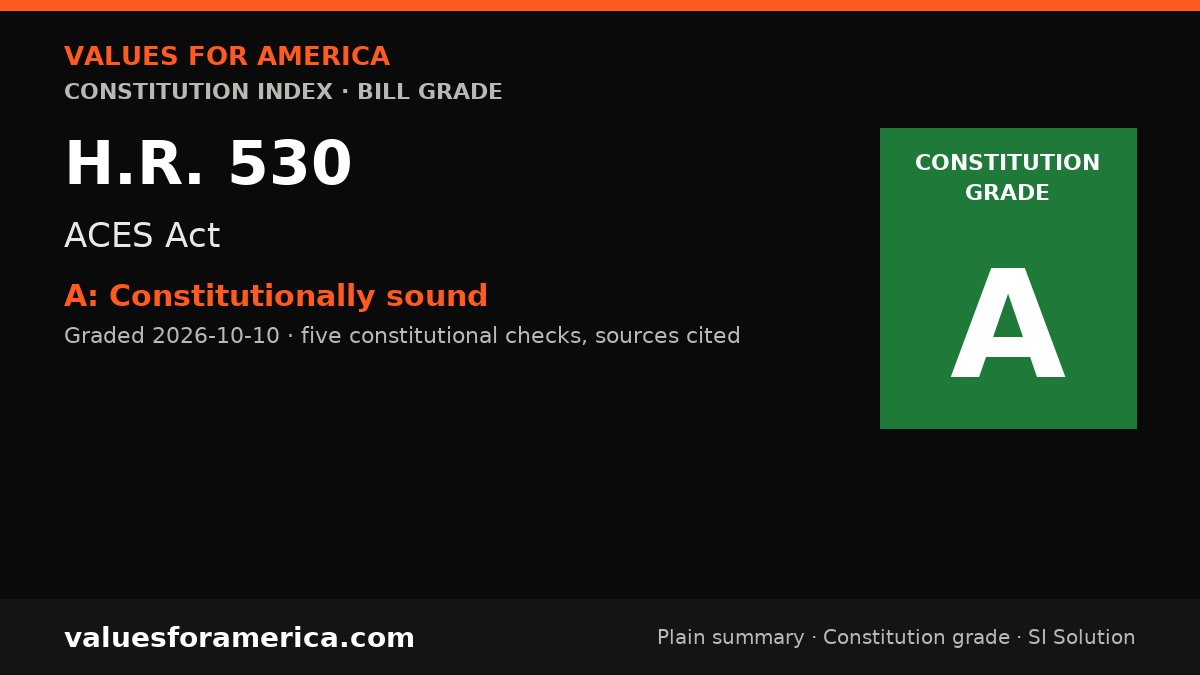
ACES Act
Cosponsors: 35 (16 D, 19 R) · per Congress.gov, 2026-10-11
Introduced: 2025-01-16
Latest action (2025-05-06): Received in the Senate and Read twice and referred to the Committee on Veterans' Affairs.
What H.R. 530 does, in plain terms
ACES Act This bill requires the Department of Veterans Affairs to enter into an agreement with the National Academies of Sciences, Engineering, and Medicine to study and report on the prevalence and mortality of cancers among veterans who served on active duty as aircrew members and regularly flew in fixed-wing aircraft.
Official summary by the Congressional Research Service, via Congress.gov.
Constitution Index
“VFA Constitution grade”
Constitutionally sound
Graded 2026-10-10
SI-generated grade · five published checks · not individually reviewed by a person · methodology
The ACES Act is a narrowly tailored federal action within Congress's enumerated powers to provide for the common defense and to legislate for the welfare of veterans. It mandates a study and report, which does not infringe on any constitutional rights, respects individual sovereignty, and appropriately delegates the study to a federal agency without consolidating decision-making beyond the necessary level. The bill fully complies with the Constitution.
-
✓ Passes · Enumerated powers
Congress has the power to raise and support armies and to provide and maintain a Navy under Article I, Section 8, Clauses 12 and 13. Additionally, the power to legislate for the welfare of veterans is implied by these powers and has been consistently upheld. Requiring the Department of Veterans Affairs to commission a study on cancer prevalence among aircrew veterans is a direct exercise of this a… -
✓ Passes · Bill of Rights
The bill imposes no restriction on speech, religion, assembly, press, petition, arms, quartering, search and seizure, self-incrimination, due process, takings, trial by jury, or cruel and unusual punishment. It merely mandates a study and report, which does not implicate any provision of the Bill of Rights. -
✓ Passes · Individual sovereignty
The bill does not restrict any individual's control over their person, property, speech, labor, or belief. It imposes no obligations on private citizens; it only directs a federal agency to commission a study. There is no burden on individual freedom, and no compelling justification is needed because no restriction exists. -
✓ Passes · Decentralization
The study of cancer prevalence among veterans is a matter of national scope, as veterans serve across all states and the federal government has exclusive jurisdiction over military service. An individual, local community, or state could not effectively conduct this study because the data is held by the federal government and the subject is inherently federal. The action does not consolidate decisi… -
✓ Passes · Due process and takings
The bill does not deprive any person of life, liberty, or property, nor does it take private property for public use. It does not bypass any procedural or substantive due process requirements. The action is purely informational and does not affect any individual's legal rights.
Sources: Congress.gov: HR 530 summary
Report an error in this grade
What should pass
“VFA SI Solution”
No solution yet
A sourced SI draft appears here once it passes automated checks (Constitution citation, source verification, independent SI critic). How publication works.
Related on VFA

For journalists and bloggers
“Embed this grade”
Free to use with the link back. The badge and card update when the grade changes. Embed terms →
