H.R. 5284 explained · 119th Congress · Pending in Congress
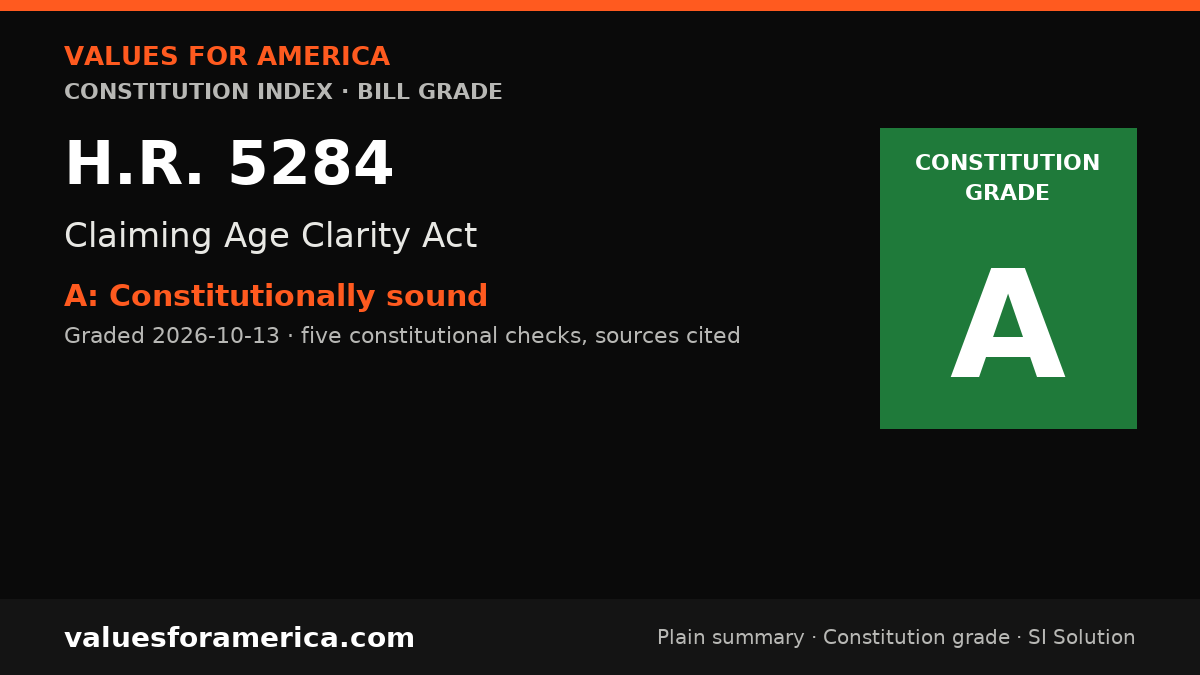
Claiming Age Clarity Act
Cosponsors: 9 (3 D, 6 R) · per Congress.gov, 2026-10-14
Introduced: 2025-09-10
Latest action (2026-10-14): Message on Senate action sent to the House.
What H.R. 5284 does, in plain terms
Claiming Age Clarity Act This bill changes certain terms that are used by the Social Security Administration (SSA) to describe the ages at which a worker may claim Social Security retirement benefits. First, the SSA must use minimum monthly benefit age instead of early eligibility age. This refers to the earliest age (62 under current law) at which a worker may claim benefits. (Currently, the benefit amount of a worker who claims benefits early is reduced to account for the longer period during which the worker is expected to receive benefits.) Second, the SSA must use standard monthly benefit age instead of full retirement age and normal retirement age. These terms refer to the age at which a worker may claim benefits without a reduction in the benefit amount. (Currently, this age ranges from 65 to 67, depending on the worker's year of birth.) Finally, the SSA must use the term maximum monthly benefit age for any reference to age 70 as the maximum age at which a worker may receive delayed retirement credits. The SSA may not use the term delayed retirement credit. These terms refer to the mechanism that increases the benefit amount of a worker who delays claiming benefits after reaching the full retirement age. (Currently, a worker receives a credit for each month between the full retirement age and age 70 that the worker delays claiming benefits. Each credit increases the benefit amount that the worker will receive after claiming benefits by a specified percentage.)
Official summary by the Congressional Research Service, via Congress.gov.
Constitution Index
“VFA Constitution grade”
Constitutionally sound
Graded 2026-10-13
SI-generated grade · five published checks · not individually reviewed by a person · methodology
This bill is purely a terminology change for Social Security Administration communications. It does not alter any substantive rights, benefits, or eligibility criteria. It is a routine exercise of Congress's spending power and does not infringe on any constitutional rights or principles of federalism.
-
✓ Passes · Enumerated powers
Congress has the power to spend for the general welfare and to make all laws necessary and proper for executing that power (Article I, Section 8, Clause 1 and Clause 18). The Social Security system is a federal program, and this bill merely adjusts the terminology used by the Social Security Administration. This is squarely within Congress's enumerated powers. -
✓ Passes · Bill of Rights
The bill does not affect speech, religion, assembly, press, petition, the right to bear arms, quartering of soldiers, search and seizure, self-incrimination, due process, takings, trial rights, jury rights, cruel and unusual punishment, unenumerated rights, or reserved powers. It is a purely administrative terminology change with no impact on any of the first ten amendments. -
✓ Passes · Individual sovereignty
The bill does not restrict any individual's freedom of action, property, speech, labor, or belief. It only changes the labels used by the Social Security Administration to describe existing benefit claiming ages. No individual's rights are burdened or restricted. -
✓ Passes · Decentralization
The Social Security system is a federal program, and the terminology used by the Social Security Administration is inherently a federal matter. The bill does not consolidate any new decision-making authority; it merely updates the language used in an existing federal program. The four-question test is not implicated because the action is purely administrative and does not shift authority from indi… -
✓ Passes · Due process and takings
The bill does not affect any procedural or substantive due process rights, nor does it take any property. It does not alter the calculation of benefits or the ages at which they can be claimed; it only changes the terms used to describe those ages. There is no deprivation of life, liberty, or property, and no just compensation issue arises.
Sources: Congress.gov: HR 5284 summary
Report an error in this grade
The Framers
“Founders’ Verdict”
Confidence 0.75
SI-generated · automated checksSI-generated · passed automated checks (Constitution citation, source verification, independent SI critic) · not individually reviewed by a person · Report an error: hello@valuesforamerica.com
Synthesis
Article I, Section 8, Clause 1 together with the Necessary and Proper Clause in Clause 18 authorizes Congress to prescribe uniform administrative terms for federal retirement benefits. The official summary states the measure directs federal officers in describing ages for claiming retirement benefits, changing terminology for minimum, standard, and maximum monthly benefits without altering eligibility or amounts. Uniform language is plainly adapted to orderly execution of a lawfully established federal administration. Conservatives gain limited government held to administration rather than expansion, with no new power, spending, or mandate on the states; progressives gain clear public notice that helps citizens understand benefit timing. The strongest objection is that gentle renaming cannot cure want of authority over retirement itself, reserved by the Tenth Amendment. That objection fails here because this verdict judges only the administrative means described, not the underlying program, and Congress may speak plainly and uniformly where it lawfully administers.
The measure merely prescribes the language by which officers of the general government shall describe ages for claiming retirement benefits under laws already enacted. The power to provide for the general welfare and to lay and collect revenues for that purpose plainly embraces the administration of such provision, as explained in Federalist No. 30 and Federalist No. 33. The Necessary and Proper Clause authorizes Congress to direct the means and forms by which its officers execute federal law, and precision of terms is a proper means to render execution uniform and intelligible. No legislative…
This measure directs the department administering federal retirement benefits to employ new names for the ages of sixty-two, sixty-five to sixty-seven, and seventy, and for credits for delayed claims. The names themselves lay no tax and inflict no direct penalty, yet they sustain and adorn a federal establishment for the support of individuals in old age. The powers granted to the legislature in Article I, Section 8 contain no grant of a general care of subsistence, labour, or retirement. What is not granted is retained, for the Tenth Amendment reserves to the states and to the people all powe…
As author of Federalist No. 44, I hold that where a power is entrusted to the general government, means plainly adapted to its execution follow by implication. The administration of retirement benefits, once lawfully established, requires intelligible rules for notice and operation. This measure alters only terms used by the Social Security Administration to describe ages for minimum, standard, and maximum monthly benefits, leaving benefit amounts and eligibility ages untouched by its official summary. It enlarges no jurisdiction and creates no new obligation upon the States. Per Federalist No…
The Act is constitutional. Congress, entrusted with provision for the general welfare under Article I, Section 8, Clause 1, may establish offices and programs to execute that trust. Under McCulloch v. Maryland (1819), where the end be legitimate and within the scope of the Constitution, all means which are appropriate and plainly adapted to that end are constitutional under the Necessary and Proper Clause, Article I, Section 8, Clause 18. Prescribing uniform terms of minimum monthly benefit age, standard monthly benefit age, and maximum monthly benefit age for administration of federal benefit…
Report an error in this Founders' Verdict
What should pass
“VFA SI Solution”
No solution yet
A sourced SI draft appears here once it passes automated checks (Constitution citation, source verification, independent SI critic). How publication works.
Related on VFA

For journalists and bloggers
“Embed this grade”
Free to use with the link back. The badge and card update when the grade changes. Embed terms →
