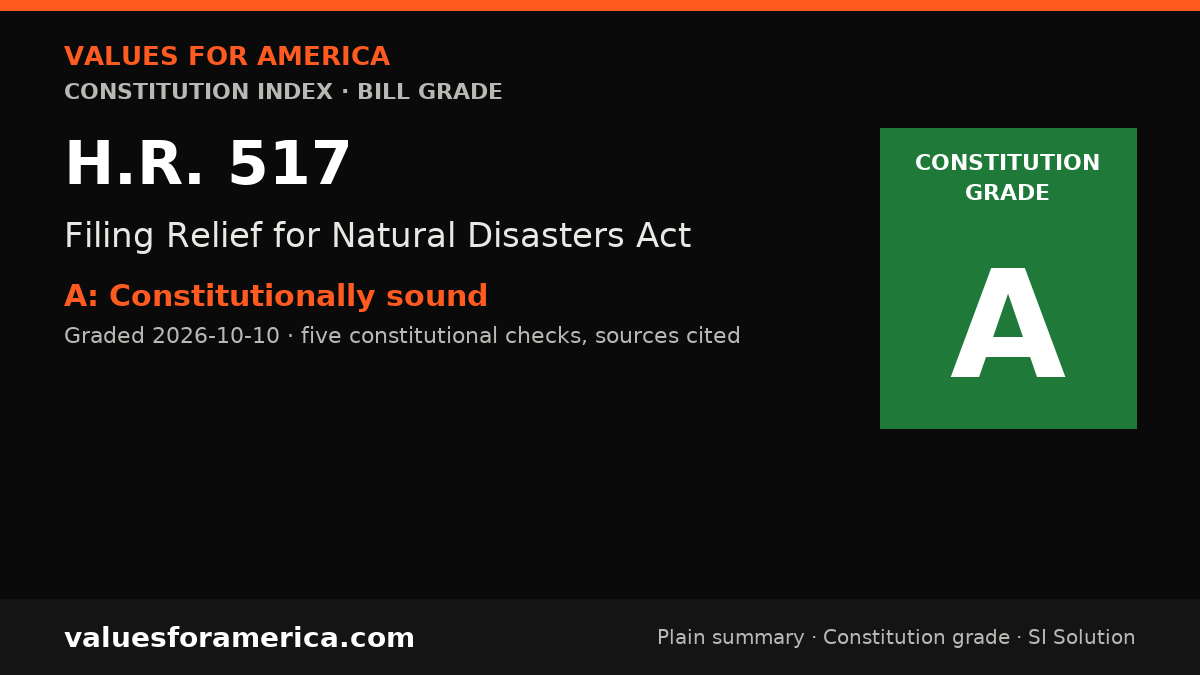
H.R. 517 explained · 119th Congress · Became law
Filing Relief for Natural Disasters Act
Cosponsors: 1 (1 D, 0 R) · per Congress.gov, 2026-10-11
Introduced: 2025-01-16
Latest action (2025-07-24): Became Public Law No: 119-29.
What H.R. 517 does, in plain terms
Filing Relief for Natural Disasters Act This act authorizes the Internal Revenue Service (IRS) to postpone federal tax deadlines for taxpayers affected by a qualified state declared disaster, upon written request by the state governor. The act also increases the automatic extension of federal tax deadlines for certain taxpayers. Under current law, the IRS may postpone federal tax deadlines for taxpayers affected by a federally declared disaster, including (but not limited to) deadlines for (1) filing federal tax returns, (2) paying federal taxes, (3) making retirement plan contributions, and (4) tax assessments and collections. The act authorizes the IRS to postpone such federal tax deadlines for taxpayers affected by a qualified state declared disaster upon written request by the state’s governor (or the District of Columbia mayor). Under the act, a state includes the District of Columbia, Puerto Rico, the U.S. Virgin Islands, Guam, American Samoa, and the Northern Mariana Islands. The act defines qualified state declared disaster as any natural catastrophe, fire, flood, or explosion that causes damage of sufficient severity and magnitude to warrant a request to postpone such federal tax deadlines. Further, under current law, an automatic extension of such federal tax deadlines applies to certain relief workers, individuals killed or injured as a result of a federally declared disaster, and taxpayers whose principal residence, business, or tax records are located in a federally declared disaster area. The act increases the automatic extension of federal tax deadlines for these taxpayers to 120 days (from 60 days).
Official summary by the Congressional Research Service, via Congress.gov.
Constitution Index
“VFA Constitution grade”
Constitutionally sound
Graded 2026-10-10
SI-generated grade · five published checks · not individually reviewed by a person · methodology
The Filing Relief for Natural Disasters Act is a constitutionally sound exercise of federal taxing power. It authorizes the IRS to postpone federal tax deadlines for disaster-affected taxpayers, a measure squarely within Congress's enumerated power to lay and collect taxes under Article I, Section 8, Clause 1. The law does not infringe on any constitutional right, respects state sovereignty by requiring a governor's request, and does not take property without due process. It is a modest, procedural relief measure that passes all constitutional checks.
-
✓ Passes · Enumerated powers
Congress has the explicit power to lay and collect taxes under Article I, Section 8, Clause 1. This act directly concerns the administration of federal tax deadlines, which is an integral part of the federal taxing power. The IRS's authority to postpone deadlines is a reasonable exercise of that power, and the act does not exceed the scope of Congress's enumerated authority. -
✓ Passes · Bill of Rights
The act does not infringe on any of the first ten amendments. It imposes no restrictions on speech, religion, assembly, press, petition, arms, quartering, search and seizure, self-incrimination, due process, trial rights, or cruel and unusual punishment. It is purely a relief measure that grants extensions, not a restriction on rights. -
✓ Passes · Individual sovereignty
The act does not restrict individual liberty; rather, it expands the ability of individuals to comply with tax obligations during disasters. It provides relief from deadlines, which is a benefit, not a burden. The burden of proof for any restriction is not triggered because there is no restriction. -
✓ Passes · Decentralization
The act respects federalism by requiring a state governor's written request before the IRS may postpone deadlines for a state-declared disaster. This ensures that the federal government does not act unilaterally in a state's internal affairs. The decision to request relief remains at the state level, and the federal action is limited to tax administration, which is inherently federal. The act does… -
✓ Passes · Due process and takings
The act does not deprive anyone of property or liberty without due process. It does not take property; it only postpones tax deadlines. The extension of deadlines is a procedural benefit that enhances due process by giving taxpayers more time to comply. There is no arbitrary government action; the act provides clear criteria for qualified state declared disasters and requires a governor's request.
Sources: Congress.gov: HR 517 summary
Report an error in this grade
What should pass
“VFA SI Solution”
No solution yet
A sourced SI draft appears here once it passes automated checks (Constitution citation, source verification, independent SI critic). How publication works.
Related on VFA

For journalists and bloggers
“Embed this grade”
Free to use with the link back. The badge and card update when the grade changes. Embed terms →
