H.R. 5143 explained · 119th Congress · Pending in Congress
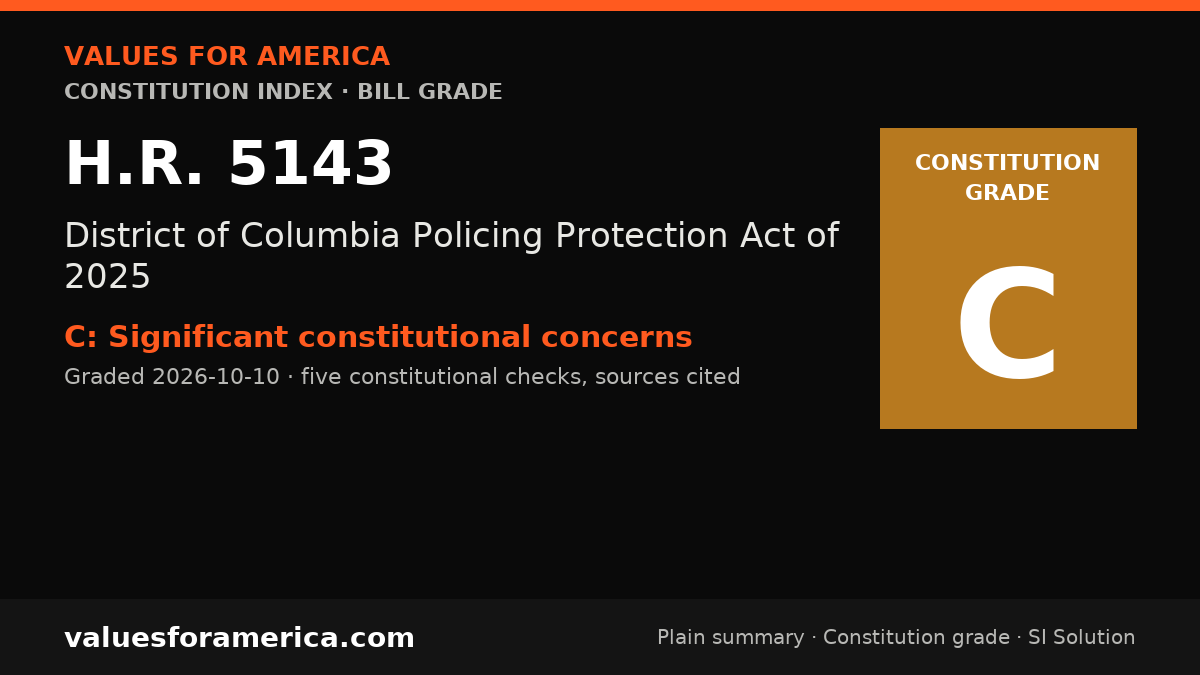
District of Columbia Policing Protection Act of 2025
Cosponsors: 2 (0 D, 2 R) · per Congress.gov, 2026-10-10
Introduced: 2025-09-04
Latest action (2025-09-18): Received in the Senate.
What H.R. 5143 does, in plain terms
District of Columbia Policing Protection Act This bill repeals restrictions on the circumstances under which law enforcement officers in the District of Columbia (DC) may engage in vehicular pursuits (i.e., police chases) of suspects fleeing in motor vehicles, and instead generally requires such pursuits in the absence of other means of apprehension. Currently, pursuant to DC's Comprehensive Policing and Justice Reform Amendment Act of 2022, law enforcement officers generally may not engage in vehicular pursuits of suspects fleeing in motor vehicles unless the officer reasonably believes (1) the suspect was involved in a crime of violence or poses an immediate and serious threat to another person, (2) the pursuit is necessary to prevent that threat and is not likely to result in death or serious injury to any person, and (3) all other options have been exhausted or are unreasonable given the circumstances. The bill repeals these restrictions and instead requires law enforcement officers to engage in vehicular pursuits of suspects fleeing in motor vehicles unless the officer or a higher-ranking officer reasonably believes that (1) such pursuit would be futile, (2) the pursuit would entail an unacceptable risk of harm to a person other than the suspect, or (3) the suspect can be apprehended more effectively or expeditiously by other means. The bill also requires the Department of Justice to report to Congress on the costs and benefits of DC’s Metropolitan Police Department adopting technology that alerts the public of an active police pursuit in their immediate vicinity.
Official summary by the Congressional Research Service, via Congress.gov.
Constitution Index
“VFA Constitution grade”
Significant constitutional concerns
Graded 2026-10-10
SI-generated grade · five published checks · not individually reviewed by a person · methodology
The bill raises significant constitutional concerns by overriding the District of Columbia's local legislative authority over its own policing policies, thereby undermining the principle of local self-governance and the Tenth Amendment's reservation of powers to the states and the people. While the federal government has plenary authority over the District under Article I, Section 8, Clause 17, this action consolidates decision-making at the federal level in a manner that is inconsistent with the constitutional preference for local control. Additionally, the bill's mandate for vehicular pursuits may increase risks to public safety and individual rights, but it does not directly infringe upon specific Bill of Rights protections. The bill's reporting requirement on technology is a minor federal oversight function.
-
✓ Passes · Enumerated powers
The federal government has plenary authority over the District of Columbia under Article I, Section 8, Clause 17, which grants Congress exclusive legislative power over the seat of government. Therefore, Congress has the enumerated power to legislate on policing matters in the District. -
✓ Passes · Bill of Rights
The bill does not directly infringe upon any of the first ten amendments. It does not restrict speech, religion, assembly, press, petition, arms, quartering, search and seizure, self-incrimination, due process, fair trial, jury, cruel and unusual punishment, or unenumerated rights. However, the mandate for vehicular pursuits could indirectly increase risks to life and liberty, but this is not a di… -
✗ Concern · Individual sovereignty
The bill restricts the ability of local communities to determine their own policing policies, which affects the collective sovereignty of the people of the District of Columbia. It imposes a federal mandate that may increase the risk of harm to individuals during police pursuits, potentially infringing on their right to personal safety and security. The government has not provided a compelling con… -
✗ Concern · Decentralization
The bill fails the decentralization test because it consolidates decision-making at the federal level over a matter that is inherently local. The District of Columbia's local government had already enacted its own comprehensive policing reform, and the federal government is overriding that local decision. This violates the principle of subsidiarity and the Tenth Amendment's reservation of powers t… -
✓ Passes · Due process and takings
The bill does not bypass due process or take property without just compensation. It does not affect procedural or substantive due process rights, nor does it involve the taking of private property. The reporting requirement on technology is a standard federal oversight function and does not implicate due process concerns.
Sources: Congress.gov: HR 5143 summary
Report an error in this grade
What should pass
“VFA SI Solution”
No solution yet
A sourced SI draft appears here once it passes automated checks (Constitution citation, source verification, independent SI critic). How publication works.
Related on VFA

For journalists and bloggers
“Embed this grade”
Free to use with the link back. The badge and card update when the grade changes. Embed terms →
