H.R. 5140 explained · 119th Congress · Pending in Congress
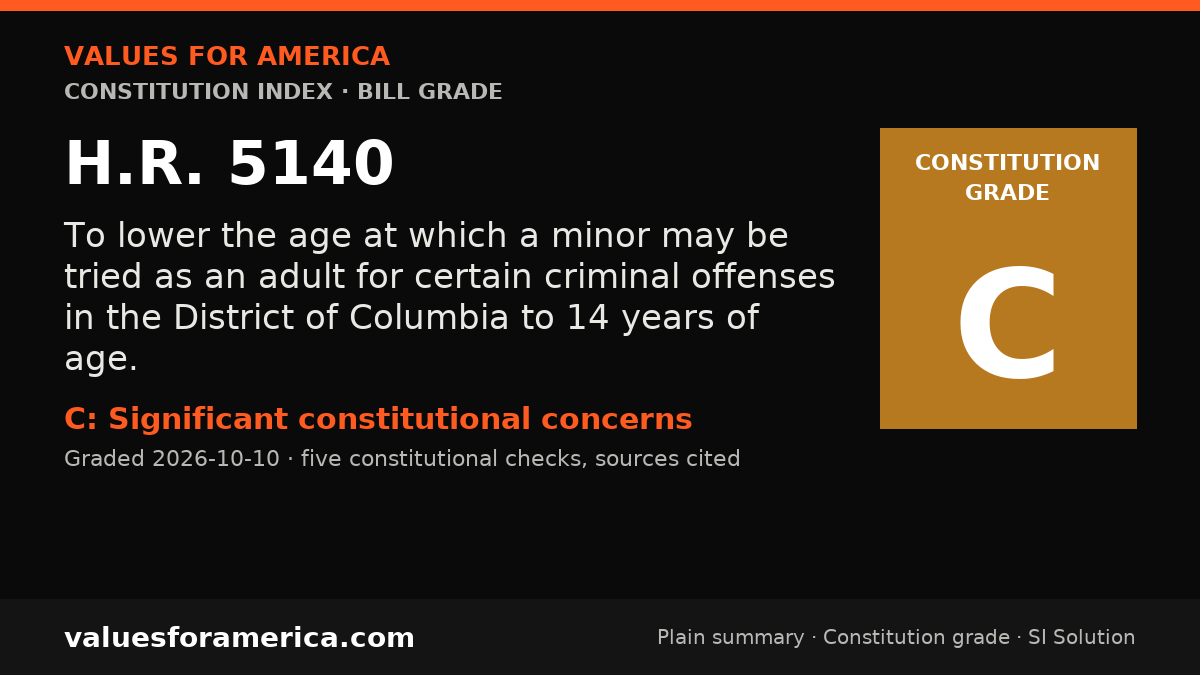
To lower the age at which a minor may be tried as an adult for certain criminal offenses in the District of Columbia to 14 years of age.
Cosponsors: 6 (0 D, 6 R) · per Congress.gov, 2026-10-10
Introduced: 2025-09-04
Latest action (2025-09-17): Received in the Senate.
What H.R. 5140 does, in plain terms
This bill lowers the age at which an individual may be tried as an adult for certain criminal offenses in the District of Columbia (DC) to 14 years of age. Under current DC law, an individual who is under 18 years of age is tried as a juvenile in family court. However, an individual who is 16 years of age or older may be tried as an adult if the individual is charged with murder, first-degree sexual abuse, burglary in the first degree, robbery while armed, or assault with intent to commit any such offense. Additionally, an individual who is 15 years of age or older may be tried as an adult if the individual is alleged to have committed a felony and it is determined that (1) it is in the interest of the public welfare to try the individual as an adult, and (2) there are no reasonable prospects for the individual's rehabilitation. The bill lowers the minimum age to be tried as an adult in these cases to 14 years of age.
Official summary by the Congressional Research Service, via Congress.gov.
Constitution Index
“VFA Constitution grade”
Significant constitutional concerns
Graded 2026-10-10
SI-generated grade · five published checks · not individually reviewed by a person · methodology
This bill raises significant constitutional concerns, particularly regarding due process, individual sovereignty, and the proper scope of federal power over the District of Columbia. While Congress has plenary authority over DC under Article I, Section 8, Clause 17, the bill's lowering of the adult trial age to 14 without adequate procedural safeguards or consideration of developmental differences creates serious tensions with the Fifth Amendment's Due Process Clause and the Eighth Amendment's prohibition on cruel and unusual punishment. The bill also fails the decentralization test by consolidating decision-making at the federal level when local DC authorities could handle juvenile justice policy. A structural rewrite is needed to ensure due process protections and proportionality.
-
✓ Passes · Enumerated powers
Congress has explicit constitutional authority to legislate for the District of Columbia under Article I, Section 8, Clause 17, which grants Congress 'exclusive Legislation in all Cases whatsoever, over such District.' This plenary power includes setting criminal justice and juvenile justice policies for DC. The bill is within this enumerated power. -
✗ Concern · Bill of Rights
The bill raises serious concerns under the Eighth Amendment's prohibition on cruel and unusual punishment, as the Supreme Court has recognized that children are constitutionally different from adults for sentencing purposes (Roper v. Simmons, 2005; Miller v. Alabama, 2012). Lowering the adult trial age to 14 without individualized consideration of a minor's maturity, culpability, and capacity for … -
✗ Concern · Individual sovereignty
The bill restricts the liberty and future of minors as young as 14 by subjecting them to adult criminal proceedings, which carry far harsher penalties and long-term consequences. The government bears a heavy burden to justify such a restriction, especially given the well-established scientific consensus that adolescent brains are not fully developed in areas of impulse control and decision-making.… -
✗ Concern · Decentralization
The bill fails the decentralization test. While the District of Columbia is a federal enclave, the question of juvenile justice policy—including the age of adult prosecution—is one that could be handled by local DC authorities (the DC Council and local courts) without federal intervention. The bill consolidates decision-making at the federal level when local governance is more appropriate and resp… -
✗ Concern · Due process and takings
The bill raises due process concerns under the Fifth Amendment. Transferring a 14-year-old to adult court without a robust, individualized hearing that considers the minor's age, maturity, mental health, prior record, and prospects for rehabilitation may violate procedural due process. The Supreme Court has held that juvenile transfer decisions must include meaningful consideration of the minor's …
Sources: Congress.gov: HR 5140 summary
Report an error in this grade
What should pass
“VFA SI Solution”
No solution yet
A sourced SI draft appears here once it passes automated checks (Constitution citation, source verification, independent SI critic). How publication works.
Related on VFA

For journalists and bloggers
“Embed this grade”
Free to use with the link back. The badge and card update when the grade changes. Embed terms →
