H.R. 5125 explained · 119th Congress · Pending in Congress
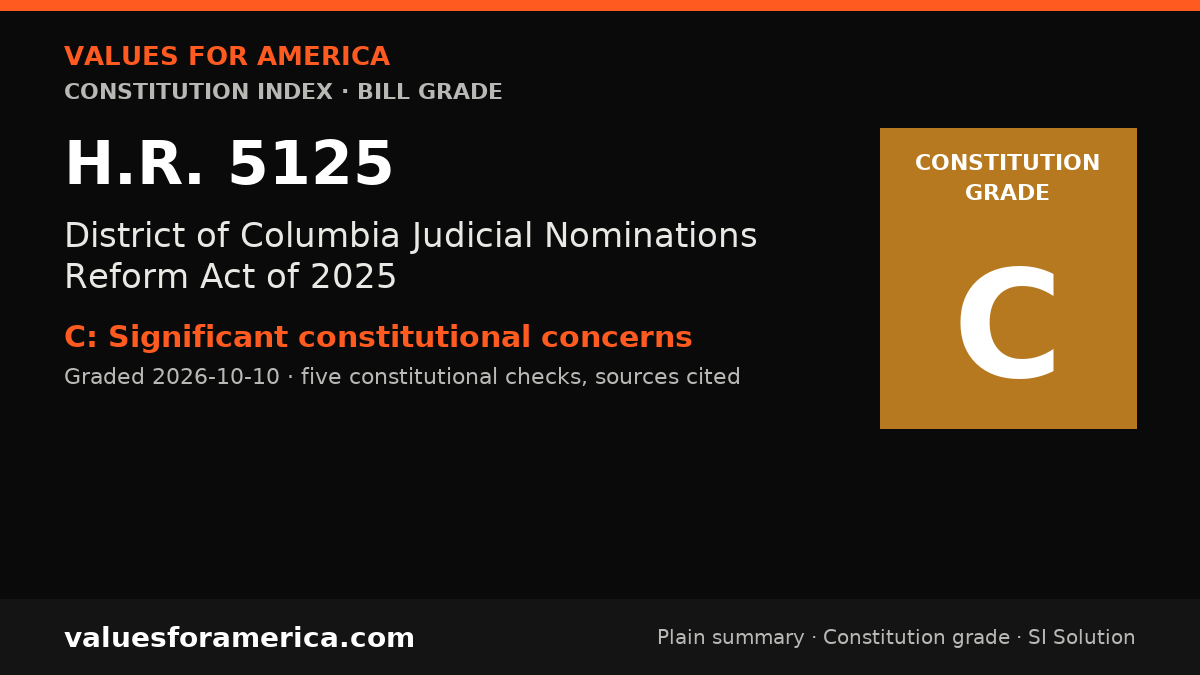
District of Columbia Judicial Nominations Reform Act of 2025
Cosponsors: 2 (0 D, 2 R) · per Congress.gov, 2026-10-10
Introduced: 2025-09-04
Latest action (2025-09-18): Received in the Senate.
What H.R. 5125 does, in plain terms
District of Columbia Judicial Nominations Reform Act This bill terminates the District of Columbia (DC) Judicial Nomination Commission. Currently, the commission recommends to the President nominees for judges for DC's Superior Court and Court of Appeals, who must then be confirmed by the Senate. The commission also appoints the chief judges for these courts. The bill terminates the commission's involvement in nominations and requires the President to appoint the chief judges.
Official summary by the Congressional Research Service, via Congress.gov.
Constitution Index
“VFA Constitution grade”
Significant constitutional concerns
Graded 2026-10-10
SI-generated grade · five published checks · not individually reviewed by a person · methodology
The bill raises significant constitutional concerns by altering the District of Columbia's judicial nomination process in a way that consolidates power in the President and removes a local check on judicial appointments. While Congress has broad authority over the District under Article I, Section 8, Clause 17, the bill's centralization of appointment power and elimination of a local commission undermines principles of decentralization and local self-governance, though it does not directly violate a specific constitutional provision.
-
✓ Passes · Enumerated powers
Congress has plenary authority over the District of Columbia under Article I, Section 8, Clause 17, which grants Congress exclusive legislative power over the seat of government. This includes the authority to structure the District's judiciary. The bill falls within this enumerated power. -
✓ Passes · Bill of Rights
The bill does not infringe on any rights protected by the Bill of Rights. It concerns the process for appointing judges, not the rights of individuals. No amendment is implicated. -
✓ Passes · Individual sovereignty
The bill does not restrict individual liberty, property, speech, labor, or belief. It only changes the appointment mechanism for judges. Individuals' rights are not directly affected. -
✗ Concern · Decentralization
The bill fails the decentralization test. While the District of Columbia is a federal entity, the bill consolidates judicial appointment power in the President, removing a local commission's role. This centralizes decision-making at the federal level, contrary to the principle of local control. The questions: (1) individuals cannot handle judicial appointments, (2) the local community (DC) could h… -
✓ Passes · Due process and takings
The bill does not implicate due process or takings. It does not deprive any person of life, liberty, or property without due process, nor does it take private property for public use without just compensation. The Fifth Amendment is not violated.
Sources: Congress.gov: HR 5125 summary
Report an error in this grade
What should pass
“VFA SI Solution”
No solution yet
A sourced SI draft appears here once it passes automated checks (Constitution citation, source verification, independent SI critic). How publication works.
Related on VFA

For journalists and bloggers
“Embed this grade”
Free to use with the link back. The badge and card update when the grade changes. Embed terms →
