H.R. 5107 explained · 119th Congress · Pending in Congress
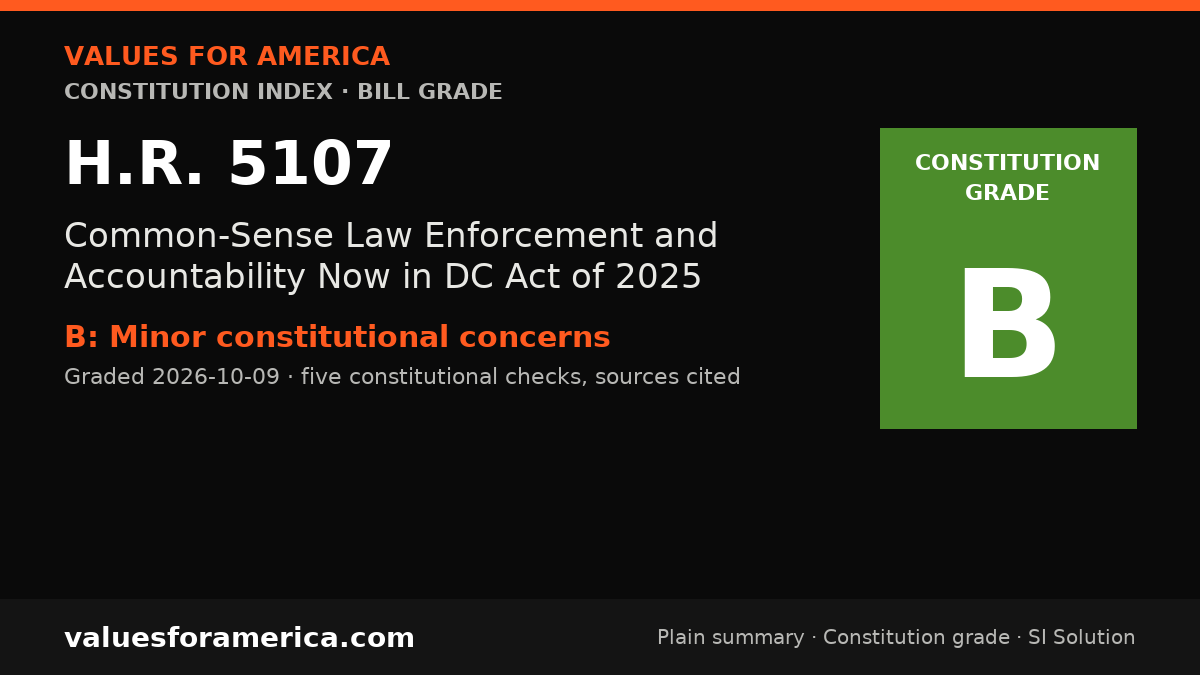
Common-Sense Law Enforcement and Accountability Now in DC Act of 2025
Cosponsors: 29 (1 D, 28 R) · per Congress.gov, 2026-10-10
Introduced: 2025-09-03
Latest action (2025-11-20): Received in the Senate.
What H.R. 5107 does, in plain terms
Common-Sense Law Enforcement and Accountability Now in DC Act or the CLEAN DC Act This bill repeals the Comprehensive Policing and Justice Reform Amendment Act of 2022, enacted by the Council of the District of Columbia. Any provision of law amended or repealed by that act is restored or revived as if it had not been enacted. (The act sets forth a variety of measures that focus on policing, including measures prohibiting the use of certain neck restraints by law enforcement officers, requiring additional procedures related to body-worn cameras, and expanding access to police disciplinary records.)
Official summary by the Congressional Research Service, via Congress.gov.
Constitution Index
“VFA Constitution grade”
Minor constitutional concerns
Graded 2026-10-09
SI-generated grade · five published checks · not individually reviewed by a person · methodology
Congress has plenary authority over the District of Columbia under Article I, Section 8, Clause 17, so the bill's repeal of a local DC law is within federal enumerated powers. The bill does not directly infringe any Bill of Rights protections, restrict individual sovereignty, or violate due process or takings. However, it consolidates decision-making upward by overriding a local council's policing reforms, creating minor tension with the principle of decentralization. This is a mostly sound bill with a fixable structural concern.
-
✓ Passes · Enumerated powers
Article I, Section 8, Clause 17 grants Congress exclusive legislative authority over the District of Columbia. Repealing a local DC Council act is a valid exercise of that power. -
✓ Passes · Bill of Rights
The bill does not itself restrict speech, religion, press, assembly, petition, arms, quartering, search and seizure, self-incrimination, due process, takings, fair trial, jury, cruel and unusual punishment, or unenumerated rights. It removes certain police restrictions but does not mandate any conduct that would violate the Bill of Rights. -
✓ Passes · Individual sovereignty
The bill imposes no new restrictions on individuals' person, property, speech, labor, or belief. It removes restrictions on government actors, which does not directly limit individual freedom. -
✗ Concern · Decentralization
While Congress has constitutional authority over DC, the bill overrides a local council's democratically enacted policing reforms, consolidating decision-making at the federal level. The local community (DC Council) had already handled the matter, so this action fails the fourth question of the decentralization test. -
✓ Passes · Due process and takings
The bill does not bypass procedural or substantive due process; it is a straightforward legislative repeal. No property is taken without just compensation. The Fifth Amendment is not implicated.
Sources: Congress.gov: HR 5107 summary
Report an error in this grade
What should pass
“VFA SI Solution”
No solution yet
A sourced SI draft appears here once it passes automated checks (Constitution citation, source verification, independent SI critic). How publication works.
Related on VFA

For journalists and bloggers
“Embed this grade”
Free to use with the link back. The badge and card update when the grade changes. Embed terms →
