H.R. 509 explained · 119th Congress · Pending in Congress
Western Hemisphere Nearshoring Act
Cosponsors: none · per Congress.gov, 2026-10-12
Introduced: 2025-01-16
Latest action (2025-01-16): Referred to the Committee on Ways and Means, and in addition to the Committee on Foreign Affairs, for a period to be subsequently determined by the Speaker, in each case for consideration of such provisions as fall within the jurisdiction of the committee concerned.
What H.R. 509 does, in plain terms
Western Hemisphere Nearshoring Act This bill provides assistance for corporations to relocate operations from China to Latin America or Caribbean (LAC) countries and specifies actions to expand trade and nuclear energy agreements with LAC countries. Specifically, the U.S. International Development Finance Corporation must use at least 10% of its funding to finance moving, workforce development, and facility construction costs associated with such relocations. Tariffs collected by the United States on goods manufactured in China shall be used to fund such assistance. The President must provide duty-free or other preferential treatment for goods and services produced in a LAC country by a corporation that received relocation assistance under this bill. A corporation must meet certain conditions to receive these benefits, including creating sufficient jobs in the LAC country and guaranteeing that the corporation will not be controlled by China, Russia, or other foreign adversary government. State-owned enterprises are not eligible. Additionally, the Office of the U.S. Trade Representative must start trade negotiations with each LAC country that does not have a free trade agreement with the United States if the country meets certain conditions (such as reducing economic reliance on China). The President is authorized to start negotiations with a LAC country for the sale of nuclear reactors if these same conditions are met and the sale does not threaten U.S. national security. Neither Cuba nor Venezuela qualify as a LAC country unless the Department of State certifies that the country has taken certain actions, including holding free and fair elections.
Official summary by the Congressional Research Service, via Congress.gov.
Constitution Index
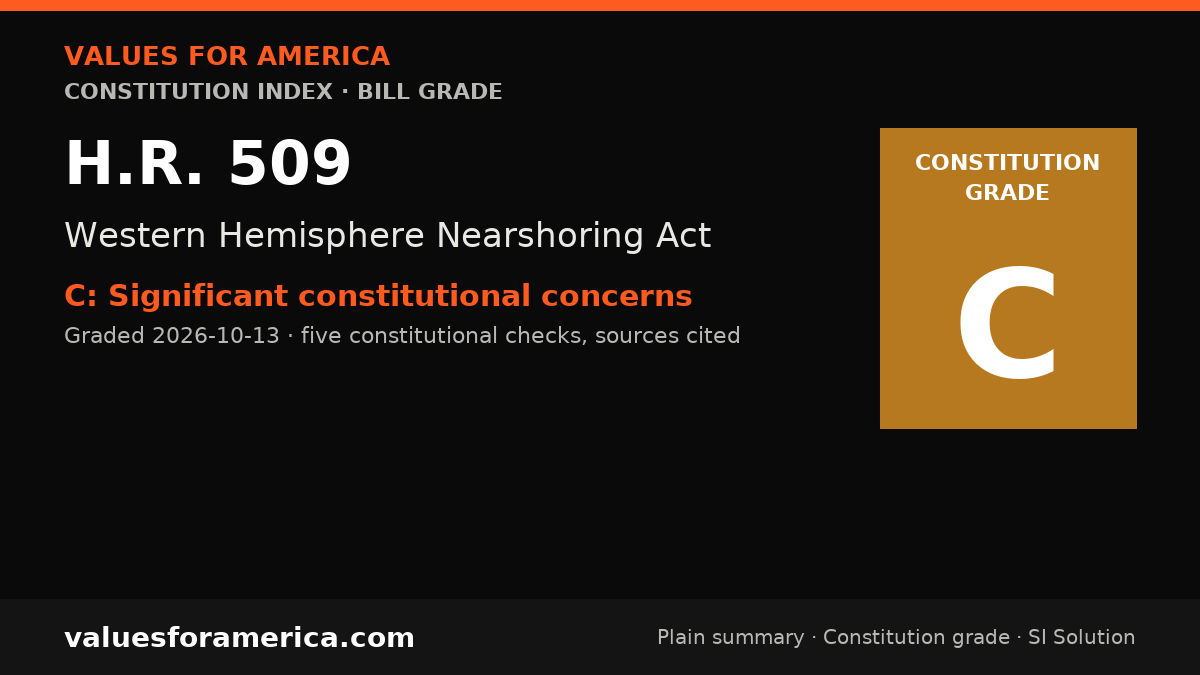
“VFA Constitution grade”
Significant constitutional concerns
Graded 2026-10-13
SI-generated grade · five published checks · not individually reviewed by a person · methodology
The bill raises significant constitutional concerns primarily because it conditions trade benefits on foreign policy outcomes and uses tariff revenue for purposes not directly tied to the regulation of commerce, potentially exceeding enumerated powers and infringing on state sovereignty. While the bill does not directly violate the Bill of Rights, its use of tariffs as a funding mechanism and its delegation of broad authority to the executive raise due process and separation of powers issues.
-
✗ Concern · Enumerated powers
The bill's use of tariffs to fund relocation assistance and its conditioning of trade benefits on foreign policy objectives may exceed Congress's enumerated powers. While Congress has the power to regulate foreign commerce (Article I, Section 8, Clause 3) and to lay and collect taxes (Article I, Section 8, Clause 1), the use of tariff revenue for purposes not directly tied to regulating commerce o… -
✓ Passes · Bill of Rights
The bill does not directly infringe on any of the rights protected by the first ten amendments. It does not restrict speech, religion, assembly, press, petition, arms, quartering, search and seizure, self-incrimination, due process, takings, fair trial, jury, cruel and unusual punishment, unenumerated rights, or reserved powers. The conditions on corporations (e.g., not being controlled by foreign… -
✓ Passes · Individual sovereignty
The bill does not restrict individual liberties. It provides incentives for corporations to relocate, but does not compel any individual or corporation to act against their will. The conditions for receiving benefits are voluntary, and the bill does not impose mandates on individuals or private entities. -
✗ Concern · Decentralization
The bill consolidates decision-making at the federal level, which is appropriate for foreign affairs and international trade, as these are inherently federal responsibilities under the Constitution. However, the bill's use of tariff revenue to fund corporate relocation may be seen as an overreach into areas that could be handled by states or the private sector. The four-question test: (1) Individu… -
✗ Concern · Due process and takings
The bill's use of tariff revenue to fund corporate relocation may constitute a taking of property (tariffs are taxes on imported goods) without just compensation, as the funds are diverted from the general treasury to specific private interests. Additionally, the bill's delegation of authority to the President to negotiate trade agreements and nuclear reactor sales without clear standards may viol…
Sources: Congress.gov: HR 509 summary
Report an error in this grade
What should pass
“VFA SI Solution”
No solution yet
A sourced SI draft appears here once it passes automated checks (Constitution citation, source verification, independent SI critic). How publication works.
Related on VFA

For journalists and bloggers
“Embed this grade”
Free to use with the link back. The badge and card update when the grade changes. Embed terms →
