H.R. 508 explained · 119th Congress · Pending in Congress
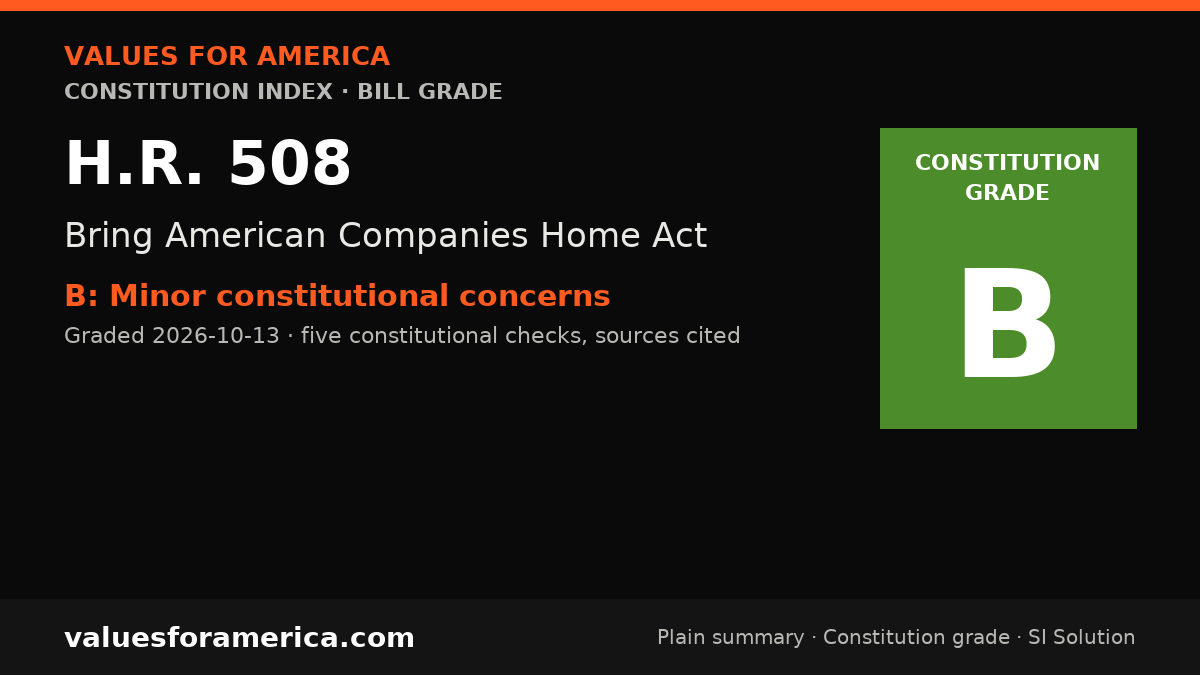
Bring American Companies Home Act
Cosponsors: none · per Congress.gov, 2026-10-12
Introduced: 2025-01-16
Latest action (2025-01-16): Referred to the House Committee on Ways and Means.
What H.R. 508 does, in plain terms
Bring American Companies Home Act This bill requires the Department of the Treasury to establish a program and regulations allowing U.S. persons (U.S. citizens or residents, domestic partnerships or corporations, or estates and trusts) to deduct in the tax year incurred costs of moving inventory, equipment, and supplies used in a trade or business from China to the United States. The bill also establishes a trust fund and appropriates to such fund tariff amounts collected by the United States on goods manufactured in China, appropriates from such trust fund to the general fund of the Treasury amounts equivalent to the reduction in revenue resulting from the tax deduction, and requires amounts to be transferred between funds at least monthly.
Official summary by the Congressional Research Service, via Congress.gov.
Constitution Index
“VFA Constitution grade”
Minor constitutional concerns
Graded 2026-10-13
SI-generated grade · five published checks · not individually reviewed by a person · methodology
The bill is a federal tax incentive that falls within Congress's broad taxing and spending powers under Article I, Section 8, Clause 1. It does not infringe on individual rights, respects decentralization by using incentives rather than mandates, and provides clear procedural rules. The only minor concern is the use of tariff revenues to offset revenue losses, which is a permissible exercise of the spending power but raises a slight question of fiscal earmarking.
-
✓ Passes · Enumerated powers
Congress has the power to lay and collect taxes and to provide for the general welfare (Article I, Section 8, Clause 1). Tax deductions and the establishment of a trust fund to offset revenue losses are within this broad authority. The bill does not regulate interstate commerce or mandate behavior; it merely offers a tax incentive. -
✓ Passes · Bill of Rights
The bill does not restrict speech, religion, assembly, press, petition, the right to bear arms, or any other enumerated right. It imposes no searches, seizures, or criminal penalties. It is purely a tax incentive and does not implicate any provision of the Bill of Rights. -
✓ Passes · Individual sovereignty
The bill does not restrict individual liberty. It offers a voluntary tax deduction for moving business operations from China to the United States. Individuals and businesses remain free to choose whether to relocate. The burden of proof for any restriction is not triggered because there is no restriction. -
✓ Passes · Decentralization
The bill uses a federal tax incentive to encourage a specific economic activity. While the federal government is involved, it does not mandate or preempt state or local action. States and individuals retain full discretion. The federal role is limited to tax policy, which is inherently federal. The four-question test: (1) individuals and families can choose to relocate without government help, but… -
✓ Passes · Due process and takings
The bill does not take property without just compensation. It creates a tax deduction and a trust fund, which are voluntary and do not deprive anyone of property. The procedural rules for the trust fund and transfers are clear, providing adequate notice and certainty. No due process concerns arise.
Sources: Congress.gov: HR 508 summary
Report an error in this grade
What should pass
“VFA SI Solution”
No solution yet
A sourced SI draft appears here once it passes automated checks (Constitution citation, source verification, independent SI critic). How publication works.
Related on VFA

For journalists and bloggers
“Embed this grade”
Free to use with the link back. The badge and card update when the grade changes. Embed terms →
