H.R. 498 explained · 119th Congress · Pending in Congress
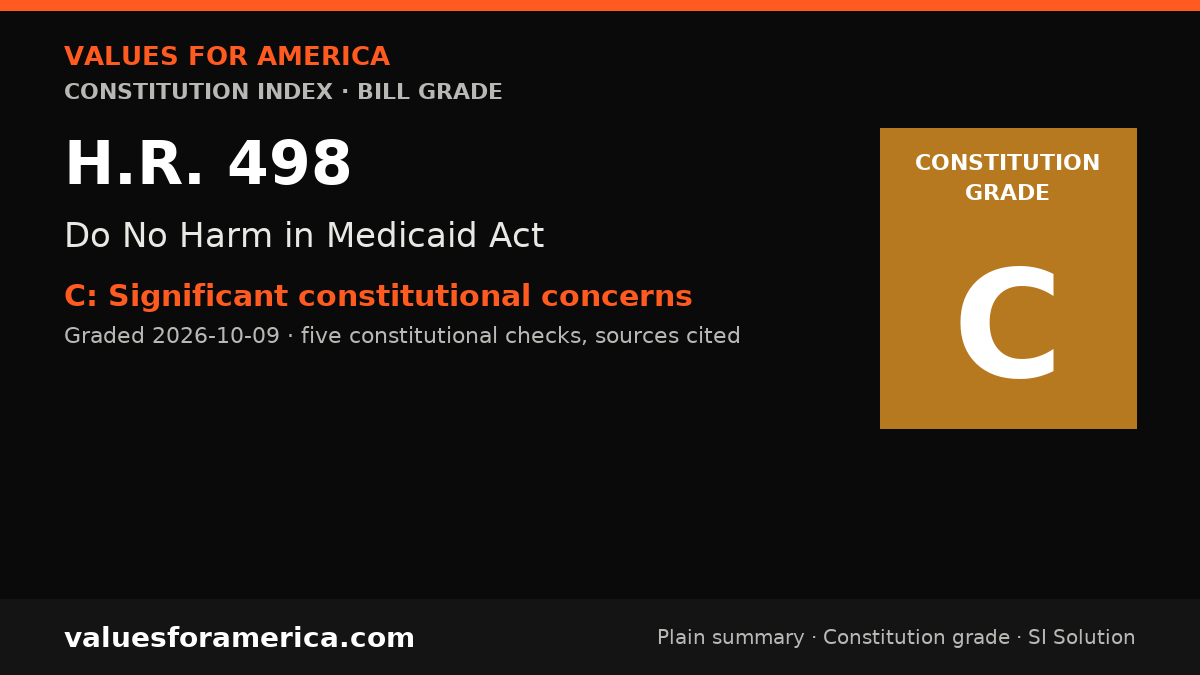
Do No Harm in Medicaid Act
Cosponsors: 6 (0 D, 6 R) · per Congress.gov, 2026-10-09
Introduced: 2025-01-16
Latest action (2025-12-18): Received in the Senate and Read twice and referred to the Committee on Finance.
What H.R. 498 does, in plain terms
Do No Harm in Medicaid Act This bill prohibits federal Medicaid payment for specified gender transition procedures for individuals under the age of 18. The bill defines these procedures to mean those that are intended to change the body of an individual to no longer correspond to the individual's biological sex (male or female), including specified surgeries, implants, and medications (e.g., hormones). The bill excludes procedures that are provided to an individual under the age of 18 with the consent of a parent or legal guardian and that are intended to (1) rectify early puberty, genetic disorders, or chromosomal abnormalities; (2) reverse prior gender transition procedures; or (3) prevent imminent death or impairment of a major bodily function.
Official summary by the Congressional Research Service, via Congress.gov.
Constitution Index
“VFA Constitution grade”
Significant constitutional concerns
Graded 2026-10-09
SI-generated grade · five published checks · not individually reviewed by a person · methodology
HR 498 raises significant constitutional concerns under the Spending Clause and the Tenth Amendment, as it conditions federal Medicaid funds on state compliance with a policy that restricts medical decision-making for minors. While the federal government has broad authority to attach conditions to spending, this bill may infringe on state police powers and parental rights, creating a tension with the Ninth and Tenth Amendments. The bill passes checks on enumerated powers and due process but fails on individual sovereignty and decentralization due to its potential to override state and family autonomy in medical care.
-
✓ Passes · Enumerated powers
The federal government has authority under the Spending Clause (Article I, Section 8, Clause 1) to set conditions on Medicaid funds, as long as conditions are unambiguous and related to the federal interest in the program. This bill conditions payment on a specific medical policy, which is a permissible exercise of spending power under South Dakota v. Dole. -
✓ Passes · Bill of Rights
The bill does not directly infringe on any enumerated right in the Bill of Rights. It does not restrict speech, religion, assembly, press, petition, arms, quartering, search and seizure, self-incrimination, due process, fair trial, jury, cruel and unusual punishment, or unenumerated rights under the Ninth Amendment. The Ninth Amendment protects unenumerated rights, but the bill's restriction on fe… -
✗ Concern · Individual sovereignty
The bill restricts access to certain medical procedures for minors, which implicates the right of parents to direct the upbringing and medical care of their children, a fundamental liberty interest protected by the Due Process Clause of the Fourteenth Amendment (Pierce v. Society of Sisters, Meyer v. Nebraska). While the government has a compelling interest in protecting minors from potentially ha… -
✗ Concern · Decentralization
The bill fails the decentralization test. (1) Individual families can handle medical decisions for their children with state and local oversight, so the federal government's involvement is not necessary. (2) Local communities and states can regulate medical procedures for minors under their police powers. (3) States can handle this without federal involvement, as they traditionally regulate medica… -
✓ Passes · Due process and takings
The bill does not bypass due process or take property without just compensation. It does not impose criminal penalties or seize property; it merely conditions federal funding on compliance. States and individuals retain the ability to challenge the conditions through the political process or courts, and the bill includes exceptions for medical emergencies and other conditions, providing procedural…
Sources: Congress.gov: HR 498 summary
Report an error in this grade
What should pass
“VFA SI Solution”
No solution yet
A sourced SI draft appears here once it passes automated checks (Constitution citation, source verification, independent SI critic). How publication works.
Related on VFA

For journalists and bloggers
“Embed this grade”
Free to use with the link back. The badge and card update when the grade changes. Embed terms →
