H.R. 494 explained · 119th Congress · Pending in Congress
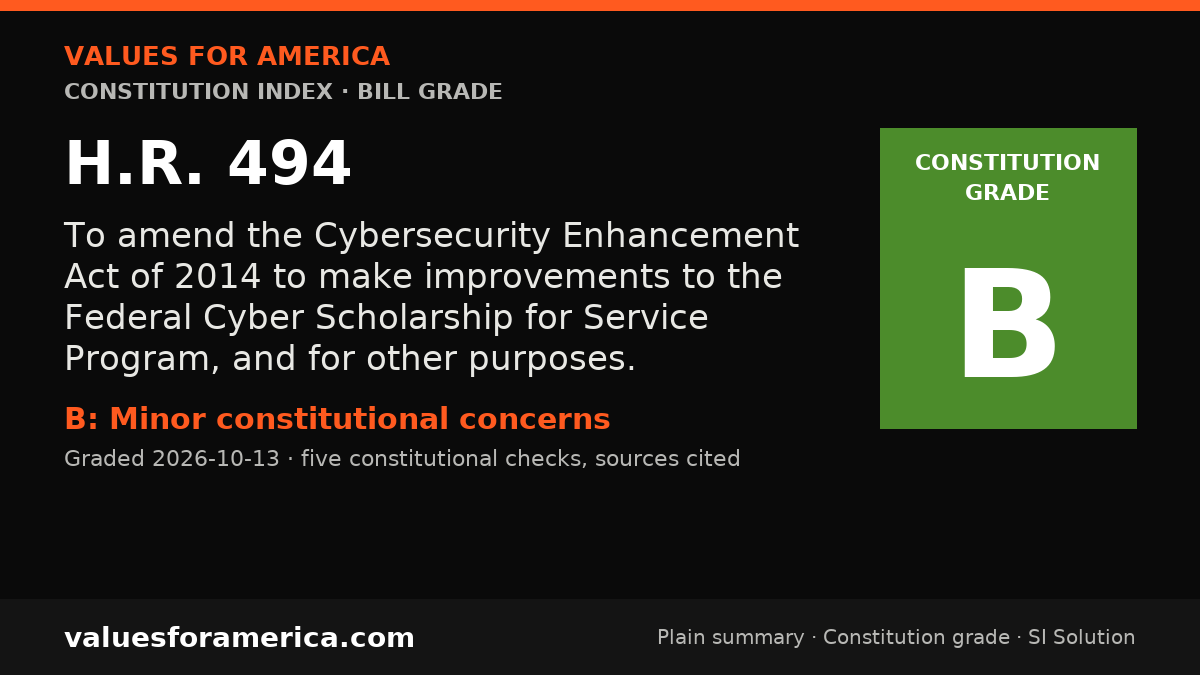
To amend the Cybersecurity Enhancement Act of 2014 to make improvements to the Federal Cyber Scholarship for Service Program, and for other purposes.
Cosponsors: 1 (0 D, 1 R) · per Congress.gov, 2026-10-12
Introduced: 2025-01-16
Latest action (2025-01-16): Referred to the House Committee on Science, Space, and Technology.
What H.R. 494 does, in plain terms
This bill makes certain changes to the CyberCorps Scholarship for Service program, including increasing available scholarship amounts to cover up to five years of eligible tuition. The program offers scholarships to students pursuing higher education in cybersecurity and related fields, including artificial intelligence, quantum computing, and aerospace. Under current law, the scholarship covers up to three years of tuition. Recipients must generally commit to work in cybersecurity for a government agency or institution of higher education following completion of their degree program for a period equivalent to the duration of the scholarship. If a recipient fails to fulfill the postgraduation work requirements, some or all of the scholarship must be repaid or treated as a loan. The bill also provides statutory authority for the National Science Foundation to treat as a Federal Direct Unsubsidized Loan the full amount of any scholarship award that is treated as a loan. Under current law, Federal Direct Unsubsidized Loans are subject to certain conditions (e.g., interest rates and repayment schedules) and are eligible for student loan forgiveness under the Public Service Loan Forgiveness program.
Official summary by the Congressional Research Service, via Congress.gov.
Constitution Index
“VFA Constitution grade”
Minor constitutional concerns
Graded 2026-10-13
SI-generated grade · five published checks · not individually reviewed by a person · methodology
The bill operates within Congress's enumerated powers under the Spending Clause and the General Welfare Clause, and it does not infringe on individual rights. The primary constitutional tension is the expansion of the scholarship program's loan conversion mechanism, which may inadvertently expand federal involvement in student debt and potentially affect individual sovereignty by tying educational funding to government service. However, the program is voluntary and the service requirement is a reasonable condition on the receipt of federal funds. The bill does not consolidate power beyond the federal level in a way that violates the Tenth Amendment, as it addresses a national cybersecurity workforce need. The grade reflects minor concerns about the breadth of the loan conversion and the potential for the program to grow beyond its original scope.
-
✓ Passes · Enumerated powers
Congress has authority under Article I, Section 8, Clause 1 (the Spending Clause) to provide for the general welfare and to appropriate funds for programs that support national security and education. The CyberCorps Scholarship for Service program is a federal spending program aimed at developing a cybersecurity workforce, which is a legitimate federal interest. The bill's provisions are within th… -
✓ Passes · Bill of Rights
The bill does not infringe on any of the first ten amendments. It does not restrict speech, religion, assembly, press, petition, arms, quartering, search and seizure, self-incrimination, due process, takings, trial rights, jury rights, cruel and unusual punishment, or unenumerated rights. The program is voluntary, and the service requirement is a condition of receiving a scholarship, not a compell… -
✓ Passes · Individual sovereignty
The bill does not restrict what individuals can do with their own person, property, speech, labor, or belief. It offers a voluntary scholarship program with a service obligation. Individuals are free to accept or decline the scholarship. The service requirement is a contractual condition, not a government mandate. The burden is on the government to justify any restriction, and here there is no res… -
✓ Passes · Decentralization
The program addresses a national cybersecurity workforce shortage that individual states or localities are unlikely to fully address on their own. The federal government is the appropriate level to coordinate and fund such a program. The bill does not consolidate decision-making upward beyond the minimum necessary; it operates within an existing federal program. The four-question test: (1) individ… -
✓ Passes · Due process and takings
The bill does not bypass due process or take property without just compensation. The scholarship program is voluntary, and the repayment/loan conversion provisions are contractual. Recipients are given notice of the service requirement and the consequences of non-compliance. The bill provides statutory authority for the NSF to treat scholarship amounts as loans, which is a procedural mechanism tha…
Sources: Congress.gov: HR 494 summary
Report an error in this grade
What should pass
“VFA SI Solution”
No solution yet
A sourced SI draft appears here once it passes automated checks (Constitution citation, source verification, independent SI critic). How publication works.
Related on VFA

For journalists and bloggers
“Embed this grade”
Free to use with the link back. The badge and card update when the grade changes. Embed terms →
