H.R. 493 explained · 119th Congress · Pending in Congress
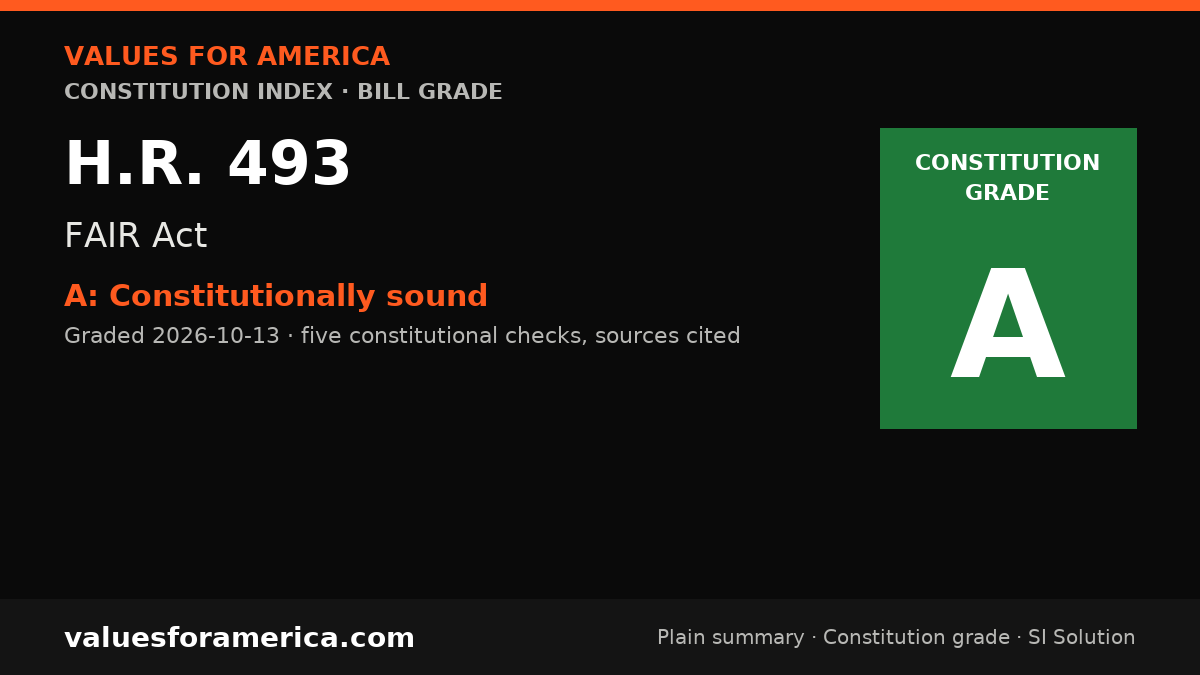
FAIR Act
Cosponsors: 36 (35 D, 1 R) · per Congress.gov, 2026-10-10
Introduced: 2025-01-16
Latest action (2025-09-16): ASSUMING FIRST SPONSORSHIP - Mr. Walkinshaw asked unanimous consent that he may hereafter be considered as the first sponsor of H.R. 493, a bill originally introduced by Representative Connolly, for the purpose of adding cosponsors and requesting reprintings pursuant to clause 7 of rule XII. Agreed to without objection.
What H.R. 493 does, in plain terms
Federal Adjustment of Income Rates Act or the FAIR Act This bill modifies pay rates for federal employees in 2026. Specifically, the bill increases rates under the statutory pay systems and for prevailing rate employees by 3.3% and increases locality pay by 1%.
Official summary by the Congressional Research Service, via Congress.gov.
Constitution Index
“VFA Constitution grade”
Constitutionally sound
Graded 2026-10-13
SI-generated grade · five published checks · not individually reviewed by a person · methodology
The FAIR Act is a straightforward adjustment of federal employee pay rates, which falls squarely within Congress's enumerated power under Article I, Section 8, Clause 1 to 'pay the Debts and provide for the common Defence and general Welfare of the United States.' It does not infringe any constitutional rights, restrict individual sovereignty, centralize power beyond the federal government's own workforce, or violate due process or takings protections. The bill is fully constitutional.
-
✓ Passes · Enumerated powers
Congress has explicit constitutional authority under Article I, Section 8, Clause 1 to set compensation for federal employees as part of its power to provide for the general welfare and manage federal operations. The bill adjusts pay rates for federal workers, which is a core administrative function of the federal government. -
✓ Passes · Bill of Rights
The bill does not regulate speech, religion, assembly, press, petition, arms, quartering, search and seizure, self-incrimination, due process, takings, trial rights, or cruel and unusual punishment. It has no effect on any right protected by the first ten amendments. -
✓ Passes · Individual sovereignty
The bill only adjusts pay rates for federal employees who voluntarily work for the government. It does not restrict any person's control over their own person, property, speech, labor, or belief. Federal employees retain full freedom to accept or decline employment under the new pay schedule. -
✓ Passes · Decentralization
The bill concerns the compensation of federal employees, which is inherently a federal matter. An individual cannot set federal pay rates; a local community cannot manage federal payroll; a state cannot set federal employee salaries. The action does not consolidate decision-making upward beyond what is necessary because the federal government is the employer. -
✓ Passes · Due process and takings
The bill increases pay rates, so it does not take property or reduce compensation. It applies prospectively to 2026, providing fair notice. No person is deprived of life, liberty, or property without due process. The Fifth Amendment is not implicated.
Sources: Congress.gov: HR 493 summary
Report an error in this grade
What should pass
“VFA SI Solution”
No solution yet
A sourced SI draft appears here once it passes automated checks (Constitution citation, source verification, independent SI critic). How publication works.
Related on VFA

For journalists and bloggers
“Embed this grade”
Free to use with the link back. The badge and card update when the grade changes. Embed terms →
