H.R. 4922 explained · 119th Congress · Pending in Congress
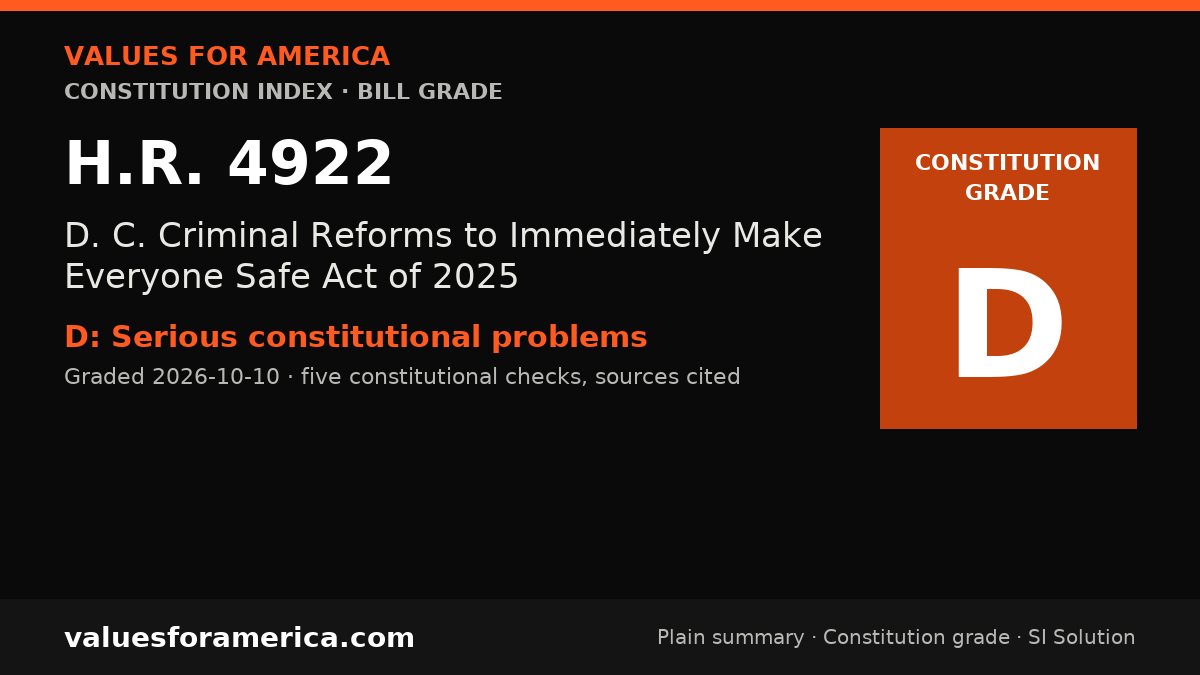
D. C. Criminal Reforms to Immediately Make Everyone Safe Act of 2025
Cosponsors: 8 (0 D, 8 R) · per Congress.gov, 2026-10-10
Introduced: 2025-08-08
Latest action (2025-09-17): Received in the Senate.
What H.R. 4922 does, in plain terms
DC Criminal Reforms to Immediately Make Everyone Safe Act or the DC CRIMES Act This bill limits the authority of the District of Columbia (DC) government over its criminal sentencing laws. The bill eliminates the DC government’s authority to enact any act, resolution, or rule to change any criminal liability sentence in effect on the date of the bill's enactment. The bill also (1) reduces the maximum age of a youth offender from 24 years to 18 years, and (2) repeals a provision that allows a DC criminal court to issue a sentence to a youth offender that is less than the mandatory minimum term otherwise required by law. A DC criminal court currently has the discretion to reduce or modify certain criminal sentences for a youth offender under specified circumstances. For example, a DC court may sentence a youth offender to probation in lieu of confinement. (However, this discretion does not apply to several specified violent crimes.) Additionally, the bill directs the Office of the Attorney General for DC to publish, and update monthly, certain youth offender crime data on a publicly accessible website.
Official summary by the Congressional Research Service, via Congress.gov.
Constitution Index
“VFA Constitution grade”
Serious constitutional problems
Graded 2026-10-10
SI-generated grade · five published checks · not individually reviewed by a person · methodology
The bill likely violates the Tenth Amendment and principles of federalism by stripping the District of Columbia of its authority to adjust criminal sentencing laws, while also raising serious Eighth Amendment concerns by eliminating judicial discretion for youth offenders and imposing harsher mandatory minimums. The federal government's enumerated powers do not extend to micromanaging local criminal justice policy in this manner, and the bill consolidates decision-making at the federal level without a compelling constitutional justification.
-
✗ Concern · Enumerated powers
The federal government's enumerated powers under Article I, Section 8 do not include general police power over criminal law. While Congress has plenary authority over the District of Columbia under Article I, Section 8, Clause 17, this authority is typically exercised to provide for the District's governance, not to override the District's own legislative choices in a manner that undermines local … -
✗ Concern · Bill of Rights
The bill raises serious Eighth Amendment concerns by eliminating judicial discretion to impose sentences below mandatory minimums for youth offenders aged 18-24 and reducing the youth offender age cap from 24 to 18. This could result in cruel and unusual punishment for young adults who are developmentally different from older offenders, and the mandatory minimums may be disproportionate to the off… -
✗ Concern · Individual sovereignty
The bill restricts the liberty of young adult offenders by subjecting them to harsher sentences without the possibility of judicial leniency, which directly impacts their personal freedom and autonomy. The government has not provided a compelling justification for treating 18-24 year olds as fully mature adults for sentencing purposes, especially given scientific evidence about brain development. … -
✗ Concern · Decentralization
The bill fails the decentralization test. (1) Individuals and families cannot handle criminal sentencing on their own, but (2) the local community (the District of Columbia) can and should handle its own criminal justice policy. (3) The state (or in this case, the District) can handle this without federal involvement. (4) The bill consolidates decision-making at the federal level, overriding the D… -
✗ Concern · Due process and takings
The bill may violate substantive due process by arbitrarily imposing harsher sentences on youth offenders without a rational basis, and by stripping the DC government of its legislative authority without a legitimate federal interest. Procedural due process is also implicated because the bill retroactively changes sentencing rules, potentially affecting individuals who committed offenses before th…
Sources: Congress.gov: HR 4922 summary
Report an error in this grade
What should pass
“VFA SI Solution”
No solution yet
A sourced SI draft appears here once it passes automated checks (Constitution citation, source verification, independent SI critic). How publication works.
Related on VFA

For journalists and bloggers
“Embed this grade”
Free to use with the link back. The badge and card update when the grade changes. Embed terms →
