H.R. 4758 explained · 119th Congress · Pending in Congress
Homeowner Energy Freedom Act
Cosponsors: 2 (0 D, 2 R) · per Congress.gov, 2026-10-09
Introduced: 2025-07-25
Latest action (2026-02-25): Received in the Senate and Read twice and referred to the Committee on Energy and Natural Resources.
What H.R. 4758 does, in plain terms
Homeowner Energy Freedom Act This bill repeals the Department of Energy's (1) high-efficiency electric home rebate program for certain electrification projects in low- or moderate-income households, (2) state-based home energy efficiency contractor training grants, and (3) assistance for states and local governments to adopt specified building energy codes. It also rescinds any unobligated balances available for the rebates or adopting the building energy codes. (The unobligated balances for the contractor training grants were previously rescinded by the 2025 reconciliation act.)
Official summary by the Congressional Research Service, via Congress.gov.
Constitution Index
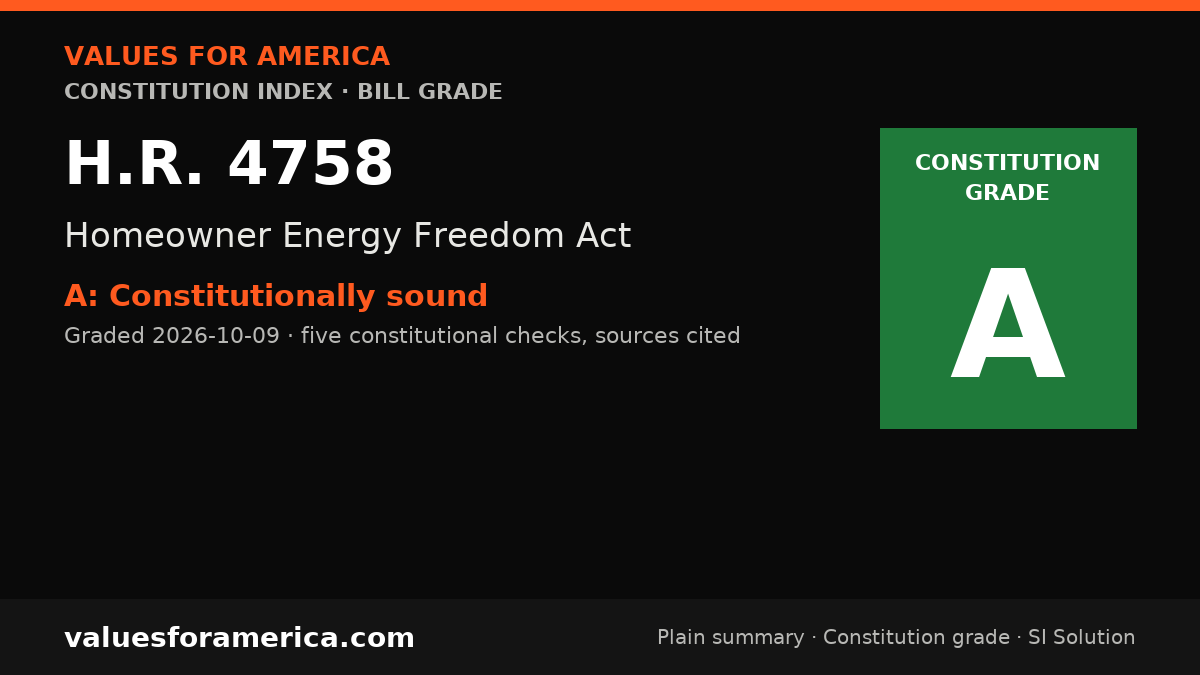
“VFA Constitution grade”
Constitutionally sound
Graded 2026-10-09
SI-generated grade · five published checks · not individually reviewed by a person · methodology
This bill is constitutional. It uses Congress's legislative power to repeal federal spending programs and rescind unobligated balances, which is consistent with Article I, Section 8, Clause 1. It does not restrict individual rights, take vested property, or consolidate power; instead it reduces federal involvement in home energy decisions and returns those choices to individuals and states.
-
✓ Passes · Enumerated powers
Congress has authority under Article I, Section 8, Clause 1 to spend for the general welfare and therefore to repeal or amend federal spending programs. Rescinding unobligated balances is part of Congress's power over the federal budget and existing statutes. This bill does not exceed any enumerated power. -
✓ Passes · Bill of Rights
Repealing federal rebate programs, contractor training grants, and building energy code assistance does not infringe any right protected by the Bill of Rights. It does not touch speech, religion, press, assembly, petition, arms, quartering, search and seizure, self-incrimination, trial rights, jury rights, cruel punishment, or unenumerated rights. -
✓ Passes · Individual sovereignty
This bill removes federal programs rather than restricting personal conduct. It does not tell homeowners what to do with their property, labor, or beliefs. Ending optional subsidies does not burden individual sovereignty; it leaves individuals free to make their own energy decisions without federal involvement. -
✓ Passes · Decentralization
The bill fails none of the four decentralization questions. Individuals and families can choose home energy improvements without a federal rebate program. Local communities and states may adopt their own building codes and efficiency policies if they wish. The bill reduces federal consolidation by repealing federal programs and returning authority to lower levels of government. -
✓ Passes · Due process and takings
Repealing a program and rescinding unobligated balances does not deprive anyone of life, liberty, or property without due process. No one has a vested property right in future rebate payments or unallocated federal funds. There is no Fifth Amendment taking requiring just compensation.
Sources: Congress.gov: HR 4758 summary
Report an error in this grade
What should pass
“VFA SI Solution”
No solution yet
A sourced SI draft appears here once it passes automated checks (Constitution citation, source verification, independent SI critic). How publication works.
Related on VFA

For journalists and bloggers
“Embed this grade”
Free to use with the link back. The badge and card update when the grade changes. Embed terms →
