H.R. 4690 explained · 119th Congress · Pending in Congress
Reliable Federal Infrastructure Act
Cosponsors: 7 (0 D, 7 R) · per Congress.gov, 2026-10-08
Introduced: 2025-07-23
Latest action (2026-04-27): Received in the Senate and Read twice and referred to the Committee on Environment and Public Works.
What H.R. 4690 does, in plain terms
Reliable Federal Infrastructure Act This bill repeals certain energy efficiency performance standards for new federal buildings and federal buildings undergoing major renovations. Specifically, the bill repeals the performance standards that phase out fossil fuel use in such buildings by FY2030. The bill directs the Department of Energy to implement the standards as though such phase-out requirements had never taken effect until it issues regulations with revised performance standards. The bill also specifies that certain systems that certify green buildings may not prohibit federal buildings from obtaining a certification as a green building or high-performance green building solely based on direct or indirect consumption of fossil fuels.
Official summary by the Congressional Research Service, via Congress.gov.
Constitution Index
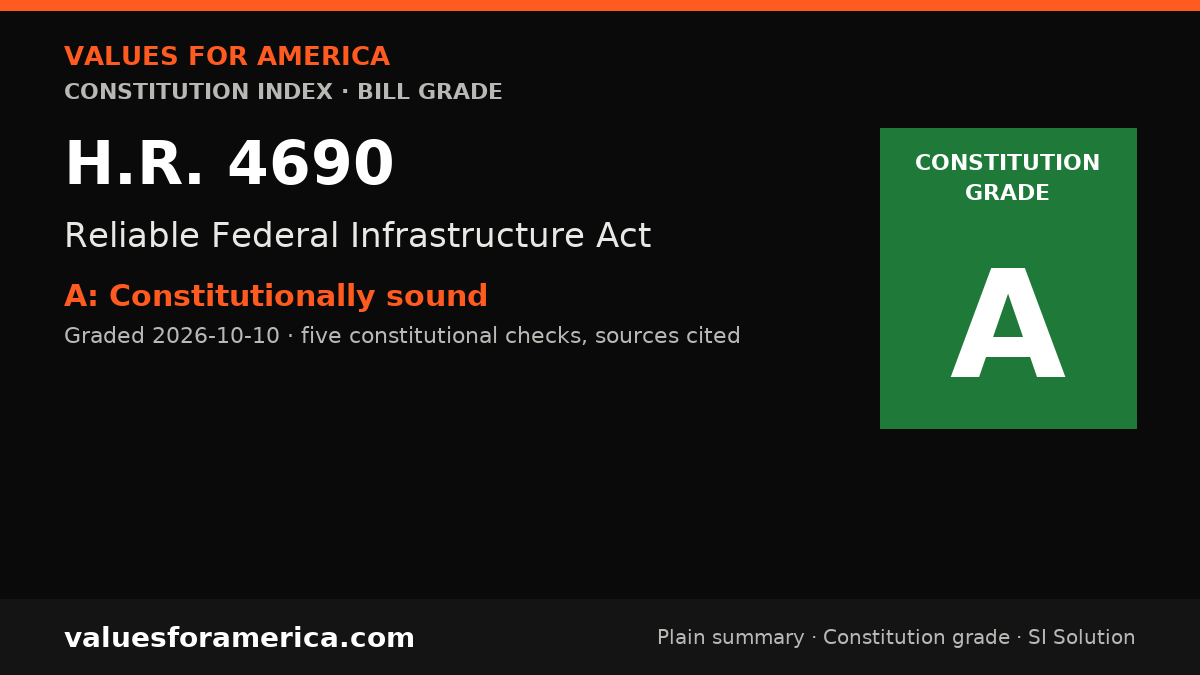
“VFA Constitution grade”
Constitutionally sound
Graded 2026-10-10
SI-generated grade · five published checks · not individually reviewed by a person · methodology
This bill is fully constitutional. It repeals a federal mandate that would have phased out fossil fuel use in federal buildings by 2030, and it directs the Department of Energy to issue revised standards. The bill operates entirely within Congress's enumerated power over federal property and procurement, does not infringe any Bill of Rights protections, respects individual sovereignty by not restricting private conduct, passes all four decentralization questions, and does not violate due process or takings protections.
-
✓ Passes · Enumerated powers
Congress has explicit constitutional authority over federal property and buildings under Article I, Section 8, Clause 17 (power to exercise exclusive legislation over federal enclaves) and the Property Clause (Article IV, Section 3, Clause 2). Setting energy performance standards for federal buildings is a valid exercise of Congress's power to manage federal property and procurement. Repealing or … -
✓ Passes · Bill of Rights
The bill does not restrict speech, religion, assembly, press, petition, arms, quartering, search and seizure, self-incrimination, due process, takings, fair trial, jury, cruel and unusual punishment, or any other right enumerated in the first ten amendments. It only changes internal federal building standards. -
✓ Passes · Individual sovereignty
The bill imposes no restrictions on private persons, their property, speech, labor, or belief. It only governs federal buildings and federal procurement. No individual is required or prohibited from any action by this legislation. -
✓ Passes · Decentralization
The bill passes all four decentralization questions. (1) Individuals and families cannot handle federal building standards because federal buildings are owned by the national government. (2) Local communities cannot handle federal building standards because federal buildings are under federal jurisdiction. (3) States cannot handle federal building standards because federal buildings are under excl… -
✓ Passes · Due process and takings
The bill does not deprive any person of life, liberty, or property without due process, nor does it take private property for public use without just compensation. It only modifies internal federal building standards, which does not implicate the Fifth Amendment's Due Process or Takings Clauses.
Sources: Congress.gov: HR 4690 summary
Report an error in this grade
What should pass
“VFA SI Solution”
No solution yet
A sourced SI draft appears here once it passes automated checks (Constitution citation, source verification, independent SI critic). How publication works.
Related on VFA

For journalists and bloggers
“Embed this grade”
Free to use with the link back. The badge and card update when the grade changes. Embed terms →
