H.R. 4638 explained · 119th Congress · Pending in Congress
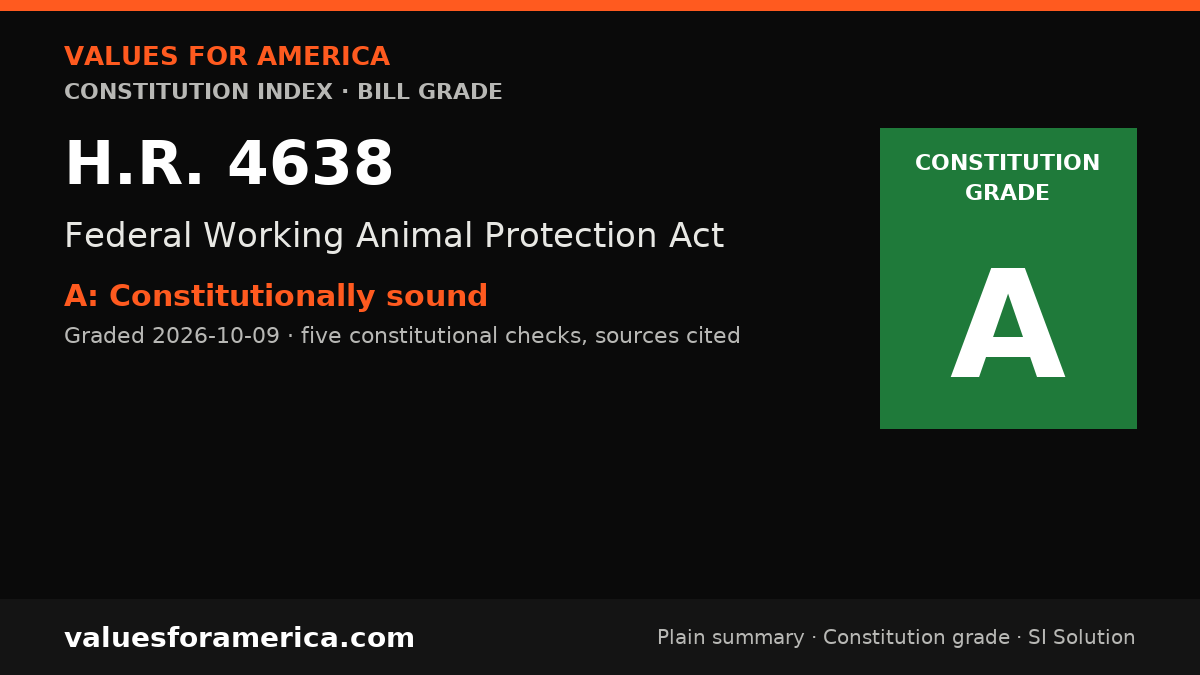
Federal Working Animal Protection Act
Cosponsors: 19 (0 D, 19 R) · per Congress.gov, 2026-10-09
Introduced: 2025-07-23
Latest action (2026-03-19): Received in the Senate and Read twice and referred to the Committee on the Judiciary.
What H.R. 4638 does, in plain terms
Bill to Outlaw Wounding of Official Working Animals Act or the BOWOW Act This bill establishes that a non-U.S. national (alien under federal law) convicted of, or who admits to having committed, an offense related to harming animals used in law enforcement is inadmissible and deportable.
Official summary by the Congressional Research Service, via Congress.gov.
Constitution Index
“VFA Constitution grade”
Constitutionally sound
Graded 2026-10-09
SI-generated grade · five published checks · not individually reviewed by a person · methodology
The Federal Working Animal Protection Act is constitutional. It operates squarely within Congress's plenary power over immigration and naturalization under Article I, Section 8, Clause 4. The bill does not restrict any right protected by the Bill of Rights, does not infringe individual sovereignty of U.S. nationals, respects decentralization by leaving state and local animal cruelty laws untouched, and provides full due process through criminal conviction or admission as a prerequisite for immigration consequences.
-
✓ Passes · Enumerated powers
Congress has explicit constitutional authority over immigration and naturalization under Article I, Section 8, Clause 4. The bill creates a ground of inadmissibility and deportability for non-U.S. nationals convicted of harming law enforcement animals. This is a classic exercise of the federal immigration power, which the Supreme Court has long recognized as plenary and inherent in national sovere… -
✓ Passes · Bill of Rights
The bill does not infringe any provision of the first ten amendments. It imposes immigration consequences on non-U.S. nationals based on criminal convictions, which does not implicate the First Amendment (speech, religion, assembly, press, petition), Second Amendment (arms), Third Amendment (quartering), Fourth Amendment (search and seizure), Fifth Amendment (self-incrimination, due process, takin… -
✓ Passes · Individual sovereignty
The bill does not restrict what a U.S. person can do with their own person, property, speech, labor, or belief. It applies only to non-U.S. nationals seeking admission to or presence in the United States. The government has a compelling constitutional interest in controlling the borders and setting conditions for entry and stay. The burden is properly on the non-citizen to comply with immigration … -
✓ Passes · Decentralization
The bill passes all four questions of the decentralization test. (1) An individual or family cannot handle immigration policy unilaterally; this is a federal function. (2) A local community or county cannot set national immigration rules. (3) A state cannot set federal immigration policy. (4) The bill does not consolidate decision-making upward beyond the minimum necessary; immigration is inherent… -
✓ Passes · Due process and takings
The bill provides full procedural due process. It requires a criminal conviction or an admission by the non-U.S. national before immigration consequences attach. This ensures fair notice, a fair hearing, and the presumption of innocence. No property is taken without just compensation; the bill does not involve any taking of property. The immigration consequences are civil, not criminal, and are ba…
Sources: Congress.gov: HR 4638 summary
Report an error in this grade
What should pass
“VFA SI Solution”
No solution yet
A sourced SI draft appears here once it passes automated checks (Constitution citation, source verification, independent SI critic). How publication works.
Related on VFA

For journalists and bloggers
“Embed this grade”
Free to use with the link back. The badge and card update when the grade changes. Embed terms →
