H.R. 4553 explained · 119th Congress · Pending in Congress
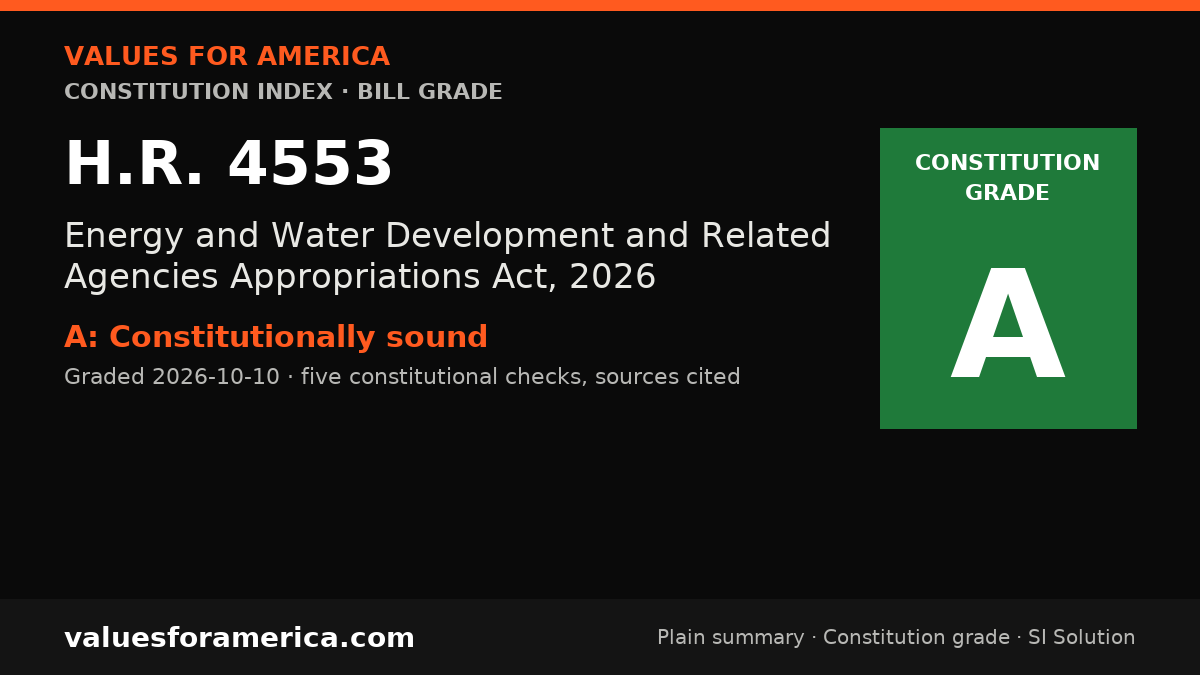
Energy and Water Development and Related Agencies Appropriations Act, 2026
Cosponsors: none · per Congress.gov, 2026-10-10
Introduced: 2025-07-21
Latest action (2025-09-10): Read the second time. Placed on Senate Legislative Calendar under General Orders. Calendar No. 156.
What H.R. 4553 does, in plain terms
Energy and Water Development and Related Agencies Appropriations Act, 2026 This bill provides FY2026 appropriations for U.S. Army Corps of Engineers civil works projects, the Department of the Interior's Bureau of Reclamation, the Department of Energy (DOE), and several independent agencies. The bill provides appropriations for U.S. Army Corps of Engineers civil works projects, including for Investigations, Construction, Mississippi River and Tributaries, Operation and Maintenance, the Regulatory Program, Flood Control and Coastal Emergencies, Expenses, the Office of the Assistant Secretary of the Army for Civil Works, and the Water Infrastructure Finance and Innovation Program. The bill provides appropriations to the Department of the Interior for the Central Utah Project and the Bureau of Reclamation. The bill provides appropriations to DOE for energy programs, including Energy Efficiency and Renewable Energy; Cybersecurity, Energy Security, and Emergency Response; Electricity; Grid Deployment; Nuclear Energy; Fossil Energy; Naval Petroleum and Oil Shale Reserves; the Strategic Petroleum Reserve; the Northeast Home Heating Oil Reserve; the Energy Information Administration; Non-Defense Environmental Cleanup; the Uranium Enrichment Decontamination and Decommissioning Fund; Science; Nuclear Waste Disposal; the Advanced Research Projects Agency—Energy; the Title 17 Innovative Technology Loan Guarantee Program; the Advanced Technology Vehicles Manufacturing Loan Program; the Tribal Energy Loan Guarantee Program; Indian Energy Policy and Programs; Departmental Administration; and the Office of the Inspector General. The bill also provides appropriations to DOE for Atomic Energy Defense Activities of the National Nuclear Security Administration, Environmental and Other Defense Activities, and the Power Marketing Administrations. The bill provides appropriations to several independent agencies, including the Federal Energy Regulatory Commission and the Nuclear Regulatory Commission. The bill also sets forth requirements and restrictions for using funds provided by this and other appropriations acts.
Official summary by the Congressional Research Service, via Congress.gov.
Constitution Index
“VFA Constitution grade”
Constitutionally sound
Graded 2026-10-10
SI-generated grade · five published checks · not individually reviewed by a person · methodology
This bill is a routine appropriations bill funding energy, water, and related infrastructure programs. It operates squarely within Congress's enumerated power to tax and spend for the general welfare (Article I, Section 8, Clause 1) and the necessary and proper clause. It does not restrict any individual rights, impose mandates on private conduct, or centralize power beyond what is constitutionally permissible for federal spending. The bill passes all five constitutional checks with no violations.
-
✓ Passes · Enumerated powers
Congress has explicit constitutional authority under Article I, Section 8, Clause 1 (the Taxing and Spending Clause) to appropriate funds for the general welfare. Funding the Army Corps of Engineers (commerce and navigation under Clause 3), the Bureau of Reclamation (property under Clause 17), and Department of Energy programs (defense under Clause 12, general welfare) all fall within enumerated p… -
✓ Passes · Bill of Rights
The bill does not restrict speech, religion, press, assembly, petition, arms, quartering, search and seizure, self-incrimination, due process, takings, fair trial, jury, cruel and unusual punishment, or any other right protected by the first ten amendments. It is a funding measure with no prohibitions or mandates on individual conduct. -
✓ Passes · Individual sovereignty
The bill imposes no restrictions on what individuals may do with their person, property, speech, labor, or belief. It funds government programs and infrastructure projects. No individual is compelled to act or refrain from acting. The burden on individual sovereignty is zero. -
✓ Passes · Decentralization
The four-question test: (1) Individuals cannot fund large-scale water and energy infrastructure alone — this is a legitimate government function. (2) Local communities cannot manage national energy security, nuclear waste, or interstate water projects. (3) States cannot unilaterally manage the Strategic Petroleum Reserve, nuclear weapons activities, or interstate energy grids. (4) The bill does no… -
✓ Passes · Due process and takings
The bill does not bypass due process or take private property without just compensation. It funds government operations and infrastructure projects. Any property acquisitions by the Army Corps or Bureau of Reclamation would be subject to existing Fifth Amendment takings requirements and separate statutory procedures. The bill itself contains no provisions that violate procedural or substantive due…
Sources: Congress.gov: HR 4553 summary
Report an error in this grade
What should pass
“VFA SI Solution”
No solution yet
A sourced SI draft appears here once it passes automated checks (Constitution citation, source verification, independent SI critic). How publication works.
Related on VFA

For journalists and bloggers
“Embed this grade”
Free to use with the link back. The badge and card update when the grade changes. Embed terms →
