H.R. 4544 explained · 119th Congress · Pending in Congress
American Access to Banking Act
Cosponsors: none · per Congress.gov, 2026-10-08
Introduced: 2025-07-17
Latest action (2026-05-21): Received in the Senate and Read twice and referred to the Committee on Banking, Housing, and Urban Affairs.
What H.R. 4544 does, in plain terms
American Access to Banking Act This bill requires federal financial regulators to review and streamline the application process for the formation of de novo, or new, depository institutions or credit unions. Regulators must (1) review the application process; (2) to the extent practicable, collect necessary information from other agencies in order to minimize requests for applicant information; and (3) review how de novo financial intuitions raise capital while maintaining investor protections, including the impact of restrictions on raising capital. At the request of an applicant, regulators must (1) designate an employee as a caseworker to assist in the application process, and (2) provide a list of similar institutions interested in serving as a mentor. Each regulator must also develop a state and stakeholder engagement plan to assist interested parties with understanding the relevant regulatory processes.
Official summary by the Congressional Research Service, via Congress.gov.
Constitution Index
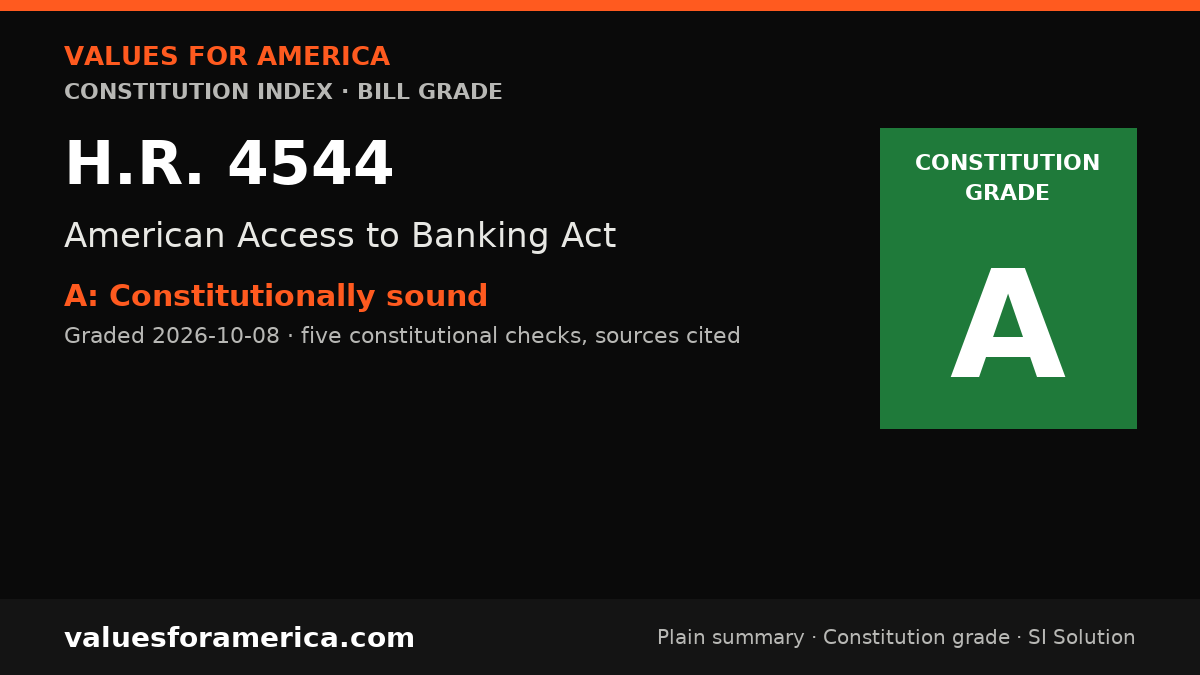
“VFA Constitution grade”
Constitutionally sound
Graded 2026-10-08
SI-generated grade · five published checks · not individually reviewed by a person · methodology
HR 4544 is a procedural reform within clear federal banking authority that reduces regulatory friction, infringes no rights, takes no property, and decentralizes in effect by easing entry for new institutions. Fully constitutional.
-
✓ Passes · Enumerated powers
Congress has authority over the federal banking system under Article I, Section 8, Clause 3 Commerce Clause and Clause 18 Necessary and Proper Clause, plus Clause 5 power to regulate currency and financial system. Directing federal regulators to review and streamline de novo charter applications is within that enumerated authority and does not create new extra-constitutional power. -
✓ Passes · Bill of Rights
No provision restricts speech, religion, press, assembly, arms, search, trial rights, or other protections in Amendments 1-10. The bill imposes no speech restriction under First Amendment, no search under Fourth Amendment, and no taking under Fifth Amendment. It reduces regulatory burden rather than infringing rights. -
✓ Passes · Individual sovereignty
The bill expands individual sovereignty by lowering barriers to forming banks and credit unions and to accessing banking services. It places no new restriction on person, property, speech, labor, or belief, and requires no justification burden. Government action here removes obstacles rather than imposing them. -
✓ Passes · Decentralization
Chartering federally insured depository institutions is inherently governmental and interstate under Tenth Amendment principles. Individuals, localities, and states alone cannot charter federal institutions. The bill does not consolidate power upward; it directs existing federal regulators to streamline, coordinate, and assist applicants, moving toward minimum necessary central control. -
✓ Passes · Due process and takings
No deprivation of life, liberty, or property without due process under Fifth Amendment Due Process Clause, and no taking of private property under Fifth Amendment Takings Clause. The bill adds procedural assistance, caseworkers, and information-sharing to make licensing fairer and less arbitrary, improving procedural due process.
Sources: Congress.gov: HR 4544 summary
Report an error in this grade
What should pass
“VFA SI Solution”
No solution yet
A sourced SI draft appears here once it passes automated checks (Constitution citation, source verification, independent SI critic). How publication works.
Related on VFA

For journalists and bloggers
“Embed this grade”
Free to use with the link back. The badge and card update when the grade changes. Embed terms →
