H.R. 4465 explained · 119th Congress · Pending in Congress
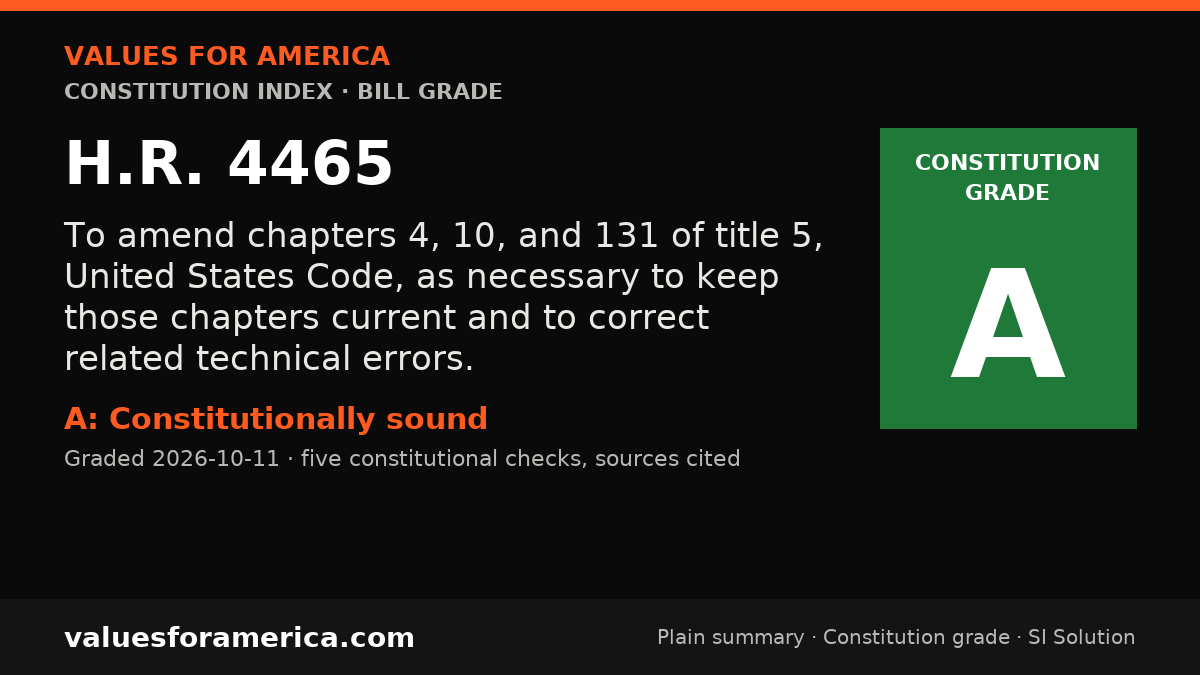
To amend chapters 4, 10, and 131 of title 5, United States Code, as necessary to keep those chapters current and to correct related technical errors.
Cosponsors: none · per Congress.gov, 2026-10-14
Introduced: 2025-07-16
Latest action (2026-09-14): Received in the Senate and Read twice and referred to the Committee on the Judiciary.
What H.R. 4465 does, in plain terms
This bill amends Chapter 4 (Inspectors General), Chapter 10 (Federal Advisory Committees), and Chapter 131 (Ethics in Government) of Title 5 of the U.S. Code. The amendments (1) incorporate laws enacted after October 19, 2021, that amend or repeal provisions of those chapters, and (2) make related technical corrections.
Official summary by the Congressional Research Service, via Congress.gov.
Constitution Index
“VFA Constitution grade”
Constitutionally sound
Graded 2026-10-11
SI-generated grade · five published checks · not individually reviewed by a person · methodology
This bill is a purely technical, housekeeping measure that updates the U.S. Code to reflect previously enacted laws and correct technical errors. It does not grant new powers, restrict rights, or alter the balance of federalism. It is fully consistent with Congress's authority to organize and codify federal law under Article I, Section 8, Clause 18 (the Necessary and Proper Clause) and Article I, Section 1, which vests all legislative powers in Congress.
-
✓ Passes · Enumerated powers
Congress has the explicit constitutional authority to enact laws and to codify, amend, and correct the U.S. Code. This bill is an exercise of Congress's legislative power under Article I, Section 1, and its authority to make all laws necessary and proper for carrying into execution its enumerated powers under Article I, Section 8, Clause 18. The bill does not expand federal jurisdiction or create … -
✓ Passes · Bill of Rights
The bill does not implicate any of the first ten amendments. It makes no changes to speech, religion, assembly, press, petition, arms, quartering, search and seizure, self-incrimination, due process, takings, trial rights, jury rights, cruel and unusual punishment, unenumerated rights, or reserved powers. It is purely technical and corrective in nature. -
✓ Passes · Individual sovereignty
The bill imposes no new restrictions on individual liberty, property, speech, labor, or belief. It does not alter the legal obligations of any person. It merely updates the text of the U.S. Code to reflect existing law, and therefore does not burden individual sovereignty in any way. -
✓ Passes · Decentralization
This bill does not shift decision-making authority to a higher level of government. It is a federal housekeeping measure that updates federal statutes. It does not preempt state law, consolidate power, or prevent individuals, communities, or states from handling their own affairs. The four-question test is satisfied: individuals, local communities, and states are unaffected in their existing capac… -
✓ Passes · Due process and takings
The bill does not affect due process rights or the Takings Clause. It does not deprive any person of life, liberty, or property without due process, nor does it take private property for public use without just compensation. It is a technical correction that does not alter substantive legal rights.
Sources: Congress.gov: HR 4465 summary
Report an error in this grade
What should pass
“VFA SI Solution”
No solution yet
A sourced SI draft appears here once it passes automated checks (Constitution citation, source verification, independent SI critic). How publication works.
Related on VFA

For journalists and bloggers
“Embed this grade”
Free to use with the link back. The badge and card update when the grade changes. Embed terms →
