H.R. 4464 explained · 119th Congress · Pending in Congress
Preventive Health Savings Act
Cosponsors: 22 (8 D, 14 R) · per Congress.gov, 2026-10-14
Introduced: 2025-07-16
Latest action (2026-09-16): Ordered to be Reported by the Yeas and Nays: 29 - 0.
What H.R. 4464 does, in plain terms
Preventive Health Savings Act This bill requires the Congressional Budget Office (CBO), upon receiving a request from Congress, to determine if proposed legislation would reduce spending outside of the 10-year budget window through the use of preventive health care. Under the bill, the term preventive health care generally refers to an action that focuses on the health of the public, individuals, and defined populations in order to protect, promote, and maintain health and wellness and prevent disease, disability, and premature death. If CBO determines that the proposed legislation would result in net reductions in budget outlays from the use of preventive health care, any CBO projection regarding the legislation must include (1) a description and estimate of the reductions in outlays, and (2) a description of the basis for these conclusions. Any estimate provided by CBO pursuant to this bill must be used as a supplementary estimate and may not be used to determine compliance with the Congressional Budget Act of 1974 or any other budgetary enforcement controls.
Official summary by the Congressional Research Service, via Congress.gov.
Constitution Index
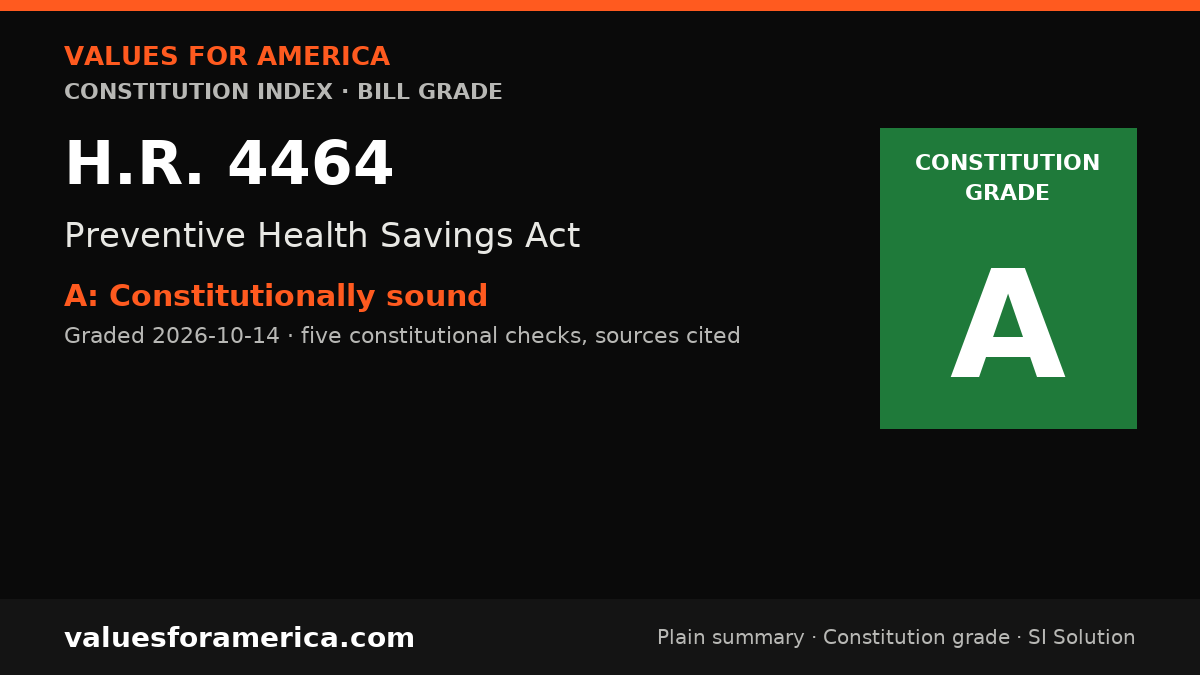
“VFA Constitution grade”
Constitutionally sound
Graded 2026-10-14
SI-generated grade · five published checks · not individually reviewed by a person · methodology
This bill is fully constitutional. It merely requires the Congressional Budget Office to produce supplementary estimates about long-term savings from preventive health care when Congress requests them. It does not expand federal power beyond existing enumerated authority, infringes no rights, respects individual sovereignty, properly leaves decisions at the congressional level, and imposes no takings or due process violations.
-
✓ Passes · Enumerated powers
Congress has broad authority under Article I, Section 8, Clause 18 (the Necessary and Proper Clause) to structure its own internal budgetary and legislative processes. Requiring the CBO to produce supplementary estimates is a procedural rule for how Congress evaluates legislation, not an exercise of substantive regulatory power. The bill does not command any private party or state to act; it only … -
✓ Passes · Bill of Rights
The bill imposes no restrictions on speech, religion, press, assembly, petition, arms, quartering, search and seizure, self-incrimination, due process, takings, trial rights, or cruel and unusual punishment. It does not regulate any person's conduct. It merely directs the CBO to produce estimates when Congress requests them. No provision of the Bill of Rights is implicated. -
✓ Passes · Individual sovereignty
The bill does not restrict what any individual may do with their person, property, speech, labor, or belief. It imposes no mandates, prohibitions, or penalties on private citizens. It only affects how the Congressional Budget Office performs its analytical functions. Individual sovereignty is untouched. -
✓ Passes · Decentralization
This bill operates entirely within the federal legislative branch's internal procedures. The four-question test is not directly applicable because the action is not a regulatory or coercive measure that could be handled at lower levels. However, applying the test: (1) an individual cannot set CBO scoring rules; (2) a local community cannot; (3) a state cannot; (4) the action does not consolidate d… -
✓ Passes · Due process and takings
The bill does not deprive any person of life, liberty, or property. It does not take private property for public use. It imposes no fines, forfeitures, or penalties. It does not bypass any hearing or notice requirement. The Fifth Amendment's Due Process and Takings Clauses are not implicated.
Sources: Congress.gov: HR 4464 summary
Report an error in this grade
What should pass
“VFA SI Solution”
No solution yet
A sourced SI draft appears here once it passes automated checks (Constitution citation, source verification, independent SI critic). How publication works.
Related on VFA

For journalists and bloggers
“Embed this grade”
Free to use with the link back. The badge and card update when the grade changes. Embed terms →
