H.R. 4423 explained · 119th Congress · Pending in Congress
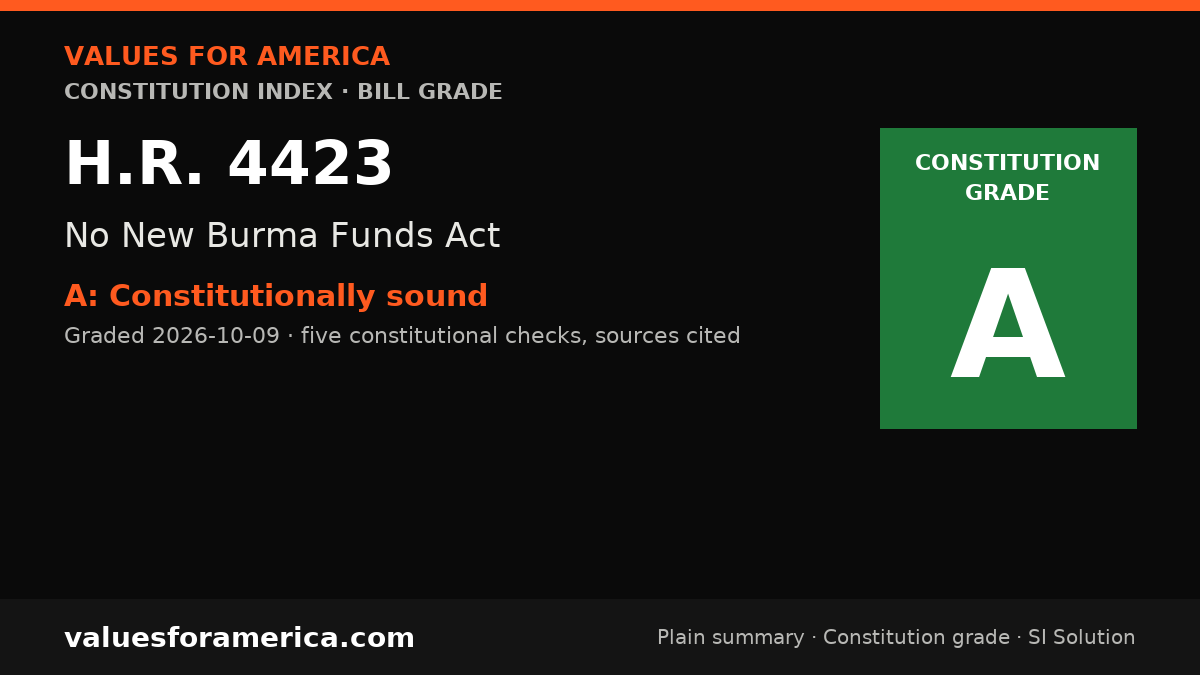
No New Burma Funds Act
Cosponsors: 3 (1 D, 2 R) · per Congress.gov, 2026-10-10
Introduced: 2025-07-15
Latest action (2025-12-02): Received in the Senate and Read twice and referred to the Committee on Foreign Relations.
What H.R. 4423 does, in plain terms
No New Burma Funds Act This bill requires the U.S. Executive Director at the International Bank for Reconstruction and Development (IBRD) to advocate and vote for a continued pause on IBRD disbursements and new financing commitments to Burma unless the Department of the Treasury determines this is not in the national interest. The IBRD is one of the two major lending facilities of the World Bank and provides loans, guarantees, risk management products, and advisory services to middle-income countries and some creditworthy low-income countries. The World Bank paused disbursements and new financing to Burma after a 2021 military coup in that country.
Official summary by the Congressional Research Service, via Congress.gov.
Constitution Index
“VFA Constitution grade”
Constitutionally sound
Graded 2026-10-09
SI-generated grade · five published checks · not individually reviewed by a person · methodology
HR 4423 is a straightforward exercise of federal authority over foreign affairs and international financial institutions. It does not infringe any constitutional rights, respects individual sovereignty, operates at the appropriate level of government (federal, as foreign policy cannot be handled by states or individuals), and raises no due process or takings concerns. The bill is fully constitutional.
-
✓ Passes · Enumerated powers
Congress has explicit constitutional authority over foreign commerce and the conduct of foreign affairs. Article I, Section 8, Clause 3 grants Congress power to 'regulate Commerce with foreign Nations,' and the Necessary and Proper Clause (Article I, Section 8, Clause 18) allows Congress to direct U.S. representatives at international financial institutions as a means of executing foreign policy. … -
✓ Passes · Bill of Rights
The bill imposes no restrictions on speech, religion, press, assembly, petition, arms, quartering, search and seizure, self-incrimination, due process, trial rights, jury rights, cruel and unusual punishment, or any other right protected by the first ten amendments. It addresses only U.S. government voting policy at an international bank and has no effect on the rights of any person within U.S. ju… -
✓ Passes · Individual sovereignty
The bill does not restrict what any individual may do with their own person, property, speech, labor, or belief. It imposes no mandates, prohibitions, or burdens on private citizens. The government action here—directing a vote at an international institution—does not implicate individual sovereignty in any way. -
✓ Passes · Decentralization
Foreign policy and international financial institution governance are inherently federal matters. An individual or family cannot handle international lending policy; a local community or county cannot; a state cannot (states are constitutionally barred from entering into foreign compacts or conducting foreign policy under Article I, Section 10). The bill does not consolidate decision-making upward… -
✓ Passes · Due process and takings
The bill does not deprive any person of life, liberty, or property without due process, nor does it take private property for public use without just compensation. It directs a government official's vote on international financing—no U.S. person's property or procedural rights are affected. The Fifth Amendment's Due Process and Takings Clauses are not implicated.
Sources: Congress.gov: HR 4423 summary
Report an error in this grade
What should pass
“VFA SI Solution”
No solution yet
A sourced SI draft appears here once it passes automated checks (Constitution citation, source verification, independent SI critic). How publication works.
Related on VFA

For journalists and bloggers
“Embed this grade”
Free to use with the link back. The badge and card update when the grade changes. Embed terms →
