H.R. 4405 explained · 119th Congress · Became law
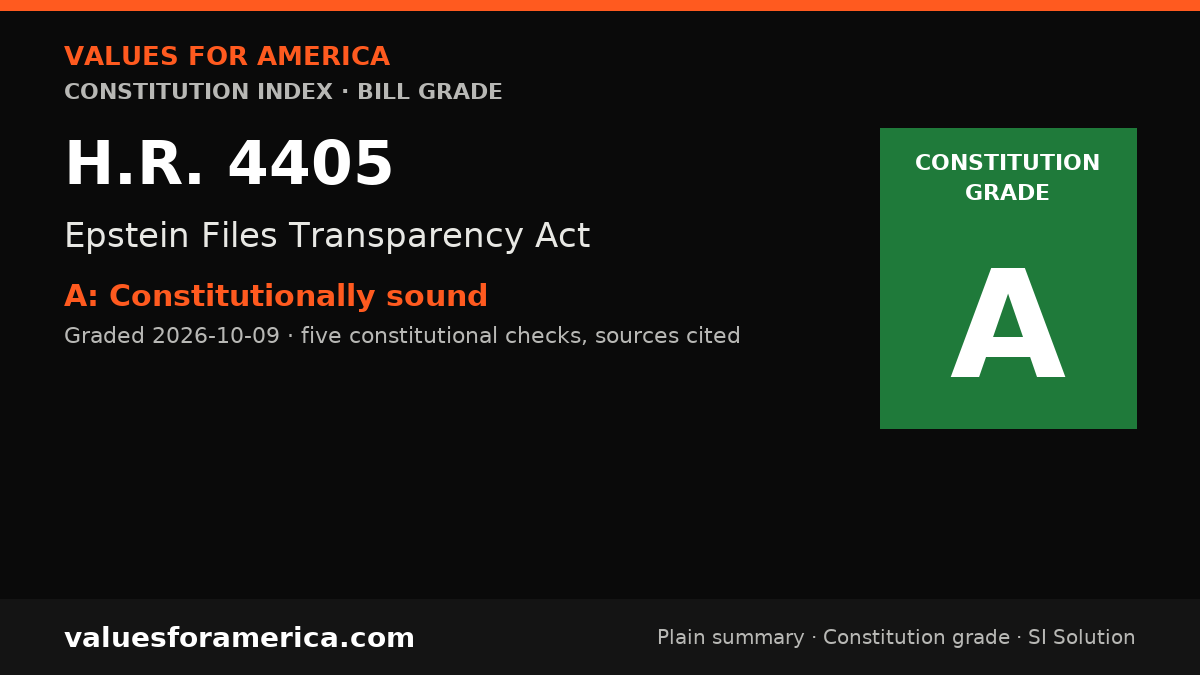
Epstein Files Transparency Act
Cosponsors: 24 (23 D, 1 R) · per Congress.gov, 2026-10-10
Introduced: 2025-07-15
Latest action (2025-11-19): Became Public Law No: 119-38.
What H.R. 4405 does, in plain terms
Epstein Files Transparency Act This act requires the Department of Justice (DOJ) to publish (in a searchable and downloadable format) all unclassified records, documents, communications, and investigative materials in DOJ's possession that relate to the investigation and prosecution of Jeffrey Epstein. This includes (1) materials that relate to Ghislaine Maxwell, (2) flight logs and travel records, and (3) individuals named or referenced (including government officials) in connection with the investigation and prosecution of Jeffrey Epstein. DOJ is permitted to withhold certain information such as the personal information of victims and materials that would jeopardize an active federal investigation. Additionally, not later than 15 days after the required publication, DOJ must report to Congress (1) all categories of information released and withheld, (2) a summary of any redactions made, and (3) a list of all government officials and politically exposed individuals named or referenced in the published materials.
Official summary by the Congressional Research Service, via Congress.gov.
Constitution Index
“VFA Constitution grade”
Constitutionally sound
Graded 2026-10-09
SI-generated grade · five published checks · not individually reviewed by a person · methodology
The Epstein Files Transparency Act is fully constitutional. It requires the Department of Justice to publish unclassified records related to the Epstein investigation, which falls squarely within Congress's enumerated power to oversee the executive branch and legislate on matters of federal criminal justice. The bill respects the Bill of Rights by explicitly protecting victim privacy and active investigations, does not restrict individual sovereignty, appropriately delegates to the federal level only what is necessary (since the records are already in federal custody), and provides no due process or takings violations.
-
✓ Passes · Enumerated powers
Congress has explicit authority under Article I, Section 8, Clause 18 (the Necessary and Proper Clause) to enact laws that facilitate the execution of federal powers, including the administration of justice and oversight of the Department of Justice. Requiring DOJ to publish records related to federal criminal investigations is a proper exercise of Congress's power to oversee the executive branch … -
✓ Passes · Bill of Rights
The bill does not infringe any provision of the Bill of Rights. It does not restrict speech, press, assembly, religion, or petition (First Amendment). It does not regulate arms (Second Amendment). It does not authorize unreasonable searches or seizures (Fourth Amendment) — rather, it mandates disclosure of already-existing government records. It explicitly protects victim privacy and active invest… -
✓ Passes · Individual sovereignty
This bill imposes no restriction on what individuals may do with their own person, property, speech, labor, or belief. It only requires the government to publish its own records. Individuals named in the records are not restricted in any way; the bill merely mandates transparency about government investigations. The burden on the government to justify this action is met by the compelling interest … -
✓ Passes · Decentralization
The bill passes all four questions of the decentralization test. (1) An individual or family could not handle this — the records are in federal custody. (2) A local community or county could not handle this — the records are federal. (3) A state could not handle this — the records belong to the federal DOJ. (4) The action does not consolidate decision-making upward unnecessarily; it merely require… -
✓ Passes · Due process and takings
The bill does not bypass due process or take property without just compensation. It requires publication of unclassified government records, with explicit protections for victim privacy and active investigations. No person is deprived of life, liberty, or property without due process of law (Fifth Amendment). No property is taken for public use without just compensation. The reporting requirement …
Sources: Congress.gov: HR 4405 summary
Report an error in this grade
What should pass
“VFA SI Solution”
No solution yet
A sourced SI draft appears here once it passes automated checks (Constitution citation, source verification, independent SI critic). How publication works.
Related on VFA

For journalists and bloggers
“Embed this grade”
Free to use with the link back. The badge and card update when the grade changes. Embed terms →
