H.R. 4371 explained · 119th Congress · Pending in Congress
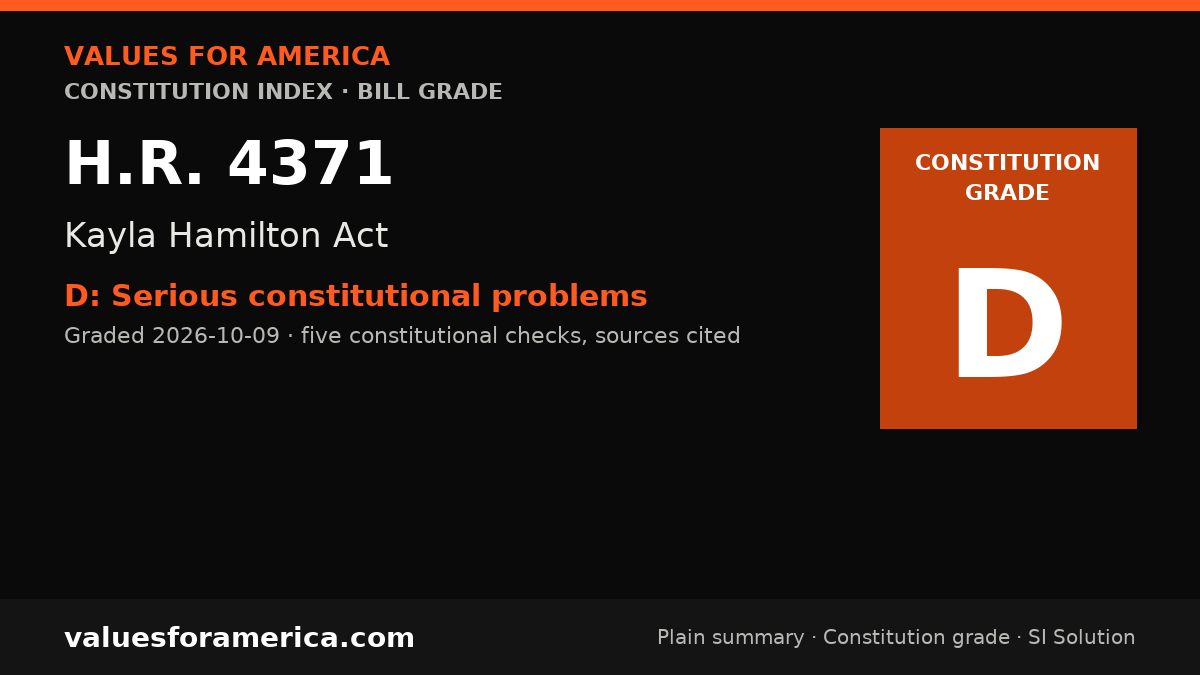
Kayla Hamilton Act
Cosponsors: 2 (0 D, 2 R) · per Congress.gov, 2026-10-09
Introduced: 2025-07-14
Latest action (2025-12-17): Received in the Senate.
What H.R. 4371 does, in plain terms
Kayla Hamilton Act This bill requires the Department of Health and Human Services (HHS) to consider additional information when it makes placement determinations for unaccompanied alien children in its custody. Under federal law, an unaccompanied alien child is a minor with no lawful immigration status and no parent or legal guardian in the United States to provide care and physical custody. Current law requires HHS to (1) place a child in the least restrictive setting that is in the child's best interest, and (2) assess the safety and suitability of a sponsor prior to placing a child with that sponsor. In determining the least restrictive setting, this bill requires (currently, permits) HHS to consider the child's danger to self, danger to the community, and flight risk. Additionally, the bill requires placement in a secure facility in the case of a child who is 13 years of age or older and has gang-related markings or tattoos or a history of gang-related arrests or criminal conduct. In assessing the safety and suitability of a sponsor, this bill requires HHS to collect and provide to the Department of Homeland Security information about all adult residents of the household, including name, date of birth, Social Security number, immigration status, contact information, and the results of all background and criminal records checks. The bill also prohibits HHS from placing a child with a sponsor who is unlawfully present in the United States.
Official summary by the Congressional Research Service, via Congress.gov.
Constitution Index
“VFA Constitution grade”
Serious constitutional problems
Graded 2026-10-09
SI-generated grade · five published checks · not individually reviewed by a person · methodology
The Kayla Hamilton Act is likely unconstitutional. Although Congress has clear power over immigration and federal custody of unaccompanied alien children, the bill's mandatory secure-facility rule would deprive children of liberty without individualized due process, and it would penalize expressive gang-related tattoos and prior arrests as conclusive evidence that secure confinement is required. The bill also restricts family placement based solely on immigration status. The bill needs structural revision: individualized hearings, proof of actual danger, and least-restrictive alternatives must be required.
-
✓ Passes · Enumerated powers
Congress has plenary authority over immigration and naturalization under Article I, Section 8, Clause 4, and the placement of unaccompanied alien children in federal custody is part of the federal immigration system. HHS custody decisions are within Congress's enumerated immigration power, so this is not a federal overreach into an area reserved to the states. -
✗ Concern · Bill of Rights
The bill requires secure-facility confinement for any child 13 or older with gang-related markings or tattoos or a history of gang-related arrests or criminal conduct. It creates an irrebuttable presumption without an individualized hearing, depriving the child of liberty in violation of Fifth Amendment due process. Tattoos and gang-related markings can also be expressive, so using them to trigger… -
✗ Concern · Individual sovereignty
A person's liberty, even a minor's, may be restricted only with a compelling constitutional justification and through fair procedures. The government has a legitimate interest in safety and immigration control, but the bill's blanket detention rule does not rest on individualized evidence of danger; it rests on status and prior arrests. The sponsor bar also restricts family unity and the right of … -
✓ Passes · Decentralization
Immigration and federal custody of unaccompanied alien children are national matters. This bill does not move decision-making to a higher level than necessary; it operates where the federal government already has custody and authority. It therefore raises no Tenth Amendment or federalism problem. -
✗ Concern · Due process and takings
The bill fails procedural due process under the Fifth Amendment. It mandates secure placement based on a child's tattoos or arrest history without providing notice, a hearing, an opportunity to challenge the gang-related finding, or an individualized determination that a secure facility is necessary. There is no takings issue because no property is taken, but the liberty deprivation is arbitrary a…
Sources: Congress.gov: HR 4371 summary
Report an error in this grade
What should pass
“VFA SI Solution”
No solution yet
A sourced SI draft appears here once it passes automated checks (Constitution citation, source verification, independent SI critic). How publication works.
Related on VFA

For journalists and bloggers
“Embed this grade”
Free to use with the link back. The badge and card update when the grade changes. Embed terms →
