H.R. 4305 explained · 119th Congress · Pending in Congress
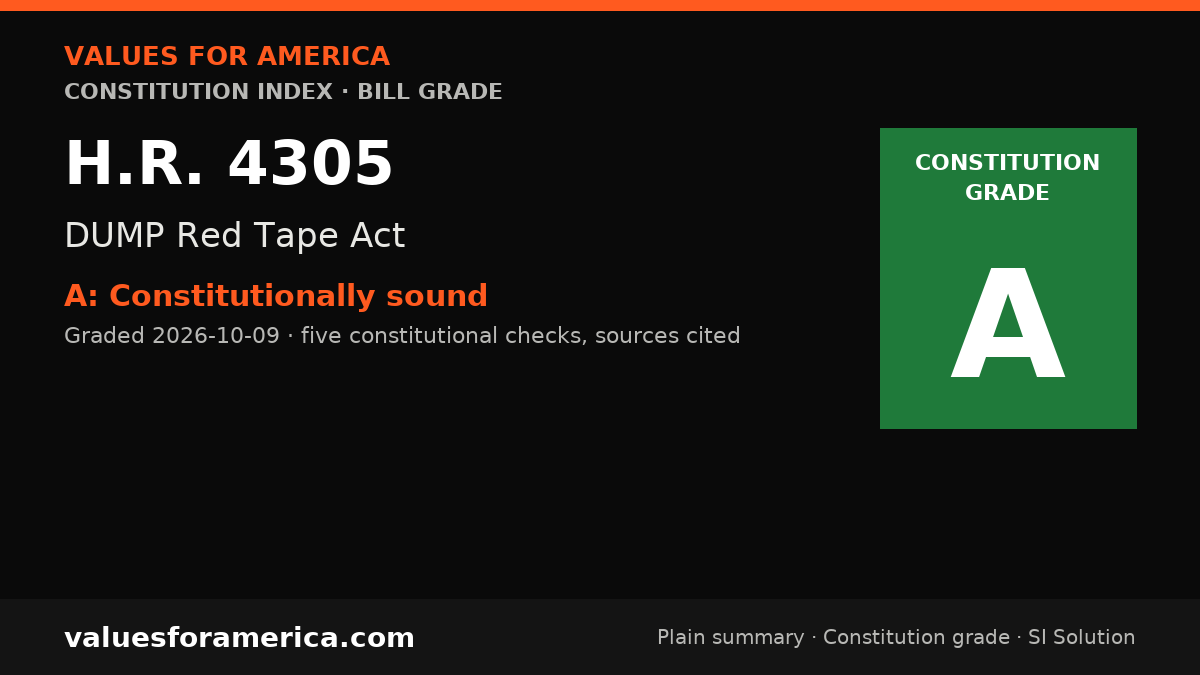
DUMP Red Tape Act
Cosponsors: 3 (0 D, 3 R) · per Congress.gov, 2026-10-10
Introduced: 2025-07-10
Latest action (2025-12-04): Received in the Senate and Read twice and referred to the Committee on Small Business and Entrepreneurship.
What H.R. 4305 does, in plain terms
Destroying Unnecessary, Misaligned, and Prohibitive Red Tape Act or the DUMP Red Tape Act This bill establishes a requirement for the Office of Advocacy of the Small Business Administration (SBA) to continue to operate and maintain the Red Tape Hotline, which receives notifications from small entities about the burden of complying with applicable rules, guidance, policy statements, or other activities of a federal agency. The office must report annually to the SBA and Congress information about the notifications received through the hotline.
Official summary by the Congressional Research Service, via Congress.gov.
Constitution Index
“VFA Constitution grade”
Constitutionally sound
Graded 2026-10-09
SI-generated grade · five published checks · not individually reviewed by a person · methodology
The bill is a narrow administrative measure directing the Small Business Administration's Office of Advocacy to maintain an existing hotline for small entities to report federal regulatory burdens and to report annually to Congress. It does not regulate private conduct, restrict rights, take property, or shift power upward beyond what is needed to address federal agency rules. It falls comfortably within Congress's enumerated powers.
-
✓ Passes · Enumerated powers
Congress has authority under Article I, Section 8, Clause 3 to regulate interstate commerce and under Article I, Section 8, Clause 18 to make laws necessary and proper for executing federal governmental functions. This bill does not regulate commerce directly; it directs an office of the Small Business Administration to operate a hotline and report on federal regulatory burdens. That is internal f… -
✓ Passes · Bill of Rights
The bill implicates none of the first ten amendments. It compels no speech, restricts no religion, press, assembly, or petition rights, authorizes no search or seizure, and imposes no criminal or civil penalty. The hotline is voluntary for small entities to use, and reporting to Congress is an ordinary informational function. -
✓ Passes · Individual sovereignty
The bill imposes no mandate on individuals or businesses. It does not restrict how a person may use their person, property, speech, labor, or belief. Small entities remain free to use or ignore the hotline. The burden of proving justification for a restriction is not triggered because there is no restriction. -
✓ Passes · Decentralization
The hotline concerns burdens imposed by federal agencies. An individual or family cannot compel changes to federal agency rules, a local community or county cannot resolve federal regulatory burden, and a state cannot require federal agencies to act. The federal level is the appropriate level for this information-gathering function, and the bill does not consolidate decision-making beyond the mini… -
✓ Passes · Due process and takings
The bill takes no property, imposes no adjudicative process, and deprives no person of life, liberty, or property. It merely establishes a reporting mechanism. There is no bypass of due process and no Takings Clause issue under the Fifth Amendment.
Sources: Congress.gov: HR 4305 summary
Report an error in this grade
What should pass
“VFA SI Solution”
No solution yet
A sourced SI draft appears here once it passes automated checks (Constitution citation, source verification, independent SI critic). How publication works.
Related on VFA

For journalists and bloggers
“Embed this grade”
Free to use with the link back. The badge and card update when the grade changes. Embed terms →
