H.R. 43 explained · 119th Congress · Became law
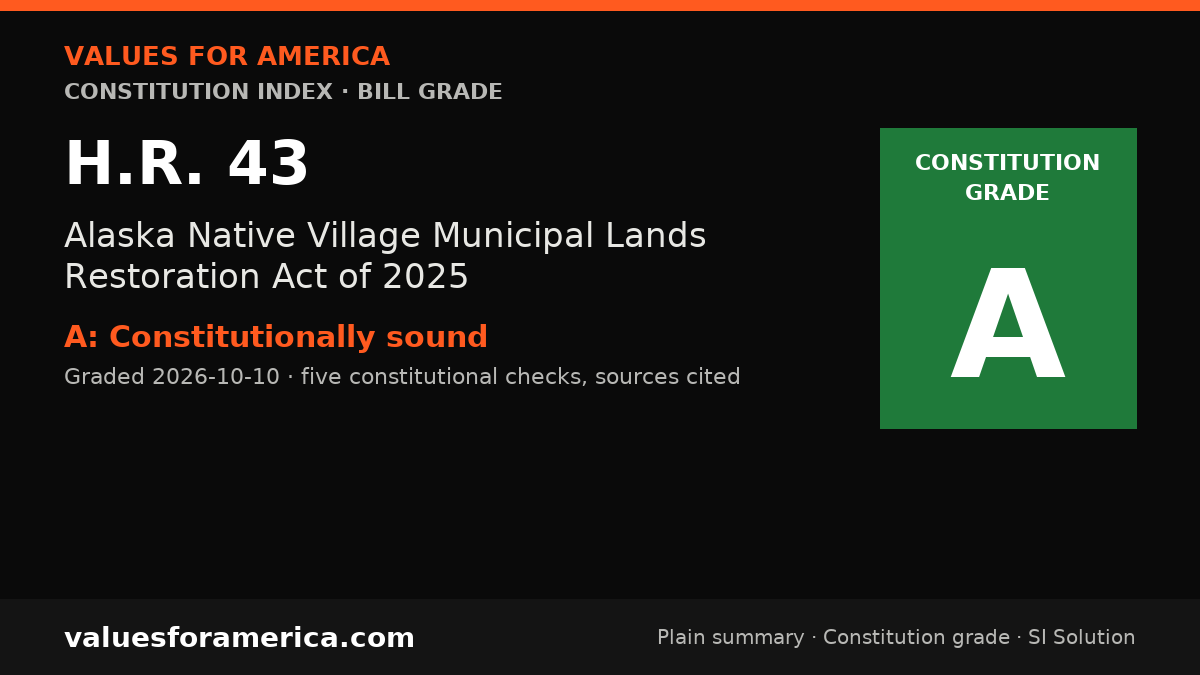
Alaska Native Village Municipal Lands Restoration Act of 2025
Cosponsors: none · per Congress.gov, 2026-10-11
Introduced: 2025-01-03
Latest action (2025-07-07): Became Public Law No: 119-23.
What H.R. 43 does, in plain terms
Alaska Native Village Municipal Lands Restoration Act of 2025 This act removes the requirement that Alaska Native village corporations must convey lands to Alaska to be held in trust for future municipal governments. The Alaska Native Claims Settlement Act (ANCSA) requires all Alaska Native village corporations that receive land under the ANCSA to convey certain lands to the existing municipality in the village or, if no municipality exists, to Alaska in trust for any municipality that may be established in the future. This act removes the requirement for conveyance. Additionally, the act allows village corporations to regain title to the lands held in trust by dissolving the trust through formal resolution by the village corporation and the residents of the Native village.
Official summary by the Congressional Research Service, via Congress.gov.
Constitution Index
“VFA Constitution grade”
Constitutionally sound
Graded 2026-10-10
SI-generated grade · five published checks · not individually reviewed by a person · methodology
This act is constitutional. It removes a federal mandate on Alaska Native village corporations, restoring their control over lands they received under the Alaska Native Claims Settlement Act. It does not expand federal power, infringe on rights, or violate due process. It appropriately returns decision-making to the affected Native communities and their residents.
-
✓ Passes · Enumerated powers
Congress has broad authority over Indian affairs under Article I, Section 8, Clause 3 (the Indian Commerce Clause), and this act is a direct amendment to the Alaska Native Claims Settlement Act, a federal statute governing Native lands. The act is within this enumerated power. -
✓ Passes · Bill of Rights
The act does not infringe on any of the first ten amendments. It removes a federal requirement and allows village corporations and residents to dissolve a trust, which is a property right, not a restriction. No speech, religion, assembly, press, petition, arms, quartering, search, self-incrimination, due process, takings, trial, jury, or cruel and unusual punishment issues are implicated. -
✓ Passes · Individual sovereignty
The act enhances individual and community sovereignty by removing a federal mandate that forced conveyance of lands. It allows village corporations and residents to regain title to lands held in trust, restoring control over their own property. This is a positive exercise of self-determination, not a restriction. -
✓ Passes · Decentralization
The act decentralizes decision-making by removing a federal requirement and allowing village corporations and residents to decide whether to dissolve a trust. It does not consolidate power upward; it returns control to the most local level—the Native village and its residents. All four questions are answered in favor of decentralization. -
✓ Passes · Due process and takings
The act does not take property without just compensation. It actually restores title to village corporations by dissolving a trust through formal resolution by the corporation and residents, which is a consensual process. No due process rights are bypassed; the act provides a clear procedure for the dissolution.
Sources: Congress.gov: HR 43 summary
Report an error in this grade
What should pass
“VFA SI Solution”
No solution yet
A sourced SI draft appears here once it passes automated checks (Constitution citation, source verification, independent SI critic). How publication works.
Related on VFA

For journalists and bloggers
“Embed this grade”
Free to use with the link back. The badge and card update when the grade changes. Embed terms →
