H.R. 4275 explained · 119th Congress · Pending in Congress
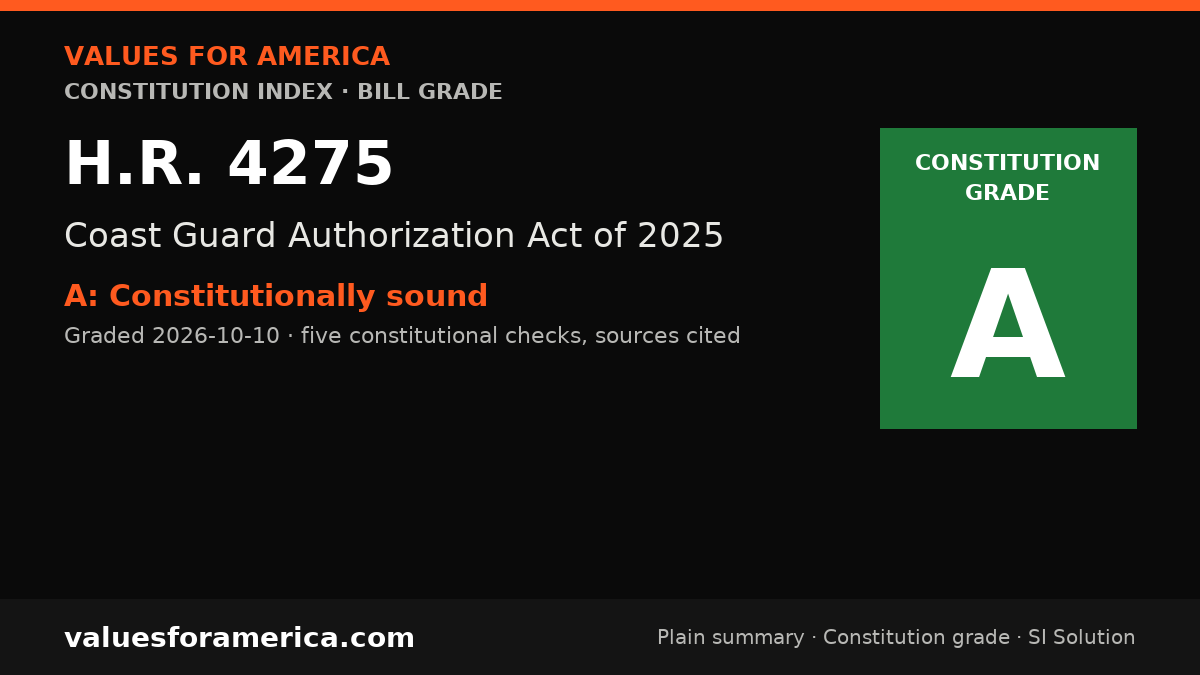
Coast Guard Authorization Act of 2025
Cosponsors: 4 (2 D, 2 R) · per Congress.gov, 2026-10-11
Introduced: 2025-07-02
Latest action (2025-07-23): Received in the Senate and Read twice and referred to the Committee on Commerce, Science, and Transportation.
What H.R. 4275 does, in plain terms
The Congressional Research Service has not published a summary of H.R. 4275 yet. Its official title: “Coast Guard Authorization Act of 2025”.
Constitution Index
“VFA Constitution grade”
Constitutionally sound
Graded 2026-10-10
SI-generated grade · five published checks · not individually reviewed by a person · methodology
The Coast Guard Authorization Act of 2025 is a routine authorization bill that operates squarely within Congress's enumerated powers under Article I, Section 8, Clauses 11–16 (to raise and support Armies, provide and maintain a Navy, make rules for the regulation of the land and naval forces, and provide for calling forth the militia to execute the laws of the Union). The bill addresses internal Coast Guard organization, personnel policies, vessel safety, pollution response, and sexual misconduct prevention—all matters of federal military and maritime authority. It does not infringe upon any Bill of Rights protections, restrict individual sovereignty without compelling justification, improperly consolidate power upward, or violate due process or takings protections. The bill passes all five constitutional checks with no significant issues.
-
✓ Passes · Enumerated powers
Congress has explicit constitutional authority to raise and support armies, provide and maintain a navy, and make rules for the regulation of the land and naval forces under Article I, Section 8, Clauses 11–16. The Coast Guard is a military service and a federal law enforcement agency operating under federal maritime jurisdiction. This bill authorizes appropriations, sets organizational structure,… -
✓ Passes · Bill of Rights
The bill does not restrict speech, religion, assembly, press, petition (First Amendment); does not infringe the right to keep and bear arms (Second Amendment); does not authorize quartering of soldiers (Third Amendment); does not expand warrantless searches or seizures (Fourth Amendment); does not compel self-incrimination or deny due process (Fifth Amendment); does not impair fair trial rights (S… -
✓ Passes · Individual sovereignty
The bill primarily governs the internal operations of the Coast Guard as a federal military service. Restrictions on personnel conduct, reporting requirements, and security clearance vetting are standard military discipline and security measures that serve compelling governmental interests in maintaining a functional armed force and protecting national security. These restrictions are narrowly tai… -
✓ Passes · Decentralization
The Coast Guard is a federal military and law enforcement agency responsible for maritime safety, security, and environmental protection that inherently requires national-level coordination and resources. An individual or family cannot handle Coast Guard functions (Question 1: false). A local community or county cannot handle Coast Guard functions (Question 2: false). A state cannot handle Coast G… -
✓ Passes · Due process and takings
The bill does not bypass procedural due process, deny presumption of innocence, or take private property without just compensation. Provisions regarding personnel separation, security clearance vetting, and misconduct investigations are internal military procedures that operate under the Uniform Code of Military Justice and established military due process standards. The bill does not authorize an…
Report an error in this grade
What should pass
“VFA SI Solution”
No solution yet
A sourced SI draft appears here once it passes automated checks (Constitution citation, source verification, independent SI critic). How publication works.
Related on VFA

For journalists and bloggers
“Embed this grade”
Free to use with the link back. The badge and card update when the grade changes. Embed terms →
