H.R. 4219 explained · 119th Congress · Pending in Congress
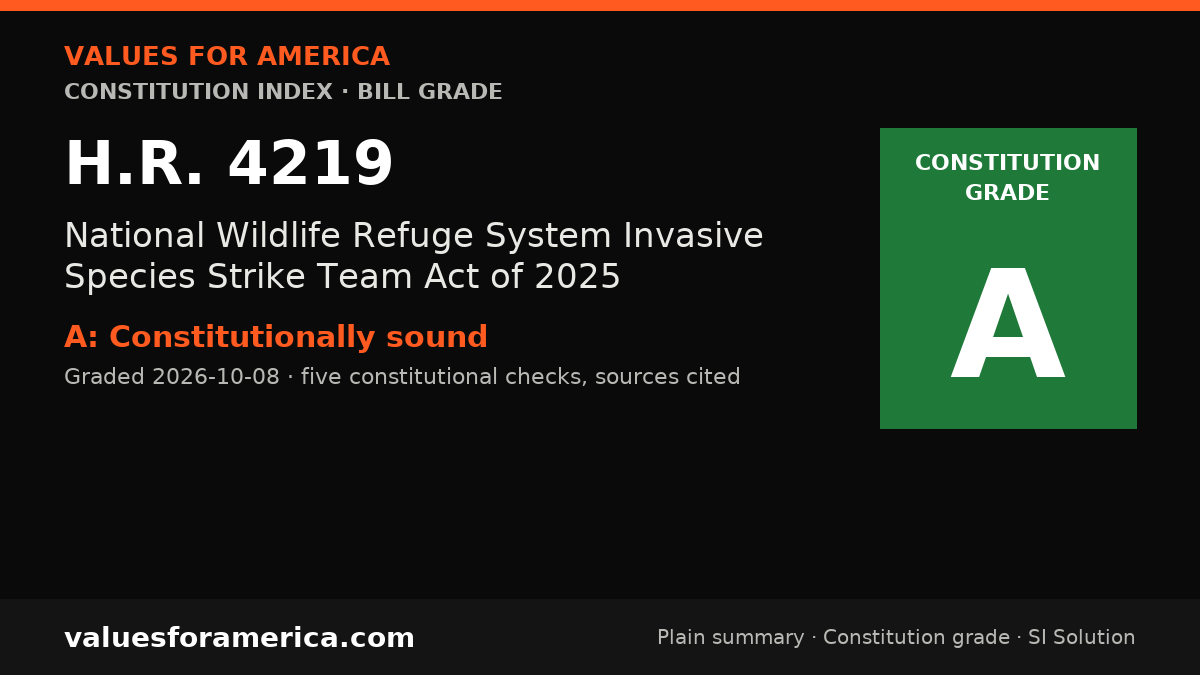
National Wildlife Refuge System Invasive Species Strike Team Act of 2025
Cosponsors: 1 (0 D, 1 R) · per Congress.gov, 2026-10-14
Introduced: 2025-06-27
Latest action (2026-09-15): Received in the Senate and Read twice and referred to the Committee on Environment and Public Works.
What H.R. 4219 does, in plain terms
National Wildlife Refuge System Invasive Species Strike Team Act of 2025 This bill provides statutory authority for the Invasive Species Strike Team program carried out by the National Wildlife Refuge System within the U.S. Fish and Wildlife Service (FWS). This program operates teams in each FWS region that coordinate with public and private entities to address invasive species and related conservation issues in and around the National Wildlife Refuge System. The bill requires FWS to report to Congress on the program's work and progress towards addressing invasive species that pose a major concern to the environment, human health, or the economy.
Official summary by the Congressional Research Service, via Congress.gov.
Constitution Index
“VFA Constitution grade”
Constitutionally sound
Graded 2026-10-08
SI-generated grade · five published checks · not individually reviewed by a person · methodology
HR 4219 gives statutory authority to an existing refuge-based invasive species program and requires a progress report. Congress is acting on federal property it already owns, which the Property Clause expressly authorizes, with no rights infringement, no private mandate, and no upward power grab.
-
✓ Passes · Enumerated powers
Congress has explicit authority under the Property Clause, Article IV, Section 3, Clause 2, to 'dispose of and make all needful Rules and Regulations respecting the Territory or other Property belonging to the United States.' The National Wildlife Refuge System is federal property. Authorizing strike teams to address invasive species on and around that property, plus requiring a report under the N… -
✓ Passes · Bill of Rights
No provision authorizes searches, seizures, speech restrictions, arms restrictions, or other infringement of the first ten amendments. The bill creates program authority and a reporting requirement for refuge lands, with coordination with public and private entities, not compulsion, censorship, or criminal penalty. No Fourth Amendment search, First Amendment speech/assembly burden, Second Amendmen… -
✓ Passes · Individual sovereignty
The bill does not restrict any person's body, property, speech, labor, or belief. Coordination with private entities is described as cooperative program work, not a mandate, prohibition, or condition on private land use. The government bears the burden to justify restrictions, but no restriction exists here to justify, so sovereignty is unimpaired. -
✓ Passes · Decentralization
(1) Individuals/families cannot manage landscape-scale invasive species across 570+ federal refuges. (2) Local counties cannot administer a national federal-property system. (3) States cannot directly manage federal refuge property without federal authorization. (4) No upward consolidation occurs because authority stays at the minimum necessary level: Congress managing existing federal property it… -
✓ Passes · Due process and takings
No deprivation of life, liberty, or property and no taking under the Fifth Amendment. No fines, forfeitures, licensing revocations, criminal process, or property seizure. The Fifth Amendment Due Process Clause and Takings Clause therefore require no additional notice, hearing, or just compensation for this program-authorization and congressional reporting requirement.
Sources: Congress.gov: HR 4219 summary
Report an error in this grade
What should pass
“VFA SI Solution”
No solution yet
A sourced SI draft appears here once it passes automated checks (Constitution citation, source verification, independent SI critic). How publication works.
Related on VFA

For journalists and bloggers
“Embed this grade”
Free to use with the link back. The badge and card update when the grade changes. Embed terms →
