H.R. 403 explained · 119th Congress · Pending in Congress
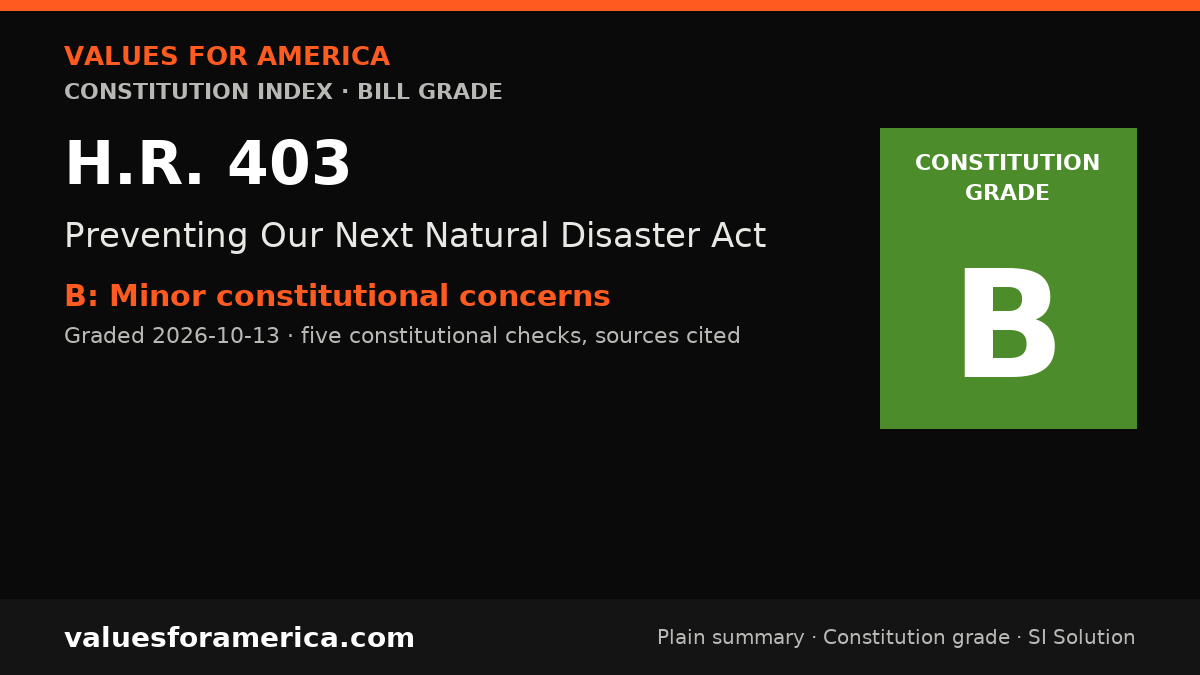
Preventing Our Next Natural Disaster Act
Cosponsors: 6 (6 D, 0 R) · per Congress.gov, 2026-10-12
Introduced: 2025-01-14
Latest action (2025-01-15): Referred to the Subcommittee on Economic Development, Public Buildings, and Emergency Management.
What H.R. 403 does, in plain terms
Preventing Our Next Natural Disaster Act This bill modifies the Building Resilient Infrastructure and Communities (BRIC) grant program of the Federal Emergency Management Agency (FEMA). Specifically, the bill increases the amount that may be set aside from FEMA's Disaster Relief Fund for BRIC from 6% to 15% of certain disaster grant amounts; authorizes FEMA to set aside 2% from the BRIC 15% set-aside for assistance with community planning and capacity building; provides a 90% federal cost share for BRIC grants to environmental justice communities, and increases the maximum number of people in small impoverished communities, which are also eligible for the 90% BRIC federal cost share; and authorizes FEMA to develop guidance regarding how to incorporate climate change into the National Risk Index, benefit-cost analyses, and improved codes, specifications, and standards to address natural hazards. FEMA must prioritize BRIC assistance for high hazard risk communities, environmental justice communities, communities with low tax revenue base per capita, and communities with a low rate of code adoption and enforcement and infrastructure maintenance expenditures; provide community outreach on project planning and grant administration; and establish a central federal database to consolidate funding data collected by all local, state, and federal agencies involved in post-disaster response and pre-disaster mitigation spending and categorize the data by type of project, funding source, and hazard types using a user-friendly database and interactive map.
Official summary by the Congressional Research Service, via Congress.gov.
Constitution Index
“VFA Constitution grade”
Minor constitutional concerns
Graded 2026-10-13
SI-generated grade · five published checks · not individually reviewed by a person · methodology
The bill operates within FEMA's existing statutory authority and does not infringe on individual rights. Its primary constitutional tension lies in the centralization of disaster data and the use of environmental justice classifications, which raise federalism and equal protection concerns, but these are not fatal to the bill's constitutionality.
-
✓ Passes · Enumerated powers
The bill amends the BRIC grant program, which is part of FEMA's disaster relief and mitigation efforts. Congress has authority under Article I, Section 8, Clause 1 (Spending Clause) to appropriate funds for the general welfare, and under the Commerce Clause (Article I, Section 8, Clause 3) to regulate activities that substantially affect interstate commerce, including disaster mitigation and respo… -
✓ Passes · Bill of Rights
The bill does not restrict speech, religion, assembly, press, petition, arms, quartering, search and seizure, self-incrimination, due process, takings, trial rights, or cruel and unusual punishment. It imposes no criminal penalties and does not authorize searches or seizures. The environmental justice provisions do not infringe on any enumerated right. -
✓ Passes · Individual sovereignty
The bill does not restrict individual liberty. It provides grants and incentives for communities to adopt building codes and plan for disasters, but it does not mandate individual behavior. The 90% cost share for certain communities is a benefit, not a burden. The central database collects government spending data, not personal information, so it does not intrude on individual privacy or property. -
✗ Concern · Decentralization
The bill fails the decentralization test because it consolidates data collection and planning at the federal level. While individuals and local communities can handle some disaster mitigation, the scale of natural disasters often exceeds local capacity, and states have historically relied on federal assistance. However, the bill's requirement for a central federal database of all local, state, and… -
✓ Passes · Due process and takings
The bill does not take property without just compensation. It provides grants and does not impose new taxes or regulations that would constitute a taking. The prioritization of certain communities for grants does not deprive others of property or liberty without due process; it is a discretionary allocation of funds, not a punitive measure.
Sources: Congress.gov: HR 403 summary
Report an error in this grade
What should pass
“VFA SI Solution”
No solution yet
A sourced SI draft appears here once it passes automated checks (Constitution citation, source verification, independent SI critic). How publication works.
Related on VFA

For journalists and bloggers
“Embed this grade”
Free to use with the link back. The badge and card update when the grade changes. Embed terms →
