H.R. 4 explained · 119th Congress · Became law
Rescissions Act of 2025
Cosponsors: 5 (0 D, 5 R) · per Congress.gov, 2026-10-11
Introduced: 2025-06-06
Latest action (2025-07-24): Became Public Law No: 119-28.
What H.R. 4 does, in plain terms
Rescissions Act of 2025 This act rescinds specified unobligated funds that were provided to the Department of State, the U.S. Agency for International Development (USAID), various independent and related agencies, and the Corporation for Public Broadcasting. The rescissions were proposed by the President under procedures included in the Congressional Budget and Impoundment Control Act of 1974. Under current law, the President may propose rescissions to Congress using specified procedures, and the rescissions must be enacted into law to take effect. Specifically, the act rescinds funds that were provided to the State Department or the President for Contributions to International Organizations; Contributions for International Peacekeeping Activities; Global Health Programs (excluding funds for programs addressing HIV/AIDS, tuberculosis, malaria, nutrition, or maternal and child health); Migration and Refugee Assistance; the Complex Crises Fund; the Democracy Fund; the Economic Support Fund (excluding funds for assistance to Jordan, Egypt, or the Countering PRC Influence Fund); Contributions to the Clean Technology Fund; International Organization and Programs; Development Assistance (excluding funds for Feed the Future Innovation Labs, the Countering PRC Influence Fund, or commodity-based food aid); Assistance for Europe, Eurasia, and Central Asia; International Disaster Assistance (excluding funds for commodity-based food aid); and Transition Initiatives. The act also rescinds funds that were provided for USAID Operating Expenses, the Inter-American Foundation, the U.S. African Development Foundation, the U.S. Institute of Peace, and the Corporation for Public Broadcasting.
Official summary by the Congressional Research Service, via Congress.gov.
Constitution Index
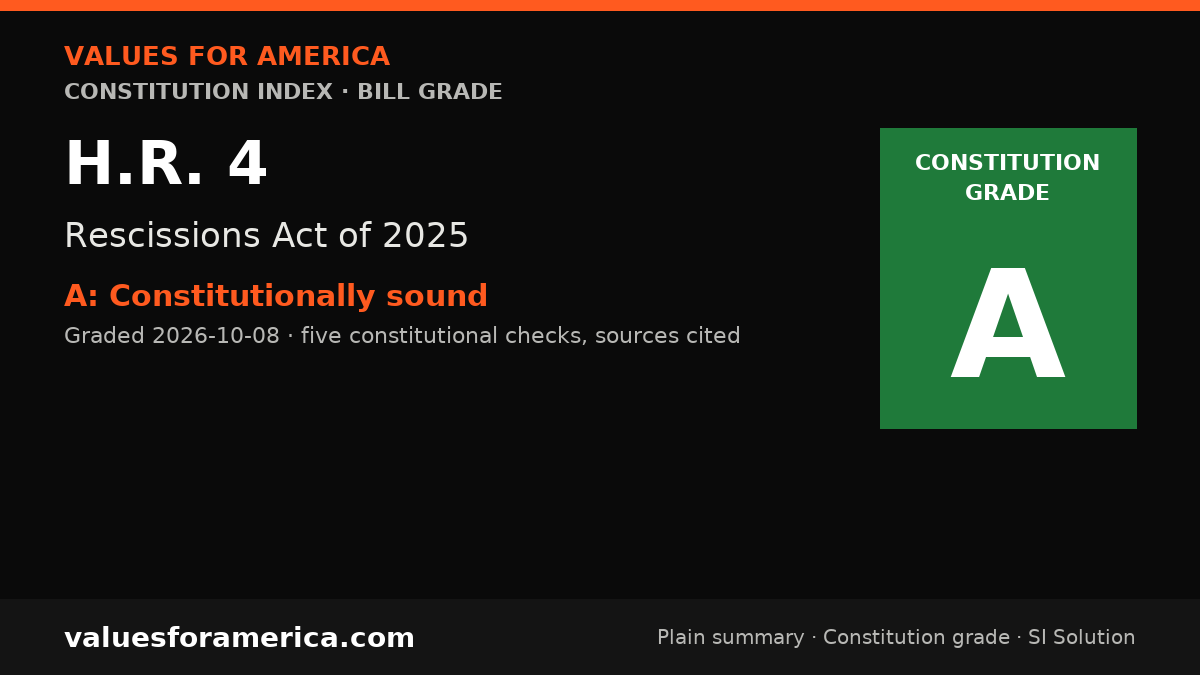
“VFA Constitution grade”
Constitutionally sound
Graded 2026-10-08
SI-generated grade · five published checks · not individually reviewed by a person · methodology
Congress exercised its core appropriations power to cancel unspent federal funds. It censors no one, mandates nothing, takes no private property, and reduces federal scope, leaving private and local action freer.
-
✓ Passes · Enumerated powers
Congress holds the power of the purse. Article I, Section 8, Clause 1 authorizes Congress to provide for the common Defence and general Welfare through spending, and Article I, Section 9, Clause 7 provides that no money shall be drawn from the Treasury but in consequence of appropriations made by law. A rescission enacted by Congress directly exercises that appropriations authority by reducing pri… -
✓ Passes · Bill of Rights
No First Amendment or other Bill of Rights provision requires Congress to subsidize speech, press, or international activity. Ending funding for the Corporation for Public Broadcasting does not censor, compel, or punish speech; private broadcasters remain free to speak. No search under the Fourth Amendment, no arms regulation under the Second Amendment, no quartering, self-incrimination, trial, ju… -
✓ Passes · Individual sovereignty
The act imposes no mandate, prohibition, or penalty on personal conduct, property use, speech, labor, or belief. It removes federal spending rather than restricting individual choice, leaving persons free to donate to, support, or operate media, health, refugee, and development efforts privately. The government bears no additional burden to justify because no individual liberty is curtailed. -
✓ Passes · Decentralization
The act moves decision-making downward by withdrawing federal funding and control from foreign aid programs and domestic media subsidies. Individuals, local communities, charities, and states can support media, relief, and development work voluntarily without federal direction. It does not consolidate power upward and does not command states; it reduces federal scope consistent with the Tenth Amen… -
✓ Passes · Due process and takings
No person is deprived of life, liberty, or property without due process under the Fifth Amendment, and no private property is taken for public use. Rescission of unobligated appropriations cancels unspent government spending authority; an expected grant or subsidy is not a vested property right requiring just compensation. The act was enacted by Congress as public law with notice and legislative p…
Sources: Congress.gov: HR 4 summary
Report an error in this grade
What should pass
“VFA SI Solution”
No solution yet
A sourced SI draft appears here once it passes automated checks (Constitution citation, source verification, independent SI critic). How publication works.
Related on VFA

For journalists and bloggers
“Embed this grade”
Free to use with the link back. The badge and card update when the grade changes. Embed terms →
