H.R. 3898 explained · 119th Congress · Pending in Congress
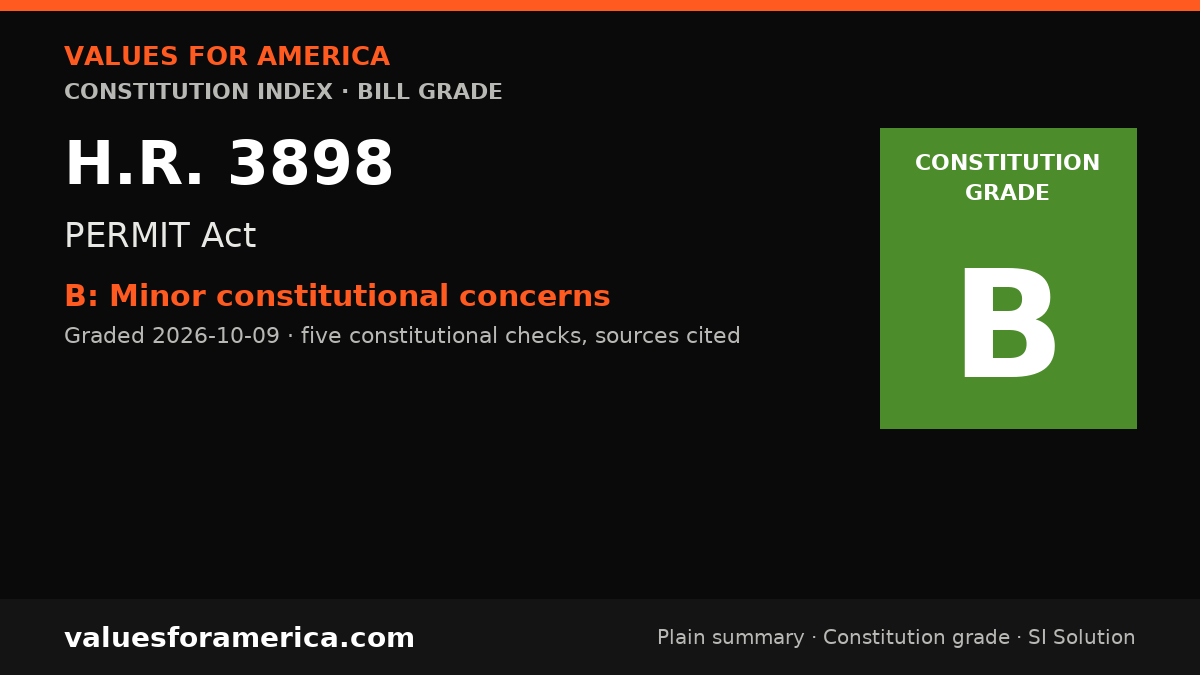
PERMIT Act
Cosponsors: 8 (0 D, 8 R) · per Congress.gov, 2026-10-09
Introduced: 2025-06-11
Latest action (2025-12-15): Received in the Senate and Read twice and referred to the Committee on Environment and Public Works.
What H.R. 3898 does, in plain terms
Promoting Efficient Review for Modern Infrastructure Today Act or the PERMIT Act This bill limits the scope of the Clean Water Act by redefining navigable waters to exclude (1) waste treatment systems, (2) ephemeral features that flow only in direct response to precipitation, (3) prior converted cropland, (4) groundwater, or (5) any other features determined to be excluded by the U.S. Army Corps of Engineers.
Official summary by the Congressional Research Service, via Congress.gov.
Constitution Index
“VFA Constitution grade”
Minor constitutional concerns
Graded 2026-10-09
SI-generated grade · five published checks · not individually reviewed by a person · methodology
The PERMIT Act is a federal statute that redefines 'navigable waters' under the Clean Water Act. It operates within Congress's enumerated commerce power over navigable waters (Article I, Section 8, Clause 3) and does not directly infringe individual rights, though its narrowing of federal jurisdiction raises minor decentralization concerns by potentially shifting regulatory gaps to states or leaving some waters unprotected.
-
✓ Passes · Enumerated powers
Congress has authority under the Commerce Clause (Article I, Section 8, Clause 3) to regulate navigable waters. The Clean Water Act's jurisdiction over 'navigable waters' has been upheld by the Supreme Court as within this power. This bill merely redefines the scope of that jurisdiction, which is a legislative choice within Congress's enumerated powers. It does not exceed federal authority because… -
✓ Passes · Bill of Rights
The bill does not implicate any of the first ten amendments. It does not restrict speech, religion, assembly, press, petition, arms, quartering, search and seizure, self-incrimination, due process, fair trial, jury, cruel and unusual punishment, unenumerated rights, or reserved powers. It is a regulatory definition change with no direct impact on individual liberties. -
✓ Passes · Individual sovereignty
The bill does not restrict what a person can do with their own person, property, speech, labor, or belief. It redefines federal regulatory jurisdiction, which may reduce federal permitting requirements for certain water features, thereby potentially increasing individual freedom to use property without federal interference. No compelling constitutional justification is needed because no restrictio… -
✗ Concern · Decentralization
The bill fails the decentralization test because it consolidates decision-making at the federal level by defining what waters are excluded from federal jurisdiction, rather than leaving that determination to states or localities. However, it passes three of the four questions: (1) individuals cannot handle this alone because water regulation involves interstate impacts; (2) local communities canno… -
✓ Passes · Due process and takings
The bill does not bypass due process, presumption of innocence, or take property without just compensation. It is a legislative definition change that applies prospectively. No individual is deprived of life, liberty, or property without a hearing. The Takings Clause (Fifth Amendment) is not implicated because the bill does not physically take property or deprive it of all economic value; it merel…
Sources: Congress.gov: HR 3898 summary
Report an error in this grade
What should pass
“VFA SI Solution”
No solution yet
A sourced SI draft appears here once it passes automated checks (Constitution citation, source verification, independent SI critic). How publication works.
Related on VFA

For journalists and bloggers
“Embed this grade”
Free to use with the link back. The badge and card update when the grade changes. Embed terms →
