H.R. 375 explained · 119th Congress · Pending in Congress
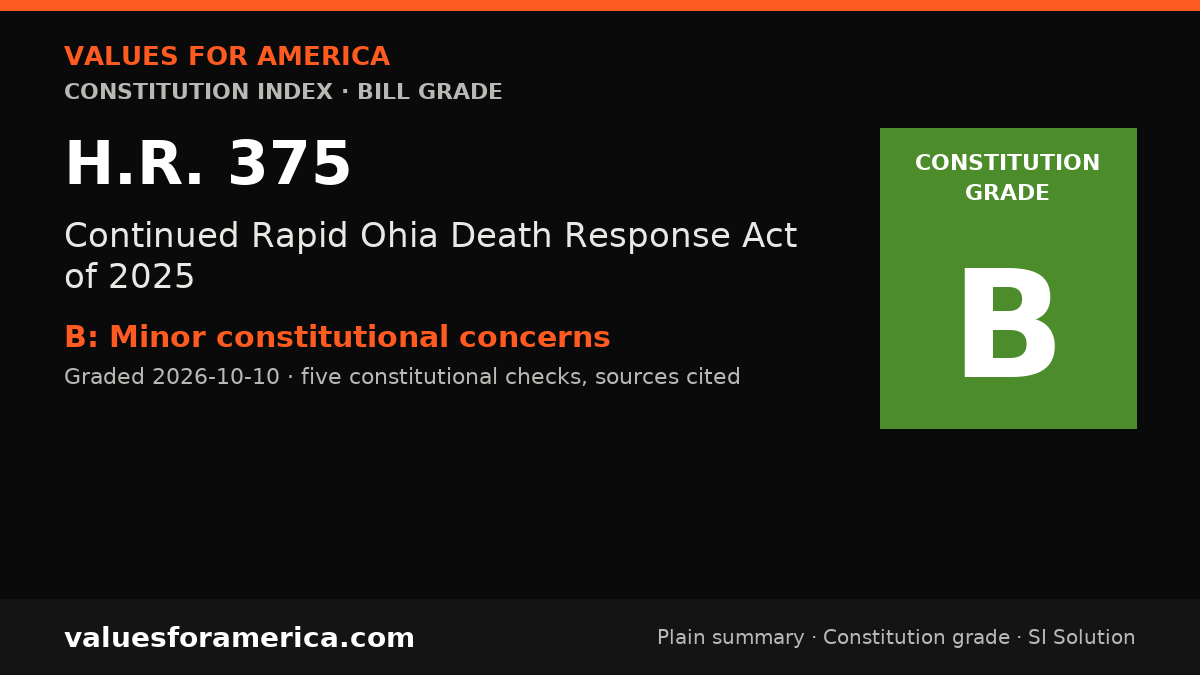
Continued Rapid Ohia Death Response Act of 2025
Cosponsors: 1 (1 D, 0 R) · per Congress.gov, 2026-10-12
Introduced: 2025-01-13
Latest action (2025-01-24): Received in the Senate and Read twice and referred to the Committee on Agriculture, Nutrition, and Forestry.
What H.R. 375 does, in plain terms
Continued Rapid Ohia Death Response Act of 2025 This bill establishes requirements to research and control Rapid Ohia Death, which is the disease caused by the fungal pathogen known as Ceratocystis fimbriata that affects the tree of the species Metrosideros polymorpha. Specifically, the Department of the Interior must partner with the Department of Agriculture (USDA) and Hawaii to control and address Rapid Ohia Death. In addition, the U.S. Geological Survey and the Forest Service Institute of Pacific Islands Forestry must continue to research Rapid Ohia Death vectors and transmission. The U.S. Fish and Wildlife Service must continue to partner with USDA, Hawaii, and local stakeholders to manage ungulates (e.g., certain mammals such as deer) in Rapid Ohia Death control areas on federal, state, and private land, with the consent of private landowners. Finally, the Forest Service must provide (1) financial assistance to prevent the spread of the fungus and to restore the native forests of Hawaii, and (2) staff and necessary infrastructure funding to the Institute of Pacific Islands Forestry to research the fungus.
Official summary by the Congressional Research Service, via Congress.gov.
Constitution Index
“VFA Constitution grade”
Minor constitutional concerns
Graded 2026-10-10
SI-generated grade · five published checks · not individually reviewed by a person · methodology
The bill generally operates within federal enumerated powers over interstate commerce, public lands, and scientific research, and it respects state and private property rights by requiring consent for actions on non-federal land. However, it raises minor concerns about federal involvement in areas that could be handled at lower levels of government, and the financial assistance provisions may create incentives that consolidate decision-making at the federal level.
-
✓ Passes · Enumerated powers
The federal government has authority under the Property Clause (Article IV, Section 3, Clause 2) to manage federal lands and resources, and under the Commerce Clause (Article I, Section 8, Clause 3) to address threats to interstate commerce, including agricultural and forestry diseases. The bill's provisions for research, control, and financial assistance are reasonably tied to these powers, as Ra… -
✓ Passes · Bill of Rights
The bill does not infringe on any of the first ten amendments. It does not restrict speech, religion, assembly, press, petition, arms, quartering, search and seizure, self-incrimination, due process, takings, fair trial, jury, cruel and unusual punishment, or unenumerated rights. The provisions are regulatory and research-oriented, not punitive or restrictive of individual liberties. -
✓ Passes · Individual sovereignty
The bill does not restrict individual action. It imposes no mandates on private persons or businesses. The only interaction with private property is the requirement that the Fish and Wildlife Service obtain the consent of private landowners before managing ungulates on private land, which respects property rights. Financial assistance is voluntary and does not compel participation. -
✗ Concern · Decentralization
The bill fails the decentralization test because it consolidates decision-making at the federal level for activities that could be handled by states or local communities. Specifically, the federal government directs research, control, and financial assistance, whereas Hawaii and local stakeholders could manage the response with less federal involvement. However, the bill does include partnerships … -
✓ Passes · Due process and takings
The bill does not bypass due process or take property without just compensation. It does not authorize seizure of private property; rather, it requires consent for actions on private land. Any federal actions on federal land are within federal authority. The financial assistance provisions are voluntary and do not constitute a taking.
Sources: Congress.gov: HR 375 summary
Report an error in this grade
What should pass
“VFA SI Solution”
No solution yet
A sourced SI draft appears here once it passes automated checks (Constitution citation, source verification, independent SI critic). How publication works.
Related on VFA

For journalists and bloggers
“Embed this grade”
Free to use with the link back. The badge and card update when the grade changes. Embed terms →
